| Piú viste |

Saturn-PIA09876~0.jpgNorthern Latitudes (Natural Colors; credits: NASA)55 visiteCaption NASA:"Saturn dominates this colorful view, taken from a vantage point high above the Rings. From here the Cassini Spacecraft can see the Rings' far side, where the dark shadow of Saturn abruptly terminates their visibility.
Mimas (about 397 Km, or approx. 247 miles across) casts its shadow onto the Planet's Northern Latitudes (just below center).
This view looks toward the unilluminated side of the Rings from about 27° above the Ring-Plane.
Images taken using red, green and blue spectral filters were combined to create this natural color view. The images were acquired with the Cassini spacecraft wide-angle camera on Feb. 26, 2008 at a distance of approx. 1,6 MKM (such as about 1 MMs) from Saturn.
Image scale is roughly 93 Km (about 58 miles) per pixel".MareKromium
|
|
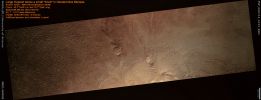
PSP_006714_2255_RED_abrowse.jpgLandslide Deposit below a small Knob in Deuteronilus Mensae (MULTISPECTRUM; credits: Lunexit)55 visiteThis image shows a possible Landslide Deposit originating from a mesa just East of the center of the scene in Deuteronilus Mensae.
The deposit is the lobe-shaped feature extending across the center of the image. Located at approx. 45° North, where ground ice is thought to be stable, it is possible that the deposit formed from "Mass Wasting" of ice-rich material.
Mass Wasting is a process driven by gravity that moves material downslope; the ice enhances the process.
The lobe has distinct textures. It is bouldery at some locations and pitted or wrinkled at others. The pitted texture may be due to desiccation (drying) of soil that can occur when ice from beneath the surface sublimates and leaves empty spaces into which the surface collapses.MareKromium
|
|

Sun-N00107153.jpgSunshine through the Rings... (natural colors; credits: Lunexit)55 visiteCaption NASA:"N00107153.jpg was taken on April 10, 2008 and received on Earth on April 11, 2008. The camera was pointing toward SATURN, F-RING that, at the time, was approx. 609.375 Km away, and the image was taken using the CL1 and CL2 filters. This image has not been validated or calibrated".MareKromium
|
|

Sun-N00107151.jpgSunshine through the Rings... (natural colors; credits: Lunexit)55 visiteCaption NASA:"Caption NASA:"N00107151.jpg was taken on April 10, 2008 and received on Earth on April 11, 2008. The camera was pointing toward SATURN, F-RING that, at the time, was approx. 613.189 Km away, and the image was taken using the CL1 and CL2 filters. This image has not been validated or calibrated".MareKromium
|
|
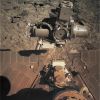
SOL1504-2N259890637EFFAY00P1938L0M1.jpgReddish Dust on the Solar Panels - Sol 1504 (MULTISPECTRUM - credits: Lunexit)55 visitenessun commentoMareKromium
|
|

PSP_006284_1145_RED_abrowse-01.jpgOn the edge of the Dunefield... (MULTISPECTRUM; credits: Lunexit)55 visitenessun commentoMareKromium
|
|

SOL196.jpgDigging in the "Dry Mud" - Sol 196 (Superdefinition; credits: Dr G. Barca)55 visitenessun commentoMareKromium
|
|

SOL314.jpgDry Terrain?!? - Sol 314 (Superdefinition + MULTISPECTRUM; credits: Dr G. Barca & Lunexit)55 visitenessun commentoMareKromium
|
|
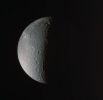
Dione-PIA09886.jpgThe North Polar Regions of Dione (True Colors; credits: Lunexit)55 visiteCaption NASA:"The Cassini Spacecraft looks down, almost directly at the North Pole of Dione. The feature just left of the Terminator at the bottom is Janiculum Dorsa, a long, roughly North-South trending ridge. Lit terrain seen here is on the anti-Saturn and Trailing Sides of Dione.
The image was taken with the Cassini spacecraft narrow-angle camera on March 22, 2008 using a spectral filter sensitive to wavelengths of UV light centered at 338 nanometers. The view was acquired at a distance of approx. 650.000 Km (about 404.000 miles) from Dione and at a Sun-Dione-Spacecraft angle of 99°.
Image scale is roughly 4 Km (about 2 miles) per pixel".MareKromium
|
|
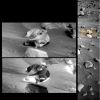
SOL364-2.jpgExtremely Unusual Landform (credits: Dr Marco Faccin)55 visitenessun commentoMareKromium
|
|

Saturn-PIA08411.jpgElectrical Storm on Saturn's Upper Troposphere (approx. true colors; credits: NASA)55 visiteCaption NASA:"It is no Great Red Spot, but these two side-by-side views show the longest-lived electrical storm yet observed on Saturn by NASA's Cassini Spacecraft.
The views were acquired more than 3 months after the storm was first detected from its lightning-produced radio discharges on Nov. 27, 2007.
Cassini imaging scientists believe the storm to be a vertically extended disturbance that penetrates from Saturn's Lower to Upper Troposphere.
The view at left was created by combining images taken using red, green and blue spectral filters, and shows Saturn in colors that approximate what the human eye would see. The storm stands out with greater clarity in the sharpened, enhanced color view at right. This view combines images taken in infrared, green and violet light at 939, 567 and 420 nanometers respectively and represents an expansion of the wavelength region of the electromagnetic spectrum visible to human eyes. This view looks toward the un-illuminated side of the Rings from about 3° above the Ring-Plane.
Janus (about 181 Km, or approx. 113 miles across) appears as a dark speck just beneath the Rings in both images.
These images were obtained with the Cassini spacecraft wide-angle camera on March 4, 2008, at a distance of approx. 1,3 MKM (about 800.000 miles) from Saturn.
Image scale is roughly 74 Km (about 46 miles) per pixel".MareKromium
|
|

Saturn-PIA08410.jpgElectrical Storm on Saturn's Upper Troposphere (natural colors; credits: NASA)55 visiteCaption NASA:"A bright, powerful, lightning-producing storm churns and coasts along the lane of Saturn's Southern Hemisphere nicknamed "Storm Alley" by scientists.
NASA's Cassini spacecraft detected this particular tempest after nearly 2 years during which Saturn did not appear to produce any large electrical storms of this kind. The storm appears as a bright, irregular splotch on the Planet near lower right.
Lightning flashes within the persistent storm produce radio waves, called Saturn Electrostatic Discharges, which the Cassini radio and plasma wave science instrument first detected on Nov. 27, 2007. Cassini's imaging cameras then spotted the storm, taking the images used to create this color view about a week later on Dec. 6, 2007.
This electrical storm is similar in appearance and intensity to those previously monitored by Cassini. All of these powerful electrostatic producing storms appeared at about 35° South Latitude on Saturn.
This storm has now been continuously tracked by Cassini for several months, whereas previous storms observed by the Spacecraft lasted for less than 30 days.
The view looks toward the un-illuminated side of the Rings from about 5° above the Ring-Plane. Tethys (about 1071 Km, or approx. 665 miles across) is seen here in the foreground, and casts its shadow onto the high Northern Latitudes.
Images taken using red, green and blue spectral filters were combined to create this natural color view. The images were acquired with the Cassini spacecraft wide-angle camera at a distance of approx. 1,7 MKM (1 MMs) from Saturn.
Image scale is roughly 97 Km (about 60 miles) per pixel".MareKromium
|
|
| 25353 immagini su 2113 pagina(e) |
 |
|
|
|
|
1908 | |
|
|
|
|





