| Piú viste |
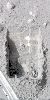
PHOE-SOL020-024-GIF2-PIA10906.gifEvaporation or Sublimation? Water or CO2? (GIF-Movie; credits: NASA)55 visitenessun commentoMareKromium
|
|
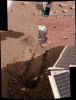
PHOE-SOL025-PIA10912.jpgMonochrome Mars: from Viking Lander 2 to Phoenix (approximate colors; credits: NASA)55 visiteCaption NASA:"This color image taken by the Surface Stereo Imager on NASA's Phoenix Mars Lander shows the trench dubbed "Snow White" after further digging on the 25th Martian Day, or Sol, of the mission (June 19, 2008). The Lander's Solar Panel is casting a shadow over a portion of the trench.
The trench is about 5 cm (2") deep and 30 cm (12") long".
Nota Lunexit: sembrano davvero poche le differenze "cromatiche" del suolo Marziano, così come appariva ai tempi del Viking Lander 2 rispetto a Phoenix. Ciò che cambia è l'intensità di fondo (accentuata nel frame Viking 2 - inset), ma la sostanza è sempre la stessa: Marte, secondo la NASA, è un Mondo sostanzialmente monocromatico (arancio, rosso, rosa o verde-giallastro che si voglia). Che tristezza e, soprattutto, che falsità...MareKromium
|
|
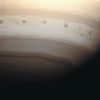
Saturn-PIA10411.jpgStorm Alley (MULTISPECTRUM-2; credits: Lunexit)55 visiteCaption NASA:"A line of dark vortices charge through Saturn's "Storm Alley" — such as a Region that has seen intensive storm activity since the Cassini Spacecraft began its observations of the Planet in early 2004.
The image was taken with the Cassini Spacecraft wide-angle camera on May 19, 2008 using a spectral filter sensitive to wavelengths of infrared light centered at 728 nanometers. The view was obtained at a distance of approx. 863.000 Km (about 536.000 miles) from Saturn.
Image scale is roughly 48 Km (about 30 miles) per pixel".MareKromium
|
|
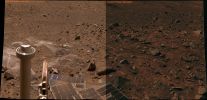
SOL422-L257_ca.jpgColor Comparison: "Paso Robles" - Sol 422 (Sx credits: Lyle.org; Dx credits: Lunexit)55 visiteUn piccolo confronto cromatico che NON HA lo scopo di dire "questa elaborazione è più bella/brutta" oppure "quella elaborazione è più verosimile/inverosimile". Certamente no. L'unico scopo di questa comparazione è didattico: nei frames prelevati dalle Gallerie Lyle.org dedicate ai MER Opportunity e Spirit - Radiometrically Calibrated Imagery - emergono con evidenza tre fatti:
1) i frames sono tutti molto luminosi (spesso ai limiti della over-saturation);
2) la Dominante Cromatica appare esasperata e tendente al rosa pallido con qualche bizzarra nuance giallastra e/o violacea;
3) l'O.A. (o Tau) è presente e visibile anche sulla brevissima distanza (tutti o quasi tutti i frames, insomma, appaiono opacizzati o leggermente fuori fuoco).
ATTENZIONE: il Lavoro svolto da Lyle.org - se non altro da un profilo volumetrico - è, dal nostro punto di vista, assai stimabile e noi lo apprezziamo (e Ve ne mostreremo anche una porzione qui, sulle pagine di Lunexit).
Ma, da un punto di vista concettuale e, se così possiamo esprimerci, "metodologico", come ovvio a nostro modestissimo parere, esso è clamorosamente errato e creatore di errori e malintesi.
Pensate un pò a questi dati:
La Luminosità di Fondo di Marte: è eccessiva. Superiore anche a quella Terrestre (e questo è un fatto improponibile).
La Dominante Cromatica: veramente esagerata (abbiamo fatto un paio di simulazioni e, nei frames Lyle, è come se il Sole splendesse di un bel color salmone).
I Contrasti: nulli, o quasi (specie per i frames relativi a Meridiani Planum).
L'Opacità Atmosferica: siamo d'accordo che, in giornate di Tau elevata, essa possa diventare ben percepibile nelle riprese tarate su obbiettivi posti a medio-lunga distanza (diciamo oltre i 50/60 metri dai Rover), ma che essa - e per giunta sempre - si riveli in forma eclatante anche su target posti solo a pochi cm dalle loro ottiche...no, questo è davvero poco credibile. Anzi: questo è un vizio interpretativo.
Nota positiva: il Cielo di Marte. Molto ben calibrato e, di fatto, probabilmente ancora più realistico di quello che tentiamo (faticosamente) di proporre noi qui, su Lunexit.
Insomma: massimo rispetto per il Lavoro di Lyle.org MA, un consiglio, quando osservate le loro Color Galleries, siate prudenti nelle valutazioni e tenete ben presente almeno tre fattori:
1) Marte è più lontano dal Sole rispetto alla Terra;
2) Marte non è un Mondo Monocromatico (come dimostrano ampiamente le immagini HST e quelle orbitali - e comunque non è certo un Pianeta color "rosa salmone"...) e, infine,
3) Marte muta le sue nuances con il passare delle ore del giorno e, quindi, al variare delle relative condizioni di luminosità (le interpretazioni Lyle, invece, sembrano essere tutte state calibrate su uno Standard di Luminosità Media - ed anche questo è un errore concettuale che poi, alla fine, si riflette e si risolve in un errore di metodo e di realismo).
Ora giudicate Voi.MareKromium
|
|
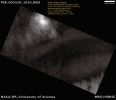
PSP_003520_1010_RED_abrowse-00.jpgSouth Polar Spiders (ctx frame - MULTISPECTRUM-2; credits: Lunexit)55 visiteThis image is located in the South Polar Region of Mars and we can see “spiders” likely caused by the sublimation of Carbon Dioxide ice.
As this happens, the gas moves through channels until it reaches the surface and vents out. These vents show up as the dark streaks because they carry dust and dirt up to the surface.MareKromium
|
|

OPP-SOL097-1P136791070RAD2002P2617L234567C1.jpgThe Sky above... - Sol 97 (Multispectral Color Imagery; credits: Lyle.org)55 visiteUna bellissima interpretazione del Cielo al di sopra di Meridiani Planum: come avevamo detto, un Lavoro davvero ECCELLENTE e meritevole di attenzione, realizzato da Lyle.org.MareKromium
|
|
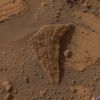
OPP-SOL049-1P132545449RAD0600P2571L234567C1.jpgMonochrome Mars - Sol 49 (Multispectral Color Imagery; credits: Lyle.org)55 visitenessun commentoMareKromium
|
|

OPP-SOL040-1P131737438RAD0552P2541L456C1.jpgMonochrome Mars - Sol 40 (Multispectral Color Imagery; credits: Lyle.org)55 visitenessun commentoMareKromium
|
|
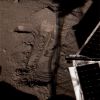
PHOE-SOL031-lg7811-7823-7824.jpgThe "Trench" - Sol 31 (natural colors; credits: Dr G. Barca)55 visitenessun commentoMareKromium
|
|

Saturn-PIA10413.jpgSwirling Clouds (MULTISPECTRUM; credits: Lunexit)55 visiteCaption NASA:"Sinuous clouds and hurricane-sized vortices mingle in Saturn's Northern Skies. This view looks toward a Region located at 70° North Latitude on Saturn.
Despite the level of detail visible here, the Region shown is wide enough to contain the planet Mars comfortably.
The image was taken with Cassini's CB1 spectral filter, which is sensitive to wavelengths of visible red light centered at 619 nanometers. The view was acquired with the spacecraft's narrow-angle camera on May 23, 2008 at a distance of approx. 1,2 MKM (about 775.000 miles) from Saturn.
Image scale is roughly 7 Km (about 4 miles) per pixel".MareKromium
|
|
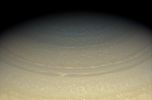
Saturn-PIA10414.jpgNorthern Blue (natural colors; credits: NASA/JPL/Space Science Institute)55 visiteCaption NASA:"Golden hues continue to creep Northward on Saturn, subduing the blues and grays the Cassini Spacecraft witnessed upon arrival in mid-2004. This view was acquired from about 27° above the Ring-Plane.
Images taken using red, green and blue spectral filters were combined to create this natural color view. The images were acquired with the Cassini Spacecraft wide-angle camera on May 23, 2008 at a distance of approx. 1,3 MKM (such as about 780.000 miles) from Saturn.
Image scale is roughly 71 Km (about 44 miles) per pixel".MareKromium
|
|
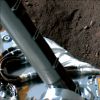
PHOE-SOL034-lg8588-8589-8595.jpgThe "Color Wheel" and the ground - Sol 34 (natural colors + MULTISPECTRUM; credits: Dr G. Barca & Lunexit)55 visitenessun commentoMareKromium
|
|
| 25353 immagini su 2113 pagina(e) |
 |
|
|
|
|
1898 | |
|
|
|
|





