| Piú viste |

SOL594-1.jpgPanorama from Sol 594 (natural colors + MULTISPECTRUM; credits: Dr G. Barca & Lunexit)55 visitenessun commentoMareKromium
|
|
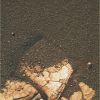
OPP-SOL590-1.jpgPaving and Pebbles... - Sol 590 (True Colors + MULTISPECTRUM; credits: Dr G. Barca & Lunexit)55 visitenessun commentoMareKromium
|
|
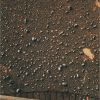
OPP-SOL586-1.jpgPaving and Pebbles... - Sol 586 (True Colors + MULTISPECTRUM; credits: Dr G. Barca & Lunexit)55 visitenessun commentoMareKromium
|
|
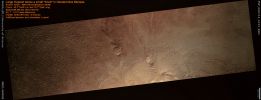
PSP_006714_2255_RED_abrowse.jpgLandslide Deposit below a small Knob in Deuteronilus Mensae (MULTISPECTRUM; credits: Lunexit)55 visiteThis image shows a possible Landslide Deposit originating from a mesa just East of the center of the scene in Deuteronilus Mensae.
The deposit is the lobe-shaped feature extending across the center of the image. Located at approx. 45° North, where ground ice is thought to be stable, it is possible that the deposit formed from "Mass Wasting" of ice-rich material.
Mass Wasting is a process driven by gravity that moves material downslope; the ice enhances the process.
The lobe has distinct textures. It is bouldery at some locations and pitted or wrinkled at others. The pitted texture may be due to desiccation (drying) of soil that can occur when ice from beneath the surface sublimates and leaves empty spaces into which the surface collapses.MareKromium
|
|

Sun-N00107153.jpgSunshine through the Rings... (natural colors; credits: Lunexit)55 visiteCaption NASA:"N00107153.jpg was taken on April 10, 2008 and received on Earth on April 11, 2008. The camera was pointing toward SATURN, F-RING that, at the time, was approx. 609.375 Km away, and the image was taken using the CL1 and CL2 filters. This image has not been validated or calibrated".MareKromium
|
|

Sun-N00107151.jpgSunshine through the Rings... (natural colors; credits: Lunexit)55 visiteCaption NASA:"Caption NASA:"N00107151.jpg was taken on April 10, 2008 and received on Earth on April 11, 2008. The camera was pointing toward SATURN, F-RING that, at the time, was approx. 613.189 Km away, and the image was taken using the CL1 and CL2 filters. This image has not been validated or calibrated".MareKromium
|
|
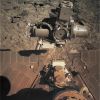
SOL1504-2N259890637EFFAY00P1938L0M1.jpgReddish Dust on the Solar Panels - Sol 1504 (MULTISPECTRUM - credits: Lunexit)55 visitenessun commentoMareKromium
|
|
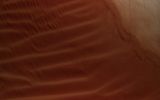
PSP_006284_1145_RED_abrowse-01.jpgOn the edge of the Dunefield... (MULTISPECTRUM; credits: Lunexit)55 visitenessun commentoMareKromium
|
|
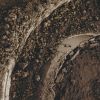
SOL196.jpgDigging in the "Dry Mud" - Sol 196 (Superdefinition; credits: Dr G. Barca)55 visitenessun commentoMareKromium
|
|
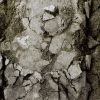
SOL314.jpgDry Terrain?!? - Sol 314 (Superdefinition + MULTISPECTRUM; credits: Dr G. Barca & Lunexit)55 visitenessun commentoMareKromium
|
|
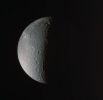
Dione-PIA09886.jpgThe North Polar Regions of Dione (True Colors; credits: Lunexit)55 visiteCaption NASA:"The Cassini Spacecraft looks down, almost directly at the North Pole of Dione. The feature just left of the Terminator at the bottom is Janiculum Dorsa, a long, roughly North-South trending ridge. Lit terrain seen here is on the anti-Saturn and Trailing Sides of Dione.
The image was taken with the Cassini spacecraft narrow-angle camera on March 22, 2008 using a spectral filter sensitive to wavelengths of UV light centered at 338 nanometers. The view was acquired at a distance of approx. 650.000 Km (about 404.000 miles) from Dione and at a Sun-Dione-Spacecraft angle of 99°.
Image scale is roughly 4 Km (about 2 miles) per pixel".MareKromium
|
|
SOL364-2.jpgExtremely Unusual Landform (credits: Dr Marco Faccin)55 visitenessun commentoMareKromium
|
|
| 25353 immagini su 2113 pagina(e) |
 |
|
|
|
|
1897 | |
|
|
|
|





