| Piú viste |

SOL040-041-GIF-Movie-MF1~0.gifDo You See?!? - Sol 41 (GIF-Movie; credits: Dr M. Faccin)55 visiteQuesto bellissimo GIF-Movie realizzato dal nostro Dr Faccin ha suscitato, in ordine ai suoi contenuti ed a quello che potrebbe mostrare, delle "controversie interpretative" anche all'interno di Lunar Explorer Italia: un fatto, quest'ultimo, che ci ha spinto a considerare ancora una volta il dato per cui, in ipotesi di immagini controverse, la "differenza", spesso, la fanno gli "occhi di chi guarda".
Allora, dato che i deadlocks non servono a nessuno e visto che qui, sulle nostre pagine, vogliamo tutti capire (o almeno vogliamo provare a capire!) ciò che si vede, per questa volta non Vi diremo nulla: nessuna "dritta", nessun "suggerimento", nessuna "informazione circostanziale".
Solo una domanda: Voi...Vedete qualcosa?!?...MareKromium
|
|

OPP-SOL510-1~0.jpgBerryland... - Sol 510 (possible True Colors; crdits: Dr G. Barca)55 visitenessun commentoMareKromium
|
|

OPP-SOL460-1N169039910EDN55DIP1586L0M1.jpgSunset on Mars... - Sol 489 (slightly enhanced Natural Colors; credits: Lunar Explorer Italia)55 visiteSolo un piccolo promemoria, in aiuto dei nostri Lettori (a volte un pò confusi anche per colpa nostra):
True Colors = sono i colori AUTENTICI, i COLORI VERI del paesaggio ripreso (i quali, in quanto veri ed autentici, NON E' DETTO che risultino visibili ai nostri occhi umani);
Natural Colors = sono i colori del paesaggio COSI' COME VISIBILI AD UN OCCHIO UMANO (medio), ossìa sono SOLO quei colori compresi nella Lunghezza d'Onda che va da (circa) 400 nm a (circa) 700 nm - il cosiddetto "Spettro della Luce Visibile" (oppure, se volete, è "quella regione dello Spettro con frequenze comprese tra 384 · 1012 Hz (per il rosso) e 769 · 1012 Hz (per il violetto)".
Approximate True Colors: è una colorizzazione APPROSSIMATA (cioè ISPIRATA A/SIMILE) a quella True (vedi sopra);
Approximate Natural Colors: è una colorizzazione APPROSSIMATA (cioè ISPIRATA A/SIMILE) a quella Natural (vedi sopra);
False Colors: è una colorizzazione fatta usando COLORI DI FANTASIA (e quindi NON RELAZIONATI nè ai True, nè ai Natural Colors).
I False Colors sono usati per evidenziare le diverse configurazioni o partizioni della superficie (come si fa, ad es., nelle Mappe Geomorfologiche), oppure per mostrare le diverse altezze dei rilievi rispetto al Datum (come si fa, ad es., nelle Mappe Altimetriche) oppure per evidenziare le diverse età o composizioni del suolo (come si fa, ad es., nella Mappe Geologiche e/o Mineralogiche).MareKromium
|
|
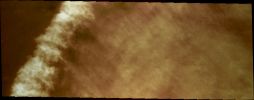
Clouds-Vastitas_Borealis_Region-PCF-LXTT-2.jpgClouds over Vastitas Borealis (Enhanced Natural Colors; credits for the additional process. and color.: Dr Paolo C. Fienga - Lunar Explorer Italia)55 visiteCaption NASA:"Dust Clouds often can obscure the Surface of Mars. When an image captures the edge of a Dust Storm Front, the loss of surface information is more than compensated for by the information that can be gleaned from analysis of the image.
As Dust Storm formation and location are unpredictable, any images of such features are priceless".
Coord.: 66,2° North. Lat. and 248,7° East Long.MareKromium
|
|

Enceladus-PIA10562.jpgCrescent Enceladus55 visiteCaption NASA:"In the boundary between light and shadow on Enceladus, run the Anbar Fossae — a series of narrow, shallow depressions.
Like other features on this geologically active moon, the fossae are named after a location in The Arabian Nights. In this case, they are named after Anbar, Iraq.
Another Iraqi namesake, the Baghdad Sulcus, is one of several warm `Tiger Stripe' fractures at the moon's South Pole from which emanate heat and icy particles (see also PIA11114).
North is up in this image, and Julnar is the largest crater visible in the Northern Hemisphere. One of the women in The Arabian Nights lends her name to this crater which is about 20 Km (about 12 miles) wide.
Fewer craters mark the Southern Hemisphere because they have been erased by later tectonic forces.
The image was taken in Visible Light with the Cassini Spacecraft narrow-angle camera on Dec. 17, 2008. The view was obtained at a distance of approx. 385.000 Km (about 239.000 miles) from Enceladus and at a Phase Angle of 104°.
Image scale is roughly 2,5 Km (about 1,6 miles) per pixel".MareKromium
|
|

OPP-SOL522-GB.jpgSurface... - Sol 522 (Hi-Def. - Enhanced and Saturated Natural Colors; credits for the additional process. and color.: Dr Gianluigi Barca - Lunar Explorer Italia)55 visitenessun commentoMareKromium
|
|

OPP-SOL1776-1N285857815EFF9500P1930R0M1.jpgPanorama, on the way to Endeavour Crater - Sol 1776 (3 - Natural Colors; credits: Lunar Explorer Italia)55 visitenessun commentoMareKromium
|
|

OPP-SOL1776-1N285857447EFF9500P1930R0M1.jpgPanorama, on the way to Endeavour Crater - Sol 1776 (1 - Natural Colors; credits: Lunar Explorer Italia)55 visitenessun commentoMareKromium
|
|

OPP-SOL522-GB-LXT.jpgSurface... - Sol 522 (Natural Colors; credits: Dr G. Barca & Lunar Explorer Italia)55 visitenessun commentoMareKromium
|
|
OPP-SOL542-GB-LXT.jpgTenuous Blue-Orange Shades... - Sol 542 (possible True Colors; credits: Dr G. Barca & Lunar Explorer Italia)55 visitenessun commentoMareKromium
|
|

SOL1789-1-GB.jpgLayers in the Dust - Sol 1789 (possible True Colors; credits: Dr G. Barca & Lunar Explorer Italia)55 visitenessun commentoMareKromium
|
|

OPP-SOL549-1-GB.jpgHole in the Ground! - Sol 549 (possible True Colors; credits: Dr G. Barca & Lunar Explorer Italia)55 visitenessun commentoMareKromium
|
|
| 25353 immagini su 2113 pagina(e) |
 |
|
|
|
|
1885 | |
|
|
|
|





