| Piú viste |

PIA07966-112203.wavAudio Signals from the the Space of Saturn (by Dr M. Faccin)55 visitenessun commentoMareKromium
|
|
PIA07966-112203-1.wavAudio Signals from the the Space of Saturn (by Dr M. Faccin)55 visitenessun commentoMareKromium
|
|
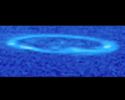
Saturn-PIA11832.jpgSaturnian Aurora55 visiteCaption NASA:"Glowing like a neon lasso, Saturn’s Aurora is seen spinning above Saturn’s North Pole over the course of most of a Saturn day in this image taken by the ultraviolet imaging spectrograph on NASA’s Cassini Spacecraft.
Saturn’s auroral lights are the result of a rain of electrically charged particles from the magnetic bubble, called the Magnetosphere, that surrounds the Planet.
When the particles strike gaseous Hydrogen in Saturn’s Atmosphere, the Hydrogen becomes excited and glows, creating Aurorae. Neon signs work in a similar way: electricity is used to excite a gas, usually Neon or Argon, in a tube.
Changes that occur in Saturn’s Magnetosphere can cause fluctuations in the Aurora. Undulations in the Aurora may be caused by waves moving along magnetic field lines.
A surge in auroral brightness is the result of a sudden injection of particles into the Magnetosphere. These charged particles come from a variety of sources, including the Sun, Saturn’s Rings, and the water ice plume of Saturn’s moon Enceladus.
This image was taken on May, 25th, 2007.
Saturn's Aurorae were discovered by NASA’s Pioneer 11 Spacecraft in 1979 and observed in the Saturn flybys by the NASA Voyager 1 and 2 Spacecrafts in the early '80s. NASA’s Hubble Space Telescope first obtained images of an Aurora in 1994. From Cassini’s always-changing orbit around Saturn, fresh observations in UltraViolet and InfraRed wavelengths are being combined with other data to help characterize similarities and differences among the Aurorae of Saturn, Jupiter and Earth". MareKromium
|
|
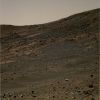
SOL723-GB-LXT2~0.jpgRocky Panorama and Skyline - Sol 723 (possible True Colors; credits: Dr G. Barca)55 visitenessun commentoMareKromium
|
|
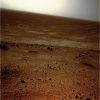
SOL398-2N161704580EFFA500P1775L0M1.jpgPanorama from above - Sol 398 (Natural Colors; credits: Lunar Explorer Italia)55 visitenessun commentoMareKromium
|
|
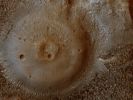
Mud_Volcano-MRO.jpgMud Volcanoes on Mars? (Natural Colors; credits: Lunar Explorer Italia)55 visiteDa "NASA - Picture of the Day" del giorno 30 Marzo 2009:"Is this a Mud Volcano on Mars? If so, could it be dredging up Martian Microbes? This strange possibility has been suggested recently and seems to fit several recent observations of Mars.
First of all, hills like this seem to better resemble Mud Volcanoes on Earth than Lava Volcanoes and Impact Craters on Mars.
Next, the pictured dome has an unusually textured surface consistent with fractured ice. Infrared images from space indicate that hills like this cool more quickly than surrounding rock, consistent with a dried mud composition.
The hills also reflect colors consistent with a composition that formed in the presence of water.
Finally, unusual plumes of gas containing Methane have been found on Mars with unknown origin. These gas plumes could conceivably have been liberated by Mud Volcanoes, were the initially warm mud to contain Methane-producing microbes drifting in a previously unobservable underground lake.
A candidate mud volcano over 100 meters across is pictured above in the Northern Plains (Vastitas Borealis Region) of Mars".MareKromium
|
|
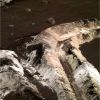
SOL790-GB.jpgBright Salts and Sulphates in Spirit's Rover Tracks - Sol 790 (possible True Colors; credits: Dr G. Barca)55 visitenessun commentoMareKromium
|
|

OPP-SOL1832-Panoramic-GB4.jpgMeteorite Fragment on the Paving? - Sol 1832 (Image-composite - possible True Colors; credits: Dr G. Barca)55 visitenessun commentoMareKromium
|
|

Saturn-PIA11461.jpgBlack Shadow from the "White Moon" (Natural Colors; credits: Lunar Explorer Italia)55 visiteCaption NASA:"The shadow of Saturn's moon Enceladus cast onto the Planet's Atmosphere appears like a drop of black ink on a canvas of Saturnian storms.
The image was taken with the Cassini spacecraft narrow-angle camera on June 20, 2008 using a spectral filter sensitive to wavelengths of Near-InfraRed Light centered at 750 nanometers. The view was obtained at a distance of approx. 1,3 MKM (such as about 810.000 miles) from Saturn and at a Sun-Saturn-Spacecraft, or Phase, Angle of 24°.
Image scale is roughly 7 Km (about 4 miles) per pixel".MareKromium
|
|
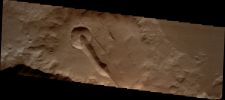
Collapse_Features-Sirenum_Fossae-20090402a-PCF-LXTT.jpgInteraction in Sirenum Fossae (Saturated Natural Colors; credits for the additional process. and color.: Dr Paolo C. Fienga - Lunar Explorer Italia)55 visiteCaption NASA:"This VIS image of part of the Sirenum Fossae shows an important interaction. The small crater in the center of the image is cut by a large fracture of the Fossae System, while the its ejecta cover a small fracture located just North-West of it.
This image indicates that the Fracture System was active both before and after the time of the impact and crater creation".
Coord.: 24,3° South Lat. and 220,0° East Long.MareKromium
|
|

SOL1864-MF.jpgWhite Sulphates and Bluish Pebbles - Sol 1864 (possible True Colors; credits: Dr M. Faccin)55 visitenessun commentoMareKromium
|
|
SOL1865-2P291928464EFFB0OAP2553L5M1.jpgDusty Landscape - Sol 1865 (Natural Colors; credits: Lunar Explorer Italia)55 visitenessun commentoMareKromium
|
|
| 25353 immagini su 2113 pagina(e) |
 |
|
|
|
|
1883 | |
|
|
|
|





