| Piú viste |

Neptune-HST4.JPGMoments of Neptune (HST - False Colors; credits: NASA, L. Sromovsky and P. Fry - University of Wisconsin-Madison)55 visitenessun commentoMareKromium
|
|
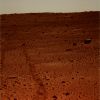
SOL103-2P135509210EFF2900P2383L7M1.jpgGusev Skyline - Sol 103 (Extremely Enhanced Natural Colors; credits: Lunar Explorer Italia)55 visitenessun commentoMareKromium
|
|
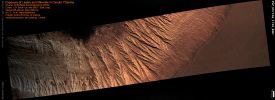
PSP_007166_1740_RED_abrowse-00~0.jpgExposure of Layers and Minerals in Candor Chasma (MULTISPECTRUM; credits: Lunexit)55 visiteScanning across several kilometers of relief, this image shows a cliff along a light-toned layered deposit in Valles Marineris. This particular cliff was targeted because of the excellent exposure of layering and the identification of the minerals Kieserite (a mineral containing Magnesium) and Hematite (an Iron Oxide).
The Hematite appears in the darker low-lying region of the image and the Kieserite is associated with the light-toned layers.
The fact that these minerals are found here with a layered deposit suggests that water may have been involved in the deposition of these minerals and the layers.
Erosion by wind has carved V-shaped patterns along the edges of many of the layers. The layers appear friable (easy to erode) so this is why wind can carve deep grooves along a steep cliff such as visible here.
The top of the layered deposit (lower part of image) is smooth and relatively dark because it is covered by debris laid down by the wind, dust and other fine materials.
The cliff has stronger winds flowing up and down it, plus the effects of gravity, so airborne debris can be shed downslope to expose the fresh brighter layered deposit.MareKromium
|
|
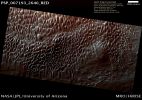
PSP_007193_2640_RED_abrowse-00~0.jpgDefrosting Northern Dunes (context frame - MULTISPECTRUM; credits: Lunexit)55 visiteIn Northern Winter a Seasonal Polar Cap composed of Carbon Dioxide (CO2) ice (dry ice) forms in the North Polar Region. This Cap covers a vast sea of dunes at high Northern Latitudes. In the spring the ice sublimates (evaporates directly from ice to gas) and this active process loosens and moves tiny dust particles.MareKromium
|
|
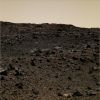
SOL541-GB.jpgRocky Skyline - Sol 541 (possible True Colors; credits: Dr G. Barca)55 visitenessun commentoMareKromium
|
|
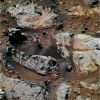
SOL554-GB.jpgColourful Outcrop and Sands - Sol 554 (possible True Colors; credits: Dr G. Barca)55 visitenessun commentoMareKromium
|
|

PSP_005392_0995_RED_abrowse-00~0.jpgImpact Crater on the South Polar Layered Deposits (context frame; MULTISPECTRUM - credits: Lunexit)55 visiteThis image covers a portion of the ice-rich SPLD.
Layers in the Mars Polar Regions are of great interest because layers in ice on the Earth, as in the Antarctic and Greenland ice caps, are known to contain records of past atmospheric, environmental, and climate conditions. By studying Mars Polar Layers, we hope to be able to understand the past climate and history of water on the Red Planet.MareKromium
|
|
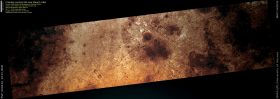
PSP_006610_2035_RED_abrowse~0.jpgPotential MSL Landing Site near Mawrth Vallis (MULTISPECTRUM; credits: Lunexit)55 visiteMawrth Vallis contains clay minerals that formed by chemical alteration of rocks by water. It is one of the short list of potential sites that the Mars Science Laboratory Rover will land at, and the HiRISE team is working to find a safe place to land in this area.
This observation shows a wide variety of scientifically interesting terrains as well as some potential hazards for landing. The central part of the image is dominated by light-toned materials with curving fractures of many different sizes. These fractures do not have a preferred orientation, indicating that they did not form in response to some regional stress pattern.
Instead, they formed by some more uniform process, possibly the drying of a thick mud deposit or the gradual rebound of the area as the overlying material was eroded away. The scattered mounds and sand dunes may or may not prove to be a danger, but it is reassuring to see that many of the impact craters have been smoothed out with a filling of wind-blown sand.MareKromium
|
|
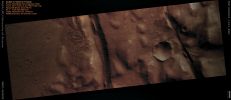
PSP_006695_1415_RED_abrowse~0.jpgGullies in Sirenum Fossae (MULTISPECTRUM; credits: Lunexit)55 visiteThis image shows parts of Sirenum Fossae that are southwest of Gorgonum Chaos. Some of the troughs (Fossae) have gullies on their walls. Gullies are incised slope features that are thought to have formed by liquid water flowing down the slopes.
It is unknown whether the water came from the subsurface or above the surface. The plains around the troughs have a number of mesas and hills that might have formed from erosion of a once-larger rock unit.
The left side of the image shows some dark linear features which MIGHT BE Dust Devil Tracks.MareKromium
|
|

Saturn-PIA10580.jpgSouthern Atmosphere (Natural Colors; credits: Lunar Explorer Italia)55 visiteCaption NASA:"A Cassini Spacecraft image captures a bright, oblong storm swirling high through the Middle Latitudes of the Southern Hemisphere.
The image was taken through a spectral filter centered on wavelengths of light that are strongly absorbed by Methane gas. Hence, any light making it through this filter to the camera's detector has bounced off clouds that are high in the Atmosphere, making them visible, while light passing through the cloud-free surroundings gets absorbed by the Methane gas there before it reaches the lower clouds.
The image was taken with the Cassini Spacecraft wide-angle camera on Jan. 5, 2009 using a spectral filter sensitive to wavelengths of near-InfraRed Light centered at 890 nanometers. The view was acquired at a distance of approx. 711.000 Km (such as about 442.000 miles) from Saturn and at a Sun-Saturn-Spacecraft, or Phase, Angle of 106°.
Image scale is roughly 39 Km (about 24 miles) per pixel".MareKromium
|
|

TheRings-PIA10581.jpgBright Spokes (Natural Colors; credits: Lunar Explorer Italia)55 visiteCaption NASA:"Signaling a return to the bright Spokes first encountered by the Cassini Spacecraft in 2005, three large white Spokes stretch out across the B-Ring. Throughout most of the last year, Cassini captured views of dark Spokes.
This image of bright Spokes was taken Jan. 14, 2009 in Visible Light with the Spacecraft's wide-angle camera.
The small moon Atlas (about 30 Km, or approx. 19 miles across) has been brightened by 30% but still appears as a faint dot between the A and F Rings in the top right quadrant of the image.
This view looks toward the sunlit side of the Rings from about 6° below the Ring-Plane. The view was acquired at a distance of approx. 551.000 Km (about 342.000 miles) from Saturn and at a Sun-Saturn-Spacecraft, or Phase, Angle of 155°. Image scale is roughly 29 Km (such as about 18 miles) per pixel".MareKromium
|
|
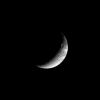
Dione-PIA10577.jpgCrescent Dione55 visiteCaption NASA:"This high-phase view of Dione shows the great contrast between the highly reflective "wisps" and the surrounding terrain. These wispy lines are geologically young fractures exposing the icy surface of the moon.
Lit terrain seen here is on the Trailing Hemisphere of Dione (about 1123 Km, or approx. 698 miles, across). North on Dione is up.
The view was acquired from a position 39° South of the moon's Equator. The image was taken in Visible Light with the Cassini Spacecraft narrow-angle camera on Dec. 26, 2008. The view was obtained at a distance of approx. 789.000 Km (about 490.000 miles) from Dione and at a Sun-Dione-spacecraft, or Phase, Angle of 124°
Image scale is roughly 5 Km (about 3 miles) per pixel".MareKromium
|
|
| 25353 immagini su 2113 pagina(e) |
 |
|
|
|
|
1879 | |
|
|
|
|





