| Piú viste |
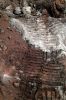
SOL429-GB.jpgRover Tracks - Sol 429 (possible True Colors; credits: Dr G. Barca)55 visitenessun commentoMareKromium
|
|
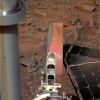
SOL425-GB.jpgLooking from above... - Sol 425 (possible True Colors; credits: Dr G. Barca)55 visitenessun commentoMareKromium
|
|
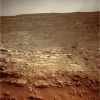
SOL1811-2N287143444EFFAZFFP0695R0M1.jpgGusev Panorama and Skyline - Sol 1811 (natural colors; credits: Lunar Explorer Italia)55 visitenessun commentoMareKromium
|
|

ZZ-Mercury-Global_View_of_the_Surface-PIA11795_fig1.jpgVarious Mercurian Surface Features (natural colors; credits: Lunar Explorer Italia)55 visiteThis NAC image displays a number of interesting geologic features characteristic of Mercury’s Surface.
The Crater indicated by the yellow arrow has unusual bright material on its floor, likely due to rocks of a different chemical composition. Bright material also has been seen in the craters Sander and Kertész.
The pink arrows point to a pair of larger and older craters that have been flooded with now solidified volcanic lava, similar to flooding seen at the impact basin Raphael. In the lower right-hand corner of the image is a large peak-ring Basin, about 210 Km (approx. 130 miles) in diameter, which also appears to have been flooded with lava. There is also a small Scarp (or "Cliff") within that Basin that cuts through a smaller crater at the edge of the Basin's inner ring, at the point indicated by the blue arrow.
Scarps on Mercury are often seen intersecting Impact Craters, such as this dramatic, previously released image from the mission's second Mercury flyby (see, for example, PIA11358).
The green arrows on the left side of the image indicate a series of Secondary Crater Chains. Chains of small craters such as these are formed when ejecta are expelled from a Primary Crater after the initial impact. Secondaries are widespread across Mercury's Surface, as was also discussed in the caption to this previously released image (see PIA10178).
Unraveling Mercury's Geologic History requires investigating the complex and overlapping relationships of Volcanic Plains, Impacts and Scarps seen on the Planet's Surface.
Date Acquired: October 6, 2008
Image Mission Elapsed Time (MET): 131774026
Instrument: Narrow Angle Camera (NAC) of the Mercury Dual Imaging System (MDIS)
Resolution: 540 meters/pixel (0,33 miles/pixel)
Scale: This image is about 550 Km (approx. 340 miles) across
Spacecraft Altitude: about 21.000 Km (approx. 13.000 miles)MareKromium
|
|
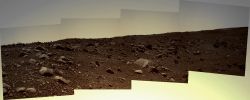
SOL558-Panoramic-GB-LXT.jpgDark Skyline - Sol 558 (Photo-composite - Natural Colors; credits: Dr G. Barca)55 visitenessun commentoMareKromium
|
|
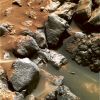
SOL493-GB.jpgColourful Outcrop and Sands - Sol 493 (possible True Colors; credits: Dr G. Barca)55 visitenessun commentoMareKromium
|
|

SOL477-2P168726853EDNAAACP2618L2M1.jpgEvening Hours... - Sol 477 (Natural Colors; credits: Lunar Explorer Italia)55 visiteQuesta colorizzazione è stata fatta solo per rispondere ad un nostro Lettore e quindi dimostrare che il nostro Processing Multispettrale opera sull'immagine A PRESCINDERSI dalle dimensioni della medesima.MareKromium
|
|
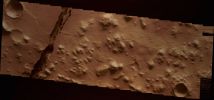
Volcanic_and_Tectonic_Features-Fissures-Cerberus_Fossae-20090213a-PCF-LXTT.jpgFeatures of Cerberus Fossae: Fissures (Saturated Natural Colors; credits for the additional process. and color.: Dr Paolo C. Fienga - Lunar Explorer Italia)55 visiteCaption NASA:"The depression seen in this image is part of the fracture system called Cerberus Fossae. The Fossae cut through hills as well as plains materials".
Coord.: 10,4° North Lat. and 159,9° East Long.MareKromium
|
|
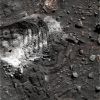
SOL431-GB.jpgRover Tracks - Sol 431 (possible True Colors; credits: Dr G. Barca)55 visitenessun commentoMareKromium
|
|
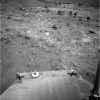
SOL1813-PIA11799.jpgDusty Solar Panels - Sol 181355 visiteCaption NASA:"NASA Mars Exploration Rover Spirit took this image using the left eye of its NavCam during the 1813th Martian Day, or Sol, of Spirit's Mission on Mars (such as February 7, 2009).
Contrast has been stretched to make dust on the Solar Panels more easily visible.
Engineering data from Spirit's power subsystem indicated that some dust blew off the Rover's Solar Array on the preceding day, Sol 1812 (such as February 6, 2009).
This image and one from Sol 1811 (such as February 5, 2009 - PIA11798) provide a before-and-after comparison of the Dust visible on Spirit's rear Solar Array. The reduction in the Dust coating is difficult to discern in the images. The Cleaning Event was detected by a change in electrical output from the Solar Panels.
Spirit's daily energy supply from the Solar Array increased by about 30 watt-hours, to about 240 watt-hours from 210 watt-hours. (Thirty watt-hours is enough to illuminate a 30 watt bulb for one hour.) Before the Sol 1812 cleaning, only 25% of sunlight hitting the array was getting past the dust to be used by the photovoltaic cells. That factor improved to 28% after the Cleaning Event.
Spirit took this image at about 14:07 MLT at Spirit's location inside Gusev Crater. The Rover's position was next to the northern edge of the low plateau called "Home Plate", visible beyond the Solar Panels". MareKromium
|
|

SOL1811-PIA11798.jpgDusty Solar Panels - Sol 181155 visiteCaption NASA:"NASA Mars Exploration Rover Spirit took this image using the left eye of its NavCam during the 1811th Martian Day, or Sol, of Spirit's mission on Mars (such as February 5, 2009). Contrast has been stretched to make dust on the Solar Panels more easily visible.
Engineering data from Spirit's power subsystem indicated that some dust blew off the Rover's Solar Array on the following day, Sol 1812 (such as February 6, 2009).
This image and one from Sol 1813 (such as February 7, 2009 - PIA11799) provide a before-and-after comparison of the dust visible on Spirit's rear Solar Array. The reduction in the dust coating is difficult to discern in the images. The Cleaning Event was detected by a change in electrical output from the Solar Panels.
Spirit's daily energy supply from the solar array increased by about 30 watt-hours, to about 240 watt-hours from 210 watt-hours. (Thirty watt-hours is enough to illuminate a 30 watt bulb for one hour.) Before the Sol 1812 cleaning, only 25% of sunlight hitting the array was getting past the dust to be used by the photovoltaic cells. That factor improved to 28% after the Cleaning Event.
Spirit took this image at about 14:49 MLT at Spirit's location inside Gusev Crater. The Rover's position was next to the Northern Edge of the low plateau called "Home Plate", visible beyond the Solar Panels".MareKromium
|
|
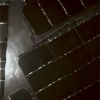
SOL432-2P164712491EDNA8C5P2275L6M1.jpgClean Solar Panels - Sol 432 (Natural Colors; credits: Lunar Explorer Italia)55 visitenessun commentoMareKromium
|
|
| 25353 immagini su 2113 pagina(e) |
 |
|
|
|
|
1877 | |
|
|
|
|





