| Piú viste |
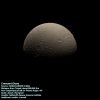
Dione-PIA11546.jpgCrescent Dione (Natural Colors; credits: Lunexit)55 visiteCaption NASA:"A large Impact Basin dominates the high Southern Latitudes of Saturn's moon Dione (see also PIA09821 to learn more from a similar image). Lit Terrain seen here is on the anti-Saturn side of Dione (such as the side that never faces Saturn). North on Dione is on the left and rotated 14° towards the upper side of the moon.
The image was taken in Visible Green Light with the Cassini Spacecraft narrow-angle camera on May 25, 2009.
The view was acquired at a distance of approx. 680.000 Km (such as about 420.000 miles) from Dione and at a Sun-Dione-Spacecraft, or Phase, Angle of 68°.
Image scale is 4 Km (about 2,5 miles) per pixel".MareKromium
|
|
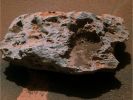
OPP-SOL1961-MF-LXT-AllFilters-.jpgBlock Island in Natural Colors - Sol 1959 (credits: Dr M. Faccin & Lunexit)55 visiteSI tratta di una meteorite? Probabilmente si. Quello che è certo è che siamo davanti ad una roccia ignea la quale presenta delle più che notevoli somiglianze con il Basalto Vescicolare - che è "indigeno", ad esempio, della Regione di Gusev Crater.
Ma ancora maggiori somiglianze sono rinvenibili fra questa roccia (il cui colore ci fa pensare alla Iron Ferrite ed al Nickel) ed un'altra "Meteorite Marziana", sempre fotografata da Opportunity, nel Sol 345 (ormai ben più di quattro anni fa!) e che noi battezzammo "Skull Rock".
Ed ora attendiamo l'Analisi NASA...MareKromium
|
|

The_Rings-PIA11666.jpgFrom "F" to "A"!55 visiteCaption NASA:"A vertically extended Structure or Object in Saturn's "F"-Ring casts a shadow long enough to reach the "A"-Ring in this Cassini image taken just days before Planet's August 2009 Equinox.
The structure can be seen as a bulge within the bright core of the "F"-Ring on the left of the image. The structure rises far enough above the Ring-Plane for the shadow to be cast across the Roche Division and onto the "A"-Ring. The shadow is barely visible stretching across the top right quadrant of the image. The shadow appears very faint here because this view looks toward the unlit side of the Rings.
This image and others like it (see PIA11662 and PIA11663) are only possible around the time of Saturn's equinox which occurs every half-Saturn-year (equivalent to about 15 Earth years). The illumination geometry that accompanies equinox lowers the sun's angle to the ring plane and causes out-of-plane structures to cast long shadows across the Rings.
Exact equinox at Saturn begins August 11, 2009, and lasts about 4 days. Shadows have grown longer as those days draw near. Cassini's cameras have spotted not only the predictable shadows of some of Saturn's moons (see PIA11657), but also the shadows of newly revealed Vertical Structures in the Rings themselves (see PIA11654).
The "A"-Ring in the first (top) image has been brightened relative to "F"-Ring to enhance visibility of the ring and shadow. The entire image in the second (bottom) version has been contrast enhanced. Bright specks in the image are background stars.
This view looks toward the unilluminated side of the Rings from about 28° above the Ring-Plane.
The image was taken in Visible Light with the Cassini Spacecraft narrow-angle camera on July 30, 2009. The view was obtained at a distance of approx. 1,8 MKM (about 1,1 MMs) from Saturn and at a Sun-Saturn-Spacecraft, or Phase, Angle of 96°.
Image scale is roughly 10 Km (a little more than 6 miles) per pixel".MareKromium
|
|

The_Rings-PIA11662.jpgAnother "Vertical Structure" in the "F"-Ring55 visiteCaption NASA:"As Saturn approaches its August 2009 Equinox, a shadow is cast by a narrow, vertically extended feature in the F-Ring.
Scientists are working to understand the origin of structures such as this one, but they think this image may show the shadow of an object on an inclined orbit which has punched through the F-Ring and dragged material along in its path.
The second (bottom) version of the image has been brightened to enhance the visibility of the ring and shadow. Background stars appear elongated in the image because of the camera's exposure time.
This image and others like it (see PIA11663) are only possible around the time of Saturn's Equinox which occurs every half-Saturn-year (equivalent to about 15 Earth years). The illumination geometry that accompanies Equinox lowers the Sun's angle to the Ring-Plane and causes out-of-plane structures to cast long shadows across the Rings. Cassini's cameras have spotted not only the predictable shadows of some of Saturn's moons (see PIA11657), but also the shadows of newly revealed vertical structures in the Rings themselves (see PIA11654).
This view looks toward the unilluminated side of the Rings from about 27° above the RingPlane.
The image was taken in Visible Light with the Cassini Spacecraft narrow-angle camera on June 11, 2009. The view was acquired at a distance of approx. 866.000 Km (about 538.000 miles) from Saturn and at a Sun-Saturn-Spacecraft, or Phase, Angle of 30°. Image scale is roughly 5 Km (a little more than 3 miles) per pixel".MareKromium
|
|

Prometheus-PIA11553.jpgPrometheus, its Shadow and Streamer Channel55 visiteCaption NASA:"The moon Prometheus casts a shadow on the thin "F"-ing marked with Streamer-Channels created by the moon in this image taken as Saturn approaches its August 2009 Equinox.
The gravity of potato-shaped Prometheus (about 86 Km, or approx. 53 miles across) periodically creates Streamer-Channels in the "F"-Ring.
(For further examples and to learn more, see PIA10461 and PIA10593. If you want to watch a movie of this process, please refer to and see PIA08397).
The novel illumination geometry created as Saturn approaches its August 2009 Equinox allows moons orbiting in or near the plane of Saturn's Equatorial Rings to cast shadows onto the Rings. These scenes are possible only during the few months before and after Saturn's Equinox which occurs only once in about 15 Earth years.
To learn more about this special time and to see movies of moons' shadows moving across the Rings, see PIA11651 and PIA11660.
This view looks toward the unilluminated side of the Rings from about 52° above the Ring-Plane. The image was taken in Visible Light with the Cassini Spacecraft narrow-angle camera on June 15, 2009.
The view was acquired at a distance of approx. 1,8 MKM (about 1,1 MMs) from Prometheus and at a Phase Angle of 85°.
Image scale is roughly 11 Km (a little less than 7 miles) per pixel".MareKromium
|
|

South_Polar_Regions-VI0310_00_5_H-PCF-LXTT.jpgVenus' South Polar Vortex (Absolute Natural Colors; credits for the additional process. and color.: Dr P>aolo C. Fienga - Lunexit Team)55 visiteCaption ESA:"This image, of the ‘Eye of the Hurricane’ on Venus was taken by the Visible and Infrared Thermal Imaging Spectrometer (VIRTIS) on board Venus Express.
This picture shows a Region in the Venusian Atmosphere about 60 Km from the Surface, at a wavelength of about 5 micrometres. In this figure, the dipole assumes an eye-like shape and from here until the last image, it is possible to see how its shape evolves rapidly in a span of only 24 hours.
The yellow dot in the image indicates the location of the South Pole".MareKromium
|
|

Tethys-N00126733.jpgCrescent Tethys (Natural Colors; credits: Lunexit)55 visiteN00126733.jpg was taken on December 17, 2008 and received on Earth December 17, 2008. The camera was pointing toward TETHYS that, at the time, was approximately 527.571 Km away. This image was taken using the CL1 and CL2 filters and it has not been validated or calibrated.MareKromium
|
|

PSP_001578_1425_RED_abrowse.jpgSouthern Crater with Gullies and a small Landslide (Natural Colors; credits: Lunexit)55 visitenessun commentoMareKromium
|
|

PSP_001348_1770_RED_abrowse-01.jpgUnusual Crater in Meridiani Planum (EDM-JP2; credits: Dr M. Faccin)55 visitenessun commentoMareKromium
|
|

OPP-SOL1985-GB-LXT3.jpgExploring "Block Island" - Sol 1985 (Natural Colors; credits: Dr G. Barca & Lunexit)55 visitenessun commentoMareKromium
|
|
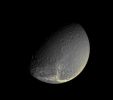
Dione-PIA11565.jpgDione55 visiteCaption NASA:"The Cassini Spacecraft looks down on the North Pole of Dione and the fine fractures that cross its Trailing Hemisphere.
The North Pole of Dione lies on the Terminator between shadow and light, about halfway down the left side of the image. This view is centered at 66° North Lat. and 224° West Long.
Lit terrain seen here is on the Trailing Hemisphere and anti-Saturn side of Dione. To learn more about Dione's fractures, see PIA09764.
The image was taken in Visible Light with the Cassini Spacecraft narrow-angle camera on July 11, 2009. The view was obtained at a distance of approx. 429.000 Km (such as about 267.000 miles) from Dione and at a Sun-Dione-Spacecraft, or Phase, Angle of 67°.
Image scale is roughly 3 Km (a little less than 2 miles) per pixel".MareKromium
|
|
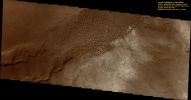
Dunes-NiliPatera-20090824a.jpgLarge Dunefield in Nili Patera (possible Natural Colors; credits: Lunexit)55 visitenessun commentoMareKromium
|
|
| 25353 immagini su 2113 pagina(e) |
 |
|
|
|
|
1876 | |
|
|
|
|





