| Piú viste |
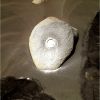
SOL337-1.jpgAfter the "Grinding" - Sol 337 (possible True Colors; credits: Dr G. Barca)55 visitenessun commentoMareKromium
|
|

OPP-SOL1755-1M283997625EFF94BBP2976M2M1.jpgSmashed Grains and Berries - Sol 1755 (natural colors; credits: Lunexit)55 visitenessun commentoMareKromium
|
|
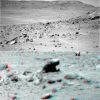
SOL405-MF~0.jpgVery unusually-looking "Boulder"... - Sol 405 (credits: Dr M. Faccin)55 visitenessun commentoMareKromium
|
|

SOL347-4_copia2.jpgStill Skyline... (4) - Sol 347 (natural colors; credits: Dr G. Barca & Lunexit)55 visitenessun commentoMareKromium
|
|

SOL1675-GB.jpgGusev Skyline and a distant Outpost - Sol 1675 (possible True Colors; credits: Dr G. Barca & Lunar Explorer Italia)55 visitenessun commentoMareKromium
|
|

PSP_005392_0995_RED_abrowse-01~0.jpgImpact Crater on the South Polar Layered Deposits (EDM n.1; MULTISPECTRUM - credits: Lunexit)55 visiteA problem with using craters to determine age on the icy SPLD is that erosion of the icy substrate and relaxation of crater topography (i. e., relief becoming more gentle) is probably more rapid on ice than on harder rocky surfaces.
A detailed study of craters in ice will help better to understand this process of how craters in ice degrade, or deteriorate, with time.
Perhaps then we will know how to use the number and distribution of craters over the icy polar layered deposits in constraining the geologic and climate history of the Mars Polar Regions.MareKromium
|
|
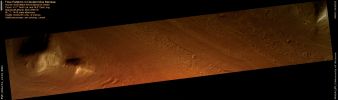
PSP_006252_2220_RED_abrowse.jpgLineated Valley Fill (MULTISPECTRUM; credits: Lunexit)55 visiteFlow patterns dominate this Region of Mars in Deuteronilus Mensae. Many of the valley floors in the area exhibit complex alignments of small ridges, hills, and pits – often called “lineated valley fill”. The cause of the small-scale texture is not known, but it may result from patterns in ice rich soils or the loss of ice.
The linear alignment we see is probably caused by downhill movement of ice-rich soil, or glacial flow in dirty ice or ice-rich soil.
The result is flow patterns, called “stream lines”, that follow the valleys and around obstacles. Many of the large knobs and mesas in this region are also surrounded by aprons of debris that appear to have flowed away from the knobs and may be ice-rich themselves. Around one large knob in this image the debris flow appears to lie on top of the lineated valley fill and is therefore probably a younger deposit.MareKromium
|
|
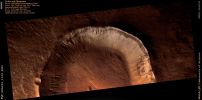
PSP_006261_1410_RED_abrowse.jpgGullies with Meanders (MULTISPECTRUM; credits: Lunexit)55 visiteThis observation features a relatively pristine crater in the Southern Mid-Latitudes. The crater still has a sharp rim on its South end, but it has experienced modification since forming.
The North half of the crater is populated by a large number of gullies that appear to emanate from resistant layers. The layers likely continue around the crater, but the gullies do not. Distinct layers are visible on the South wall of the crater.
It is unknown why gullies form on certain slopes and not others. Interestingly, the gullies themselves are not so pristine. They are covered by dunes and cut by polygonal fractures, indicating that they have been modified by aeolian and periglacial processes, respectively.
There are a large number of boulder tracks visible on the crater walls. Boulder tracks typically are approximately constant in width, and can often be seen at the track ends.
The crater floor has a texture indicative of sublimation processes.
If a soil is ice-rich under Martian conditions, the ice can sublimate causing the ground to collapse and “crinkle” where the ice used to be.
MareKromium
|
|
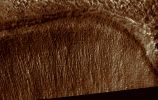
PSP_002545_1430_RED_browse-01~0.jpgJuncture of Two Branches of Dao Vallis (edm - possible True Colors; credits: Lunar Explorer Italia)55 visiteHiRISE images, such as this one (here, approximately 680 mt across), show that the mantled unit is textured and full of boulders, which contrasts with the smooth appearance of this material in MOC images.MareKromium
|
|
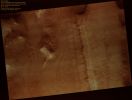
PSP_002545_1430_RED_browse-00~0.jpgJuncture of Two Branches of Dao Vallis (ctx frame - possible True Colors; credits: Lunar Explorer Italia)55 visiteMartian outflow channels are believed to be some of the largest features formed from the catastrophic flooding that scoured the landscape during ancient times. The source of the water likely originated in the subsurface and was somehow disturbed, depressurizing an aquifer, causing a sudden burst of water onto the surface.
This image shows multiple branches of the outflow channel Dao Vallis, which flows towards the West (down), ending near Hellas Basin. Although it is not clear exactly where the water that created these floods ended up, it is possible that Dao Vallis and its neighboring outflow channel, Niger Vallis, deposited water in Hellas Basin and formed a short-lived lake. Within the floor of Dao Vallis is material that appears striped, known as "lineated valley fill".
Valley fill material is thought to be ice-rich material that has flowed or been deposited onto the floor. Several lineations or "flow lines" appear to merge towards the upper left of the scene which supports this idea that the fill materials flowed, similar to slow-moving glacial material on Earth.
Also present in this scene is a mantling deposit which drapes much of the mid-latitudes of Mars. The deposit or "mantle" can be seen on south-facing slopes of positive-relief features, appearing as if its sliding off the walls. The mantle material is thought to be ice-cemented dust that was deposited during times when snowfall occurred on Mars.MareKromium
|
|
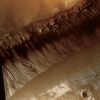
PSP_004071_1425_RED_browse-01.jpgMesas in Gorgonum Chaos (edm - possible True Colors; credits: Lunar Explorer Italia)55 visitePSP_004071_1425 shows mesas that are part of Gorgonum Chaos, a region of chaotic terrain, which is a jumble of mounds and mesas grouped together.
Chaotic terrain is most commonly found in Mars near the sources of the gigantic outflow channels. Gorgonum Chaos is one of the few exceptions.
Some of the troughs between the mesas appear to have V-shaped bottoms; there is no obvious flat floor in between. Others have dunes running down their centers probably indicating flat floors. It is possible that the mesas were once connected and that something caused fractures in the original mesa's surface that were then preferentially eroded.MareKromium
|
|

SOL040-041-GIF-Movie-MF1~0.gifDo You See?!? - Sol 41 (GIF-Movie; credits: Dr M. Faccin)55 visiteQuesto bellissimo GIF-Movie realizzato dal nostro Dr Faccin ha suscitato, in ordine ai suoi contenuti ed a quello che potrebbe mostrare, delle "controversie interpretative" anche all'interno di Lunar Explorer Italia: un fatto, quest'ultimo, che ci ha spinto a considerare ancora una volta il dato per cui, in ipotesi di immagini controverse, la "differenza", spesso, la fanno gli "occhi di chi guarda".
Allora, dato che i deadlocks non servono a nessuno e visto che qui, sulle nostre pagine, vogliamo tutti capire (o almeno vogliamo provare a capire!) ciò che si vede, per questa volta non Vi diremo nulla: nessuna "dritta", nessun "suggerimento", nessuna "informazione circostanziale".
Solo una domanda: Voi...Vedete qualcosa?!?...MareKromium
|
|
| 25353 immagini su 2113 pagina(e) |
 |
|
|
|
|
1874 | |
|
|
|
|





