| Piú viste |

PHOE-SOL090-lg24930-24931-24932-2.jpgSunrise - Sol 90 (Superdefinition; credits: Dr G. Barca)55 visitenessun commentoMareKromium
|
|

SOL381-MF.jpgWhite Dust, Orange Dust... - Sol 381 (Natural Colors; credits for the additional process. and color.: Dr M. Faccin Lunexit team)55 visitenessun commentoMareKromium
|
|

OPP-SOL1060-1.jpgFrom inside Victoria - Sol 1060 (True Colors; credits: Dr G. Barca)55 visitenessun commentoMareKromium
|
|
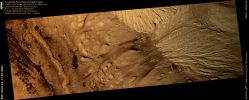
PSP_009149_1750_RED.jpgInverted Riverbed in Gale Crater (False Colors; credits: Lunexit)55 visiteGale Crater is a large, approximately 152 Km-diameter impact crater that lies near the Martian Equator. Contained within the crater is a massive central mound of layered material. With an average vertical thickness of almost 4 Km (about 2,4 miles), the Gale Crater Layered Deposits are twice as thick as the layers exposed along the Grand Canyon on Earth. Shown here is a portion of the mound with an inverted fluvial or river channel.
Topographic inversion occurs when sediments are cemented together, forming a harder layer that is resistant to later erosion. This later erosion has preferentially removed material outside the channel, leaving the former riverbed exposed as a ridge — such as a topographic high.
This inverted channel was originally detected by scientists using Mars Orbiter Camera (MOC) images onboard the Mars Global Surveyor Spacecraft.
Color variations visible in this image are mostly due to variable amounts of loose dark sediment that has accumulated unevenly across the scene.MareKromium
|
|

PSP_009192_1890_RED-01.jpgRelatively Recent Slope Streak started from a Dust Devil (edm - natural colors; credits: Lunexit)55 visitenessun commentoMareKromium
|
|

APOLLO_15_AS_15-88-11905_HR.jpgAS 15-88-11905 - Hadley Mountain (natural colors; credits: Lunexit)55 visitenessun commentoMareKromium
|
|

OPP-SOL1632-1N273075972EFF90MJP1937L0M1.jpgLight-clouds over Victoria - Sol 1632 (tri-chromatic version; credits: Lunexit)55 visitenessun commentoMareKromium
|
|
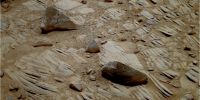
SOL1337-1.jpgRocks on Layers - Sol 1337 (True Colors; credits: Dr G. Barca)55 visitenessun commentoMareKromium
|
|
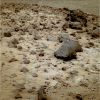
SOL1344-1.jpgRocky Garden - Sol 1344 (True Colors; credits: Dr G. Barca)55 visitenessun commentoMareKromium
|
|

SOL1388-1.jpgRover Tracks and the "Texture" of Gusev - Sol 1388 (Possible True Colors; credits: Dr G. Barca)55 visitenessun commentoMareKromium
|
|
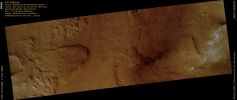
Psp_009368_1720_red.jpgIus Chasma (natural colors; credits: Lunexit)55 visiteThis image spans the floor of Ius Chasma’s Southern Trench. Ius Chasma is located in the Western Region of Valles Marineris, the Solar System’s largest canyon. This canyon is well known for its fine stratigraphic layers modified by wind and water.
The outcrops contain interchanging layers of dark and bright rocks. The layered deposits consist of dark basalt lava flows and bright sedimentary layers. The sediments are likely to be from atmospheric dust, sand, or alluvium from an ancient water source. The layers are visible on the gentle slopes above the canyon floor, in pitted areas, and in small mesa buttes. The floor of the canyon is littered with megaripples that are aligned in a North-South direction.
Ius Chasma is believed to have been shaped by a process called "sapping" that occurred when water seeped from the layers of the cliffs and evaporated before it reached the canyon floor. This process is thought to have dominated during the Amazonian Period.
Ius Chasma also has several structural features such as East trending normal Faults and Grabens that deformed the canyons. Recent geomorphological events include Mass Wasting (Avalanches) and minor Sapping from Gullies that continued to erode the canyon walls.MareKromium
|
|
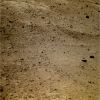
SOL1490-1.jpgGusev's Slope - Sol 1490 (natural colors; credits: Dr G. Barca)55 visitenessun commentoMareKromium
|
|
| 25353 immagini su 2113 pagina(e) |
 |
|
|
|
|
1871 | |
|
|
|
|





