| Piú viste |
OPP-SOL259-1M151176851EFF36CLP2956M2M1.jpgMartian "Mushroom" - Sol 259 (Natural Colors; credits: Lunexit)55 visitenessun commentoMareKromium
|
|

ESP_013948_1410_RED_abrowse-03.jpgGullies in Sirenum Fossae (EDM n.3 - Natural Colors; credits: Lunexit)55 visitenessun commentoMareKromium
|
|

ESP_013948_1410_RED_abrowse-01.jpgGullies in Sirenum Fossae (EDM n.1 - Natural Colors; credits: Lunexit)55 visitenessun commentoMareKromium
|
|
OPP-SOL1963-MF-MicroscopicImager.jpgIron-Nickel Meteorite - Sol 1963 (True Colors; credits: Dr M. Faccin)55 visiteCi sono volute ore di Lavoro per arrivare a questo tipo di immagine, caratterizzata da una qualità visiva, in termini di definizione e colorazione, largamente superiore a quella che la NASA mette a disposizione del Pubblico.
Vi preghiamo di tenerne conto, mentre la guardate e studiate.
Per quanto attiene il Dr Marco Faccin, non possiamo fare altro che ringraziarlo per quello che ha fatto, che fa e che farà per Lunar Explorer Italia e per tutti i suoi Lettori.MareKromium
|
|

SOL494-2N170214626ESFAAEEP1560L0M1.jpgHorizon - Sol 494 (Natural Colors; credits: Lunexit)55 visitenessun commentoMareKromium
|
|

Rhea-PIA11638.jpgCraterland (Natural Colors; credits: Lunexit)55 visiteCaption NASA:"Craters imprinted upon other craters record the long history of impacts endured by Saturn's moon Rhea.
This view looks toward the Mid-Southern Latitudes of the Saturn-facing side of Rhea. North on Rhea is up.
The image was taken in Visible Light with the Cassini Spacecraft narrow-angle camera on Oct. 13, 2009. The view was obtained at a distance of approx. 45.000 Km (about 28.000 miles) from Rhea and at a Sun-Rhea-Spacecraft, or Phase, Angle of 105°.
Image scale is approx. 260 meters (about 860 feet) per pixel".MareKromium
|
|
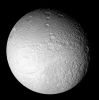
Tethys-CASSINI.jpgTethys55 visiteWhat processes formed the unusual Surface of Saturn's moon Tethys? To help find out, NASA sent the robotic Cassini Spacecraft right past the enigmatic ice moon in 2005. Pictured above is one of the HR images of an entire face of Tethys yet created. The pervasive white color of Tethys is thought to be created by fresh ice particles continually falling onto the moon from Saturn's diffuse E-Ring - particles expelled by Saturn's moon Enceladus. Some of the unusual cratering patterns on Tethys remain less well understood, however. Close inspection of the above image of Tethys' South Pole will reveal a great rift running diagonally down from the middle: Ithaca Chasma. A leading theory for the creation of this great canyon is anchored in the tremendous moon-wide surface cracking that likely occurred when Tethys' internal oceans froze.
If so, Tethys may once have harbored internal oceans, possibly similar to the underground oceans some hypothesize to exist under the surface of Enceladus today. Might ancient life be frozen down there?MareKromium
|
|
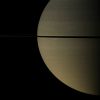
Saturn-PIA11640.jpgNarrow Shadow55 visiteCaption NASA:"From just above the Plane of Saturn's Rings, the Cassini Spacecraft snapped this shot of Saturn two months after Saturn's August 2009 Equinox, showing the shadow of its Rings as a narrow band on the Planet.
Cassini is looking toward the sunlit side of the rings from about 1° above the Ring-Plane.
The novel illumination geometry that accompanies Equinox lowers the Sun's angle to the Ring-Plane, significantly darkens the Rings, and causes out-of-plane structures to look anomalously bright and cast shadows across the Rings. These scenes are possible only during the few months before and after Saturn's Equinox, which occurs only once in about 15 Earth years.
Before and after Equinox, Cassini's cameras have spotted not only the predictable shadows of some of Saturn's moons (see, for instance, PIA11657), but also the shadows of newly revealed Vertical Structures in the Rings themselves (see PIA11665).
The image was taken with the Cassini Spacecraft wide-angle camera on Oct. 16, 2009 using a spectral filter sensitive to wavelengths of Near-InfraRed Light centered at 752 nanometers. The view was obtained at a distance of approx. 1,5 MKM (such as about 932.000 miles) from Saturn and at a Sun-Saturn-Spacecraft, or Phase, Angle of 83°.
Image scale is roughly 86 Km (approx. 53 miles) per pixel".MareKromium
|
|

OPP-SOL321-1P156680673EFF3981P2355R1M1.jpgPink Skies over Meridiani... - Sol 321 (Natural Colors; credits: Lunexit)55 visitenessun commentoMareKromium
|
|

OPP-SOL2069-GB-LXT.jpgSkyline - Sol 2069 (Natural Colors; credits: Dr G. Barca)55 visitenessun commentoMareKromium
|
|

PSP_001410_2210_RED_abrowse.jpgUnnamed Craters with Layered Deposits in Utopia Planitia (Natural Colors; credits: Lunexit)55 visiteThis image shows an Unnamed Impact Crater located in Utopia Planitia (Northern Hemisphere of Mars) that is filled with layered material.
The layered character of these Deposits is consistent with episodic deposition. Each distinct layer represents a period of sediment deposition. The layers are parallel to each other, indicating that deposition occurred by material settling onto the Surface, rather than being blown across the Surface in Sand Dunes.
The hummocky texture of these deposits suggests that volatiles (such as Carbon Dioxide Ice) are mixed in with the rocky sediment.MareKromium
|
|

Saturn-Exagon.jpgThe "Exagon" of Saturn's North Pole55 visiteIt is unclear how an unusual Hexagonal Cloud System that surrounds Saturn's North Pole was created, keeps its shape, or how long it will last.
Originally discovered during the Voyager flybys of Saturn in the 80s, nobody has ever seen anything like it elsewhere in the Solar System.
Although its IR glow was visible previously to the Cassini Spacecraft now orbiting Saturn, over the past year the mysterious Hexagonal Vortex became fully illuminated by Sunlight for the first time during the Cassini's visit. Since then, Cassini has imaged the rotating Hexagon in Visible Light enough times to create this full-view. (the North Pole center was not well imaged and has been excluded)
Planetary scientists are sure to continue to study this most unusual cloud formation for quite some time.MareKromium
|
|
| 25353 immagini su 2113 pagina(e) |
 |
|
|
|
|
1866 | |
|
|
|
|





