| Piú viste |
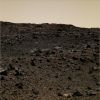
SOL541-GB.jpgRocky Skyline - Sol 541 (possible True Colors; credits: Dr G. Barca)55 visitenessun commentoMareKromium
|
|
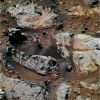
SOL554-GB.jpgColourful Outcrop and Sands - Sol 554 (possible True Colors; credits: Dr G. Barca)55 visitenessun commentoMareKromium
|
|

PSP_005392_0995_RED_abrowse-00~0.jpgImpact Crater on the South Polar Layered Deposits (context frame; MULTISPECTRUM - credits: Lunexit)55 visiteThis image covers a portion of the ice-rich SPLD.
Layers in the Mars Polar Regions are of great interest because layers in ice on the Earth, as in the Antarctic and Greenland ice caps, are known to contain records of past atmospheric, environmental, and climate conditions. By studying Mars Polar Layers, we hope to be able to understand the past climate and history of water on the Red Planet.MareKromium
|
|
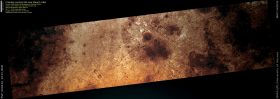
PSP_006610_2035_RED_abrowse~0.jpgPotential MSL Landing Site near Mawrth Vallis (MULTISPECTRUM; credits: Lunexit)55 visiteMawrth Vallis contains clay minerals that formed by chemical alteration of rocks by water. It is one of the short list of potential sites that the Mars Science Laboratory Rover will land at, and the HiRISE team is working to find a safe place to land in this area.
This observation shows a wide variety of scientifically interesting terrains as well as some potential hazards for landing. The central part of the image is dominated by light-toned materials with curving fractures of many different sizes. These fractures do not have a preferred orientation, indicating that they did not form in response to some regional stress pattern.
Instead, they formed by some more uniform process, possibly the drying of a thick mud deposit or the gradual rebound of the area as the overlying material was eroded away. The scattered mounds and sand dunes may or may not prove to be a danger, but it is reassuring to see that many of the impact craters have been smoothed out with a filling of wind-blown sand.MareKromium
|
|
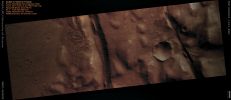
PSP_006695_1415_RED_abrowse~0.jpgGullies in Sirenum Fossae (MULTISPECTRUM; credits: Lunexit)55 visiteThis image shows parts of Sirenum Fossae that are southwest of Gorgonum Chaos. Some of the troughs (Fossae) have gullies on their walls. Gullies are incised slope features that are thought to have formed by liquid water flowing down the slopes.
It is unknown whether the water came from the subsurface or above the surface. The plains around the troughs have a number of mesas and hills that might have formed from erosion of a once-larger rock unit.
The left side of the image shows some dark linear features which MIGHT BE Dust Devil Tracks.MareKromium
|
|
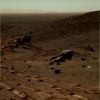
SOL510-GB.jpgRover Tracks and the "foggy" distant Rim of Gusev Crater - Sol 510 (Enhanced and Darkened Natural Colors; credits: Dr G. Barca & Lunar Explorer Italia)55 visitenessun commentoMareKromium
|
|

TheRings-PIA10581.jpgBright Spokes (Natural Colors; credits: Lunar Explorer Italia)55 visiteCaption NASA:"Signaling a return to the bright Spokes first encountered by the Cassini Spacecraft in 2005, three large white Spokes stretch out across the B-Ring. Throughout most of the last year, Cassini captured views of dark Spokes.
This image of bright Spokes was taken Jan. 14, 2009 in Visible Light with the Spacecraft's wide-angle camera.
The small moon Atlas (about 30 Km, or approx. 19 miles across) has been brightened by 30% but still appears as a faint dot between the A and F Rings in the top right quadrant of the image.
This view looks toward the sunlit side of the Rings from about 6° below the Ring-Plane. The view was acquired at a distance of approx. 551.000 Km (about 342.000 miles) from Saturn and at a Sun-Saturn-Spacecraft, or Phase, Angle of 155°. Image scale is roughly 29 Km (such as about 18 miles) per pixel".MareKromium
|
|
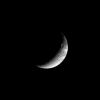
Dione-PIA10577.jpgCrescent Dione55 visiteCaption NASA:"This high-phase view of Dione shows the great contrast between the highly reflective "wisps" and the surrounding terrain. These wispy lines are geologically young fractures exposing the icy surface of the moon.
Lit terrain seen here is on the Trailing Hemisphere of Dione (about 1123 Km, or approx. 698 miles, across). North on Dione is up.
The view was acquired from a position 39° South of the moon's Equator. The image was taken in Visible Light with the Cassini Spacecraft narrow-angle camera on Dec. 26, 2008. The view was obtained at a distance of approx. 789.000 Km (about 490.000 miles) from Dione and at a Sun-Dione-spacecraft, or Phase, Angle of 124°
Image scale is roughly 5 Km (about 3 miles) per pixel".MareKromium
|
|

Tethys-PIA10582.jpgGibbous Tethys55 visiteCaption NASA:"Like the lengthy story of its Greek king namesake, the humongous Odysseus Impact Basin stretches on and on across Tethys.
The approx. 450-Km (about 280-mile) wide Odysseus Crater is a well-preserved example of an ancient multi-ringed Impact Basin. The Outer Ring's steep, cliff-like walls descend to broad internal terraces. The Inner Ring consists of a circular band of icy mountains creating a crown shape with a diameter of about 140 Km (approx. 87-miles).
This view looks toward the leading hemisphere of Tethys (1062 kilometers, or 660 miles across). North on Tethys is up and rotated 2 degrees to the right.
The image was taken in visible light with the Cassini Spacecraft narrow-angle camera on Jan. 2, 2009. The view was obtained at a distance of approx. 816.000 Km (about 507.000 miles) from Tethys and at a Sun-Tethys-Spacecraft, or Phase, Angle of 58°.
Image scale is roughly 5 Km (about 3 miles) per pixel".MareKromium
|
|

007-Ceres-PIA10235.jpg1-Ceres (natural colors, from HST - credits: NASA/ESA et al.)55 visiteCaption NASA:"This is a NASA Hubble Space Telescope color image of 1-Ceres, the largest object in the Asteroid Belt.
Astronomers enhanced the sharpness in these Advanced Camera for Surveys images to bring out features on Ceres' surface, including brighter and darker regions that could be asteroid impact features.
The observations were made in Visible and UV Light between December 2003 and January 2004.
The colors represent the differences between relatively red and blue regions. These differences may simply be due to variation on the surface among different types of material.
Ceres' round shape suggests that its interior is layered like those of terrestrial planets such as Earth. Ceres may have a rocky inner core, an icy mantle, and a thin, dusty outer crust inferred from its density and rotation rate of 9 hours. Ceres is approximately 590 miles (about 950 Km) across and was first discovered in 1801".MareKromium
|
|
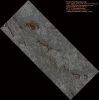
PSP_005095_0935_RED_browse~0.jpgSouth Pole Residual Cap (Swiss-Cheese Terrain Monitoring) - (Natural Colors; credits: Lunar Explorer Italia)55 visitenessun commentoMareKromium
|
|

PSP_003492_1405_RED_abrowse~0.jpgUnnamed Southern Mid-Latitude Crater with "unusually bright" Gullies (MULTISPECTRUM; credits: Lunexit)55 visiteThis image shows a Southern Mid-Latitude (unnamed) crater: it has bright landslides on its South-East and West walls, some of which have noticeable boulder tracks where boulders rolled down the slopes.
The most noticeable features of this crater are the gullies on the North wall. A couple of small gullies appear to emanate from an overhang.
The others originate at or near layers up-slope.
The layers are sturdy and resistant from erosion: the layers that appear to be decaying into resolvable boulders, instead of particles easily moved by the wind, are evidence of this.MareKromium
|
|
| 25353 immagini su 2113 pagina(e) |
 |
|
|
|
|
1863 | |
|
|
|
|





