| Piú viste |
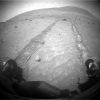
SOL1806-2F286696020EFFAZDHP1214L0M1_br.jpgStuck! - Sol 180655 visiteCaption NASA:"The Hazard Avoidance Camera on the Front of NASA's Mars Exploration Rover Spirit (Front Haz-Cam) took this image after a drive by Spirit on the 1806th Martian Day, or Sol, (such as January 31, 2009) of Spirit's Mission on the Surface of Mars.
The wheel at the bottom right of the image is Spirit's right-front wheel. Because that wheel no longer turns, Spirit drives backwards dragging that wheel. The drive on Sol 1806 covered about 30 centimeters (1 foot). The Rover Team had planned a longer drive, but Spirit stopped short, apparently from the right front wheel encountering the partially buried rock visible next to that wheel.
The Hazard Avoidance Cameras on the Front and Back of the Rover provide wide-angle views. The hill on the horizon in the right half of this image is Husband Hill. Spirit reached the Summit of Husband Hill in 2005".MareKromium
|
|

Dione-N00080526~0.jpgDione (Natural Colors; credits: Lunar Explorer Italia)55 visitenessun commentoMareKromium
|
|
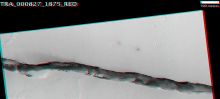
T-CerberusFossae-04.JPGThe Fissures of Cerberus Fossae (Hi-Def3-D - credits and Copyright: Dr G. Barca and Lunar Explorer Italia)55 visitenessun commentoMareKromium
|
|
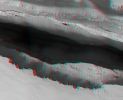
T-CerberusFossae-01.JPGThe Fissures of Cerberus Fossae (Hi-Def3-D - credits and Copyright: Dr G. Barca and Lunar Explorer Italia)55 visitenessun commentoMareKromium
|
|

T-CerberusFossae-00.JPGThe Fissures of Cerberus Fossae (Hi-Def3-D - credits and Copyright: Dr G. Barca and Lunar Explorer Italia)55 visiteUna splendida sequenza orbitale (e tridimensionale!) che ci mostra, alla massima risoluzioni possibile, le "Fissures" (lett. "fessure", "crepe a fessura") che caratterizzano la Regione Marziana che risponde al (tetro) nome di Cerberus Fossae.
Molti Ricercatori di Frontiera (su tutti: il Dr Joseph Skipper) hanno vanamente cercato - anche ricorrendo a colorizzazioni assolutamente errate e capziose) di dimostrare che, sul fondo di queste crepe, scorrono attualmente dei fluidi. Tutto lavoro inutile: è sufficiente l'analisi delle spettacolari ed ultradefinite immagini HiRise, magistralmente rese in tridimensionale dal nostro Dr Barca, per rendersi conto che siamo davanti a semplici, ancorchè affascinanti, cracks del suolo aventi un'origine probabilmente vulcanica. E sul fondo di queste fratture? C'è qualcosa?
Si, certo che c'è qualcosa, anzi: ci sono tante cose! Ci sono depositi di polveri, dunette, alcuni outcrops e svariati cumuli di macigni (tutte evidenze di crolli parziali delle pareti di questi canaloni). Null'altro.
Acqua? Forse, in un tempo remoto. Oggi, solo nell'immaginario di qualche "Ricercatore"...MareKromium
|
|
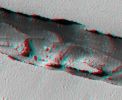
T-CerberusFossae-08.JPGThe Fissures of Cerberus Fossae (Hi-Def3-D - credits and Copyright: Dr G. Barca and Lunar Explorer Italia)55 visitenessun commentoMareKromium
|
|
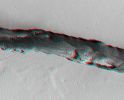
T-CerberusFossae-07.JPGThe Fissures of Cerberus Fossae (Hi-Def3-D - credits and Copyright: Dr G. Barca and Lunar Explorer Italia)55 visitenessun commentoMareKromium
|
|
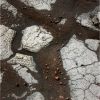
OPP-SOL609-GB-LXT.jpgMartian Paving with Orange Pebbles - Sol 609 (possible True Colors; credits: Dr G. Barca)55 visitenessun commentoMareKromium
|
|
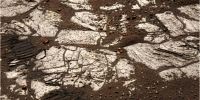
OPP-SOL599-GB-LXT.jpgMartian Paving with Orange Pebbles - Sol 599 (possible True Colors; credits: Dr G. Barca)55 visitenessun commentoMareKromium
|
|
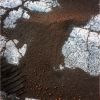
OPP-SOL581-GB-LXT.jpgMartian Paving with Orange Pebbles - Sol 581 (possible True Colors; credits: Dr G. Barca)55 visitenessun commentoMareKromium
|
|
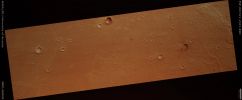
PSP_001521_2025_RED_abrowse-00.jpgThe Viking Lander 1 Landing Site - Thomas Mutch Memorial Station (ctx frame - Natural Colors; credits: Lunar Explorer Italia)55 visiteViking Lander 1 (VL1) touched down in Western Chryse Planitia on July 20, 1976.
The Lander, which has a diameter of about 3 meters, has been precisely located in the HiRISE orbital image, and likely locations have been found for the Heat-Shield, Backshell and Parachute attached to the Backshell.
The Lander location has been confirmed by overlaying the lander-derived topographic contours on the HiRISE image, which provides an excellent match. VL1 was one element of an ambitious mission to study Mars, with a 4-spacecraft flotilla consisting of 2 Orbiters and 2 Landers.MareKromium
|
|

PSP_001513_1655_RED_abrowse-00.jpgThe MER Spirit Landing Site (ctx frame - Natural Colors; credits: Lunar Explorer Italia)55 visiteThis HiRISE image shows the Landing Site of the Mars Exploration Rover Spirit. The impact crater in the upper left-hand portion of the image is "Bonneville Crater", which was investigated by Spirit shortly after landing. In the lower right-hand portion of the image is "Husband Hill", a large hill that Spirit climbed and where it spent much of its now nearly five-year mission.
M.L.T.: 15:29 (early afternoon)
Latitude (centered): 14,6° South and Longitude 175,5° East
Range to target site: 270,7 Km (approx. 169,2 miles)
Original image scale range: 27,1 cm/pixel (with 1 x 1 binning) so objects ~81 cm across are resolved
Map projected scale: 25 cm/pixel and North is up
Map projection: EQUIRECTANGULAR
Emission angle: 15,8°
Phase angle: 73,6°
Solar Incidence Angle: 60°, with the Sun about 30° above the Local Horizon
Solar Longitude: 139,1° (Northern Summer)MareKromium
|
|
| 25353 immagini su 2113 pagina(e) |
 |
|
|
|
|
1861 | |
|
|
|
|





