| Piú viste |
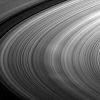
The_Rings-PIA11587.jpgSpokes on the B-Ring55 visiteCaption NASA:"Saturn's B-Ring shows off bright Spokes in the middle of this image taken at high phase.
This image was captured at a Phase Angle of 119°. To learn more about these ghostly radial markings, see PIA10567 and PIA11144.
This view looks toward the northern, sunlit side of the Rings from about 10° above the Ring-Plane. The image was taken in Visible Light with the Cassini Spacecraft narrow-angle camera on Aug. 20, 2009. The view was acquired at a distance of approx. 2,3 MKM (such as about 1,4 MMs) from Saturn.
Image scale is roughly 13 Km (about 8 miles) per pixel".MareKromium
|
|

The_Rings-PIA11674.jpgRocky-Rain on the Rings55 visiteCaption NASA:"The bright Streaks visible in these Cassini images taken during Saturn’s August 2009 Equinox are exciting evidence of a constant rain of interplanetary projectiles onto the Planet’s Rings.
Objects, each estimated to be one meter (3 feet) in size and traveling tens of kilometers per second (tens of thousands of miles per hour), likely smashed into the Rings and created elevated clouds of tiny particles that have been sheared out, or elongated and tilted, by orbital motion into bright streaks.
The image on the left shows an impact in the A-Ring. The Streak stretches from the right of the image to the middle, and it does not quite follow the arc of the Rings. The brightest part of that Streak is about 5000 Km (approx. 3100 miles) long (its azimuthal dimension) and about 200 Km (approx. 120 miles) wide (its radial extent, tip to tip) in this image.
The image on the right shows an impact into the C-Ring. This Streak is much smaller than the A-Ring Streak, and it appears on the right of the image. The brightest part of this Streak is approx. 200 Km (about 120 miles) long (its azimuthal dimension) and approx. 10 Km (about 6 miles) wide (its radial dimension, tip to tip) in this image.
By the brightness and dimensions of the Streaks, scientists estimate the impactor sizes at roughly one meter (3 feet), and the elapsed time since impact at one to two days. These Equinox data lend more confidence to a Cassini imaging observation made in 2005 of similar Streaks seen in the C-Ring (see PIA11675).
All together, these observations constitute the visual confirmation of a long-held belief that bits of interplanetary debris continually rain down on Saturn’s Rings and contribute to the Rings’ erosion and evolution.
Although the phase angle of these images is not the best for seeing clouds of small particles, these ejecta clouds are easily seen because very little sunlight is falling on the Rings during the exceedingly low Sun-angle condition prevalent during the four days surrounding exact Saturn Equinox.
Exact Equinox is when the sun is directly overhead at the Equator. A cloud of dust rising above the dark Ring-Plane is more directly catching the Sun’s rays, and is hence well lit and easily visible by contrast.
When the Ring background is at its usual brightness, impacts such as these are very difficult to detect.
The view of the A-Ring Streak on the left looks toward the northern side of the Rings from about 20° above the Ring-Plane. The image was taken in Visible Light with the Cassini Spacecraft narrow-angle camera on Aug. 13, 2009. The view was obtained at a distance of approx. 1,2 MKM (about 746.000 miles) from Saturn and at a Phase Angle of 87°.
Image scale is 7 kilometers (4 miles) per pixel.
The view of the C-Ring Streak on the right looks toward the southern side of the Rings from about 22° below the RingPlane. The image was taken in Visible Light with the Cassini Spacecraft narrow-angle camera on Aug. 11, 2009. The view was obtained at a distance of approx. 263.000 Km (about 164.000 miles) from Saturn and at a Phase Angle of 135°.
Image scale is roughly 1 Km (4007 feet) per pixel".MareKromium
|
|
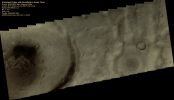
Craters-UnnamedCrater-Aonia_Terra-20091005a.jpgUnnamed Crater in Aonia Terra (False Colors; credits: Lunexit)55 visitenessun commentoMareKromium
|
|

Titan-PIA11594.jpgNorthern Layers (UV + Natural Colors; credits: Lunexit)55 visiteCaption NASA:"This UltraViolet view of Titan shows the moon's North Polar "Hood" (---> cappuccio) and its detached, high-altitude haze layer. See also PIA08137 to learn more.
This view looks toward the Saturn-facing side of Titan.
North on Titan is up and rotated 2° to the left.
The image was taken with the Cassini Spacecraft narrow-angle camera on Aug. 13, 2009 using a spectral filter sensitive to wavelengths of UltraViolet Light centered at 338 nanometers. The view was acquired at a distance of approx. 2,2 MKM (about 1,4 MMs) from Titan and at a Sun-Titan-Spacecraft, or Phase, Angle of 61°.
Image scale is roughly 26 Km (about 16 miles) per pixel".MareKromium
|
|

OPP-SOL2031-MF-LXT-ALLFILTERS-raw.jpgMetal v/s Metal - Sol 2031 (ALL Filters/RAW Natural Colors - credits: Dr M. Faccin)55 visitenessun commentoMareKromium
|
|
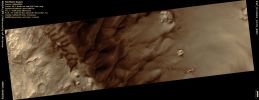
ESP_014426_2070_RED_abrowse.jpgNorthern Dunes (Natural Colors; credits: Lunexit)55 visitenessun commentoMareKromium
|
|

Titan-PIA11603.jpgSeasonal Changes on Titan (Natural Colors; credits: NASA/JPL/Space Science Institute)55 visiteSeasonal changes in the Atmosphere of Saturn's largest moon are captured in this Natural Color image, which shows Titan with a slightly darker top half and a slightly lighter bottom half.
Titan's Atmosphere has a seasonal hemispheric dichotomy, and this image was taken shortly after Saturn's August 2009 Equinox.
Images taken using red, green and blue spectral filters were combined to create this Natural Color view.
Scientists have found that the Winter Hemisphere typically appears to have more high-altitude haze, making it darker at shorter wavelengths (UltraViolet through blue) and brighter at InfraRed wavelengths.
The switch between dark and bright occurred over the course of a year or two around the last Equinox. Scientists are studying the mechanism responsible for this change, and will monitor the dark-light difference as it flip-flops now that the 2009 Equinox has signaled the coming of Spring and then Summer in the Northern Hemisphere.
Although this hemispheric boundary appears to run directly East-West near the Equator, its position is not level with latitude and is actually offset from the Equator by about 10° of Latitude.
This view looks toward the Saturn-facing side of Titan. North on Titan is up.
The images were obtained with the Cassini Spacecraft wide-angle camera on Aug. 25, 2009 at a distance of approx. 174.000 Km (such as about 108.000 miles) from Titan.
Image scale is roughly 10 Km (a little more than 6 miles) per pixel.MareKromium
|
|

PSP_004867_1220_RED_abrowse-01.jpgIce Processes in Amphitrites Patera (EDM - Natural Colors; elab. Lunexit)55 visiteThe Martian Atmosphere was dusty at the time this image was acquired, so small imperfections in the processing are very visible in the standard image products.
MareKromium
|
|

ZZ-Mercury-Terminator-PIA12279.jpgStrange Neighbors55 visiteThe MESSENGER Spacecraft was flying toward Mercury at 3,7 Km/second (8300 miles/hour) when it captured this image. The Sun was just above the horizon, and the deep shadows it cast emphasized the texture and topography of the terrain along the Terminator (day/night boundary). The large crater at upper left has a rough rim and walls, and the floor of this crater has a sunken inner circular area. At the center of the sunken floor section is an irregular depression (or pit) that is entirely in shadow in this view. Just to the South-South/West is the right half of another large crater whose rim intersects that of the crater with the sunken floor. The southern crater is about the same diameter as its northern neighbor, but instead of exhibiting a sunken floor with a pit, it has been filled nearly to its rim with smooth material likely of volcanic origin. These two close neighbors, one empty and one full, attest to the surprisingly complicated geological history of the little planet closest to the Sun.
Date Acquired: September 29, 2009
Image Mission Elapsed Time (MET): 162744138
Instrument: Narrow Angle Camera (NAC) of the Mercury Dual Imaging System (MDIS)
Resolution: 400 meters/pixel (0,25 miles/pixel)
Scale: This image is about 220 Km (approx. 140 miles) wide
Spacecraft Altitude: about 15.700 Km (approx. 9800 miles)MareKromium
|
|
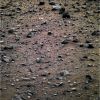
SOL2026-1_copia2.jpgGusev Surface - Sol 2026 (RAW True Colors; credits: Dr G. Barca)55 visitenessun commentoMareKromium
|
|

PSP_004650_0975_RED_abrowse.jpgExposure of South Polar Layered Deposits (Natural Colors; credits: Lunexit)55 visiteExtensive Layered Deposits are found in both Polar Regions of Mars and are thought to contain evidence of recent climate changes like ice ages on Earth.
Radar observations suggest that the NPLD - as well as the SPLD - are composed mostly of water ice, but many layered exposures, including this one, appear to be covered by a layer of dust that protects the underlying water ice from further erosion. The SPLD are more extensive than the NPLD, and have generally been less active recently.
The greater age of the SPLD is indicated by the higher density of craters on its Surface; as a matter of fact, a cluster of small craters is visible above center in this image. Also visible are widespread polygonal fractures, evidence of water ice expansion/contraction below the Surface.MareKromium
|
|

Saturn-PIA12318.jpgCosmic Vision (Natural Colors; credits: NASA/JPL/Space Science Institute)55 visiteCaption NASA:"Looking cool and serene, Saturn shares its soft glow with Cassini. This view of Saturn, its Rings and the moon Tethys represents "Target 1" in the fall 2009 edition of the Cassini Scientist for a Day contest.
(See http://saturn.jpl.nasa.gov/education/scientistforaday8thedition/.) The contest is designed to give students a taste of life as a scientist by challenging them to write an essay describing the value of one target choice among three for Cassini to image.
A bonus feature in the image is the presence of bright Spokes on and just above the ansa, or curved edge of the darkened Ring-Plane. The Spokes are made visible here by sunlight scattering through the dust-sized icy particles and toward Cassini's cameras.
Images taken using red, blue and green spectral filters were combined to create this color view.
The images were acquired with the Cassini wide-angle camera on Oct. 11, 2009 at a distance of approx. 1,7 MKM (a little more than 1 MMs) from Saturn".
Nota Lunexit: la dizione "Natural" l'abbiamo aggiunta noi, dato che la NASA - curiosamente - parla solo di "Color View" (insomma, adesso non fanno più nemmeno la fatica di dirci se si tratta di Natural, Approximate True, True e/o False Colors...bah!).MareKromium
|
|
| 25353 immagini su 2113 pagina(e) |
 |
|
|
|
|
1860 | |
|
|
|
|





