| Piú viste |

EncelalusPIA11137.jpgRelict Tiger Stripe55 visitenessun commentoMareKromium
|
|

Enceladus-PIA11139.jpgAxial Discontinuity on Enceladus55 visiteCaption NASA:"These two side-by-side images compare a "twisted" sea-floor spreading feature on Earth, known as an Offset Spreading Center (OSC), to a very similar looking twisted break, or Axial Discontinuity, in the Damascus Sulcus "Tiger Stripe" on Saturn’s moon Enceladus. The image of Enceladus was acquired by NASA’s Cassini Spacecraft imaging science sub-system during one of its four close targeted flybys of Enceladus in March, August and October 2008.
The image on the left shows a shaded relief map of bathymetry (or sonar-like topography) data along a spreading ridge on the East Pacific Rise near 9,5° North Lat. and 104° West Long.
On Earth, OSC's occur only along fast-spreading ridges - ones that spread faster than about 100 mm (such as 4") per year. They do not occur on slow-spreading ridges, like the famous Mid-Atlantic Ridge where spreading rates are often less than 20 mm (0,7") per year.
The Axial Discontinuity on Enceladus’ Damascus Sulcus, shown in the image on the right, twists in the same helical way that the OSC does on Earth. However, the morphological resemblance is no guarantee that both features are caused by fast spreading.
On Earth OSCs form when two nearly parallel spreading ridges lengthen along their ridge (or long) axes. As the lengthening tips of the ridges pass each other side-by-side in opposite directions, shear forces caused by tectonic spreading between them force the two tips to twist around each other. The twisting tip of each one eventually merges with the "neck" of the other in a "yin-yang" shaped pattern.
The result is an oval shaped basin that is surrounded by the twisted ridge tips.
On Enceladus, the twisted features have not produced an oval basin, but the pattern of the twist is very similar to the terrestrial OSC and probably similar tectonic shear forces, perhaps even tectonic spreading, resulted in this twisted shape. Note that the Enceladus image has been flipped right-to-left to make comparison to the sea-floor feature easier to see".MareKromium
|
|
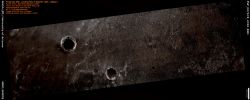
PSP_007678_2050_RED_abrowse~0.jpgProposed MSL Landing Site in Mawrth Vallis (MULTISPECTRUM; credits: Lunexit)55 visiteMawrth Vallis has a rich mineral diversity, including clay minerals that formed by the chemical alteration of rocks or loose “regolith” (soil) by water.
The CRISM instrument on the MRO Spacecraft has detected a variety of clay minerals here that could signify different processes of formation. The high resolution of the HiRISE camera helps us to see and trace out layers, polygonal fractures and, with CRISM, examine the distribution of various minerals across the surface.
This surface is scientifically compelling for the Mars Science Laboratory (MSL) Rover, although some of the terrain might be somewhat rough. Scientists use HiRISE images to find the safest possible Landing Site for the Rover.
This is one of four candidate landing sites in the Mawrth Vallis region.MareKromium
|
|

Psp_010344_2655_red.jpgScarp-Fed Dark Dunes (possible True Colors; credits: Lunar Explorer Italia)55 visiteMars Local Time: 09:59 (middle morning hours)
Coord. (centered): 85,7° South Lat. and 179,4° East Long.
Spacecraft altitude: 330,6 Km (such as about 206,6 miles)
Original image scale range: 66,1 cm/pixel (with 1 x 1 binning) so objects ~1,98 mt across are resolved
Map projected scale: 50 cm/pixel
Map projection: EQUIRECTANGULAR
Emission Angle: 17,4°
Phase Angle: 84,6°
Solar Incidence Angle: 70° (meaning that the Sun is about 20° above the Local Horizon)
Solar Longitude: 139,7° (Northern Summer)
Credits: NASA/JPL/University of Arizona
Additional process. and coloring: Lunar Explorer ItaliaMareKromium
|
|

Saturn-W00052086.jpgUnusual Saturn Image55 visiteSapreste spiegare, in un massimo di tre righe, il contenuto visivo di questo frame?... Provateci, se volete, utilizzando la funzione "commenti"!MareKromium
|
|
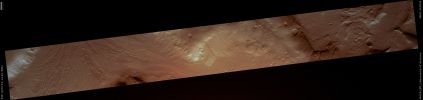
Psp_009719_2230_red.jpgFretted Terrain in Protonilus Mensae (possible True Colors; credits: Lunar Explorer Italia)55 visiteCaption NASA:"This observation shows Fretted Terrain in valleys located in Protonilus Mensae near the so-called "Crustal Dichotomy", such as the Region that separates the Southern Hemisphere Highlands from the Northern Hemisphere Lowlands.
Fretted Terrain is thought to involve movement of ice-rich material in its formation. The speckled texture of the valley fill (i.e. the Fretted Terrain) is probably due to sublimation, when ice goes directly from a solid to a gas, leaving behind empty space under the soil into which overlying material can collapse.
The linear striations in the valley fill mark the direction of movement. For example, in the valley near the top of the image (left), the material was moving across the scene.
Also in this scene, are several small craters in various stages of degradation".
§§§
Mars Local Time: 15:20 (early afternoon)
Coord. (centered): 42,4° North Lat. and 48,1° East Long.
Spacecraft altitude: 295,4 Km (such as about 184,6 miles)
Original image scale range: 59,1 cm/pixel (with 1 x 1 binning) so objects ~1,77 mt across are resolved
Map projected scale: 50 cm/pixel
Map projection: EQUIRECTANGULAR
Emission Angle: 0,4°
Phase Angle: 46,0°
Solar Incidence Angle: 46° (meaning that the Sun is about 44° above the Local Horizon)
Solar Longitude: 116,4° (Northern Summer)
Credits: NASA/JPL/University of Arizona
Additional process. and coloring: Lunar Explorer ItaliaMareKromium
|
|
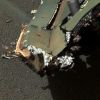
OPP-SOL358-3.jpgThe Heat-Shield, in Technicolor - Sol 358 (possible True Colors; credits: Dr G. Barca)55 visitenessun commentoMareKromium
|
|
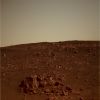
SOL573-2P177243355EFFADDVP2362R1M1.jpgAnother big outcrop - Sol 573 (natural colors; credits: Lunar Explorer Italia)55 visitenessun commentoMareKromium
|
|

Titan-PIA10546.jpgNorth Polar Haze (Saturated Natural Colors; credits for the additional process. and color.: Dr Paolo C. Fienga - Lunexit Team)55 visiteCaption NASA:"Titan's globally distributed detached haze layer and the moon's North Polar hood, both notable details of its thick atmosphere, are clearly seen in this image from the Cassini Spacecraft.
Titan is about 5150 Km (approx. 3200 miles) across, and therefore slightly larger than Mercury.
The image was taken with the Cassini Spacecraft narrow-angle camera using a combination of spectral filters sensitive to wavelengths of polarized ultraviolet light centered at 338 nanometers. The view was obtained at a distance of approx. 1,7 MKM (about 1,08 MMs) from Titan and at a Sun-Titan-Spacecraft, or Phase, Angle of 50°.
Image scale is roughly 10 Km (about 6 miles) per pixel".MareKromium
|
|
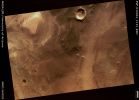
PSP_010063_2135_RED.jpgIsmenius Lacus (possible True Colors; credits: Lunar Explorer Italia)55 visiteMars Local Time: 14:16 (early afternoon)
Coord. (centered): 33,2° North Lat. and 17,4° East Long.
Spacecraft altitude: 296,7 Km (such as about 185,5 miles)
Original image scale range: 29,7 cm/pixel (with 1 x 1 binning) so objects ~59,4 cm across are resolved
Map projected scale: 25 cm/pixel
Map projection: EQUIRECTANGULAR
Emission Angle: 6,9°
Phase Angle: 54,4°
Solar Incidence Angle: 47° (meaning that the Sun is about 43° above the Local Horizon)
Solar Longitude: 129,0° (Northern Summer)
Credits: NASA/JPL/University of Arizona
Additional process. and coloring: Lunar Explorer ItaliaMareKromium
|
|

OPP-SOL1722-1.jpgHorizon, with possible Rim (in the far distance) - Sol 1722 (possible True Colors; credits: Dr G. Barca & Lunexit)55 visitenessun commentoMareKromium
|
|

OPP-SOL1755-1M283997676EFF94BBP2956M2M1.jpgSmashed Grains and Berries - Sol 1755 (natural colors; credits: Lunexit)55 visitenessun commentoMareKromium
|
|
| 25353 immagini su 2113 pagina(e) |
 |
|
|
|
|
1856 | |
|
|
|
|





