| Piú viste |

OPP-SOL1915-MF-ALLFILTERS.jpg"Dusty" NASA-logo - Sol 1915 (ALL Filters ON; credits: Dr M. Faccin & Lunar Explorer Italia)55 visiteUna elaborazione, anche questa, bellissima e tecnicamente perfetta, assolutamente degna di competere (e probabilmente vincere!) con le elaborazioni NASA-Original.MareKromium
|
|

Mimas-PIA11661.jpgEclipsing Mimas55 visiteCaption NASA:"As the moon Enceladus eclipses its neighbor Mimas, Cassini records a scene possible only around the time of Saturn's approaching Equinox.
Seven images, each taken about 30" apart, were combined to create a movie which shows the shadow of Enceladus (about 504 Km, or approx. 313 miles, across) darkening Mimas (about 396 Km, or approx. 246 miles, across).
Although Saturn has eclipsed moons in previous images (see PIA11143 and PIA11508), this is the first time that Cassini has imaged one of Saturn's moons being eclipsed by another moon rather than the Planet.
The novel illumination geometry created as the Saturnian System approaches Equinox means that during this time moons orbiting in or near the plane of Saturn's Equatorial Rings can cast shadows onto the Rings and onto each other.
This image was taken in Visible Light with the Cassini Spacecraft narrow-angle camera on May 13, 2009. The view was obtained at a distance of approx. 1,3 MKM (about 808.000 miles) from Mimas and at a Phase Angle of 43°.
Image scale is roughly 8 Km (about 5 miles) per pixel".MareKromium
|
|

SOL1892-PIA12078.jpgTroy - Sol 1892 (Natural - but strongly enhanced - Colors; credits: NASA/JPL-Caltech/Cornell University)55 visiteCaption NASA:"The soft soil exposed when wheels of NASA's Mars Exploration Rover Spirit dug into a patch of ground dubbed "Troy" exhibit variations in hue visible in this image, in which the colors have been stretched to emphasize the differences.
Spirit used its PanCam during the 1892nd Martian Day, or Sol, of the Rover's mission on Mars (April 29, 2009) to take the three images combined into this composite image. The 3 images were taken through filters centered at wavelengths of 750, 530 and 430 nanometers. Spirit had become embedded at Troy by about a week later.
The two rocks near the upper right corner of this view are each about 10 cm (4") long and 2 to 3 cm (1") wide".MareKromium
|
|

SOL463-dd_enhanced_463e-A476R1.jpgDust Devils near Spirit - Sol 463 (Tri-chromatic Version; credits for the additional process. and color.: Dr Paolo C. Fienga - Lunar Explorer Italia)55 visitenessun commentoMareKromium
|
|

OPP-SOL1929-MF-LXT.jpgThe Paving under the Berries - Sol 1929 (ALL Filters ON; credits: Dr M. Faccin & Lunar Explorer Italia)55 visitenessun commentoMareKromium
|
|
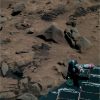
SOL069-GB-LXT.jpgHeavily Disturbed Terrain - Sol 69 (possible True Colors; credits: Dr G. Barca)55 visitenessun commentoMareKromium
|
|
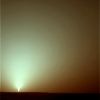
SOL1954-2P299855814EDNB1E5P2676L7M1.jpgSunset - Sol 1954 (possible True Colors; credits: Lunar Explorer Italia)55 visitenessun commentoMareKromium
|
|
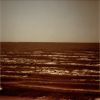
OPP-SOL1935-1P299962520EFFA3PGP2378L2M1.jpgHorizon... - Sol 1935 (Natural Colors; credits: Lunar Explorer Italia)55 visitenessun commentoMareKromium
|
|

Dione-PIA11532.jpgWispy Dione55 visiteCaption NASA:"The Cassini Spacecraft looks toward the wispy, fractured terrain of the Trailing Hemisphere of the moon Dione.
To learn more about Dione's "Wisps", see also PIA08960.
Lit Terrain seen here is on the Trailing Hemisphere of Dione (about 1123 Km, or approx. 698 miles across). North on Dione is up and rotated 29° to the right.
The image was taken in visible light with the Cassini Spacecraft narrow-angle camera on May 26, 2009. The view was acquired at a distance of approx. 1,3 MKM (about 808.000 miles) from Dione and at a Sun-Dione-Spacecraft, or Phase, Angle of 35°.
Image scale is roughly 8 Km (about 5 miles) per pixel".MareKromium
|
|

ZZ-Mercury-Craters-Tiziano_Crater-PIA12079.jpgTitian Crater (extremely enhanced Natural Colors; credits: NASA and Lunar Explorer Italia)55 visiteThis enhanced-color image shows Titian Crater (center) and is similar to an image that recently appeared in the 1st of May 2009 issue of Science magazine.
The enhanced-color view was created by using high-resolution images taken in all 11 WAC filers (one of which is shown in a previously released image, see PIA11765) and comparing and contrasting them to accentuate differences on Mercury’s Surface. Such color differences can be used to learn about the history of Mercury’s Surface in this area. In the enhanced color, the smooth floor of Titian is a brighter orange color than the surrounding area, likely due to being filled with volcanic material. Ejecta from Titian appear blueish and cover much of the Surface surrounding the Crater. This material was excavated from depth during the Crater’s formation.
Later impacts, such as the one that produced the small crater that appears yellowish in the upper center of the image, excavated material from below the Titian ejecta. This yellow-appearing material was present at or near the surface before the impact that created Titian and is a different composition (and thus, color) from its surroundings. Impacts make it possible to assess how Mercury’s Crust varies with depth and ultimately how the crust evolved through time.
Date Acquired: October 6, 2008
Instrument: Wide Angle Camera (WAC) of the Mercury Dual Imaging System (MDIS)
Resolution: 462 meters/pixel (0,29 miles/pixel)
Scale: Titian crater is about 121 Km (approx. 75 miles) in diameter
Nota Lunexit: curiosa la "chiazza violacea" visibile ad ore 01:00 del Cratere "Tiziano". La NASA, ovviamente, ha commentato tutto, tranne il dettaglio più intrigante. Noi, purtroppo, non possiamo aggiungere nulla, se non ribadire un concetto già espresso dalla NASA più volte, e cioè che "a colore diverso, nei frames colorizzati in natural enhanced colors, corrisponde un materiale diverso". Nulla di più.MareKromium
|
|
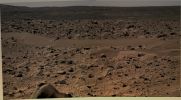
SOL071-PANORAMIC-GB-LXT.jpgRockland! - Sol 71 (Image Composite - Natural Colors; credits: Dr G. Barca & Lunar Explorer Italia)55 visitenessun commentoMareKromium
|
|

Titan-Volcanic_Features-PIA12111.jpgSouth Polar Basin55 visiteCaption NASA:"An enigmatic large Basin appears in the South Polar Region of Saturn's moon Titan at the center of this Titan Radar Mapper image from NASA's Cassini Spacecraft acquired on June 22, 2009.
The Basin has several possible origins.
It may be a Volcanic Caldera, produced by collapse after cryovolcanic eruptions.
It might be a Modified Impact Basin, partially infilled with sedimentary material.
Alternately, the basin may have formed by some other collapse process related to the presence of Subsurface Methane.
Evidence for lakes elsewhere on Titan suggests that it might have been later partially filled with liquid Methane and Ethane".
MareKromium
|
|
| 25353 immagini su 2113 pagina(e) |
 |
|
|
|
|
1853 | |
|
|
|
|





