| Piú viste |

FIGURA_04.jpgLuigi Broglio55 visiteL'ingegner Luigi Broglio in Florida, in visita al John F. Kennedy Space Center di Cape Canaveral.MareKromium
|
|

FIGURA_03.JPGLifting-up of a "Scout" missile55 visiteSollevamento di un razzo "Scout" sulla rampa della piattaforma San Marco.MareKromium
|
|

FIGURA_02.jpgThe San Marco Platform55 visiteLa Piattaforma San Marco con uno "Scout" sulla torre di lancio.
MareKromium
|
|
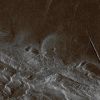
Lakshmi_Planum-PIA00249.jpgDanu Montes and Lakshmi Planum (possible Natural Colors; credits: Dr Paolo C. Fienga - Lunexit Team)55 visiteSouthwest Lakshmi Planum is bounded on the South by the Danu Montes.
Lakshmi Planum is an elevated plateau plain that is bounded on all sides by mountain chains. Here, the Danu Mountains have an angular fractured appearance. Chasms slice diagonally across the mountains in the lower left (South-West) corner of the image. Because of the steep slopes and the local relief of the mountains of several kilometers (2-3 miles, these fault-bounded troughs appear to zig-zag through the mountains when, in fact, they are probably straight if viewed from above.
The radar view provides a perspective that would place the viewer's eye to the right, 27° above the Horizon. Thus, slopes facing to the right can be seen completely, though dark, and slopes facing away to the left appear shortened, often seen only as thin bright lines. In the center of the image is a low volcanic dome (approx. 20 Km - about 12 miles - in diameter).
This type of volcanic feature frequently occurs on the low plains. This dome on the edge of Lakshmi is deformed and faulted where it has been affected by the forces that created the Danu mountains.
The image is approx. 75 Km (about 46 miles) on a side. The center is at 60° North Latitude and 324,5° East Longitude.MareKromium
|
|

Craters-Barton_Crater-PIA00463.jpgBarton Crater (possible Natural Colors; credits: Dr Paolo C. Fienga - Lunexit Team)55 visiteDuring orbits 404 through 414 on 19-20 September 1990, the Magellan Probe imaged a Peak-Ring Crater that is about 50 Km in diameter located at Latitude 27,4° North and Longitude 337,5° East. The name "Barton" has been proposed by the Magellan Science Team for this Crater, after Clara Barton, founder of the Red Cross; however, the name is tentative pending approval by the International Astronomical Union.
Barton is just at the diameter size that Venus Impact Craters appear to begin to possess Peak-Rings instead of a single Central Peak or Central Peak complex like does about 75% of the craters with diameters between about 50 and 15 Km.
The floor of the Crater is flat and radar-dark, indicating possible infilling by volcanic deposits sometime following the impact event. Barton's Central Peak Ring is discontinuous and appears to have been disrupted or separated during or following the cratering process. The extremely blocky crater deposits (ejecta) surrounding Barton appear to be most extensive on the South-West to South-East (lower left to right) side of it.MareKromium
|
|

FIGURA_08.jpgThe "San Marco - Broglio Space Center"55 visiteVeduta del segmento terrestre del San Marco - Broglio Space Center.MareKromium
|
|

FIGURA_07.JPGThe "San Marco - Broglio Space Center"55 visiteIngresso del Centro Spaziale San Marco, poi rinominato Luigi Broglio Space Center.MareKromium
|
|

FIGURA_06B.jpgThe "San Marco 3" Satellite55 visitenessun commentoMareKromium
|
|

FIGURA_06A.jpgPreparing for Launch55 visitePreparazione al lancio di un missile Scout.MareKromium
|
|

FIGURA_05.jpgThe Launch of "Ariel-5", from the San Marco Platform55 visiteLancio del satellite britannico "Ariel 5" dalla Piattaforma San Marco.
MareKromium
|
|

Hestia_Rupes-PIA00469.jpgComplex Network of Narrow Fractures near Hestia Rupes Region (possible Natural Colors; credits: Dr Paolo C. Fienga - Lunexit Team)55 visiteThis is a Magellan radar image covering an about 105- Km (approx. 63-mile) by 45-Km (approx. 27-mile) Region near Hestia Rupes on the North-Western corner of Aphrodite Terra.
The complex network of narrow (such as <1 Km) Fractures in the center of the image extends for approx. 50 Km (about 31 miles). This network exhibits tributary-like branches similar to those observed in river systems on Earth. However, the angular intersections of the tributaries suggest tectonic control.
These features appear to be due to drainage of lava along preexisting fractures and subsequent collapse of the Surface. The underlying tectonic fabric can be observed in the North-East trending Ridges which predate the Plains.MareKromium
|
|
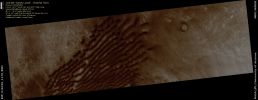
ESP_016036_1370_RED_abrowse-00.jpgDunes in Noachis Terra (CTX Frame - Natural Colors; credits: Dr Paolo C. Fienga - Lunexit Team)55 visiteDunes of sand-sized materials have been trapped on the floors of many Martian Craters.
This is one example, from an Unnamed Crater located in Noachis Terra, West of the giant Hellas Impact Basin.
The most extensive Linear Dunefields known in the Solar System are on Saturn's largest moon Titan.
But Titan, as to Mars, has a very different environment and composition and so, at a meter-scale resolution (not available yet, unfortunately) the Titanian Dunes should look (better yet: they certainly ARE) very different from the Martian ones.MareKromium
|
|
| 25353 immagini su 2113 pagina(e) |
 |
|
|
|
|
1850 | |
|
|
|
|





