| Piú viste |

Rhea_and_Titan-MF.jpgRhea and Titan (NIR View; credits: Dr M. Faccin)55 visite...Una "Visione" davvero splendida, da lasciare con il fiato sospeso...MareKromium
|
|

Tethys_and_Rhea-N00147318-N00147337.gifSilent Running: Tethys and Rhea (GIF-Movie; credits: Elisabetta Bonora)55 visitenessun commentoMareKromium
|
|
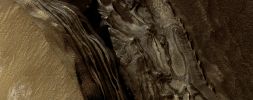
PSP_001334_2645_RED_abrowse-01.jpgNorth Polar Layered Deposits in Head Scarp of Chasma Boreale (EDM - Natural Colors; credits: Lunexit)55 visiteThis EDM shows the NPLD at top and darker materials at bottom exposed in a Scarp at the head of Chasma Boreale, a large canyon eroded into the Layered Deposits.
The Polar Layered Deposits appear of a brown/reddish color because of dust mixed within them, but they are ice-rich as indicated by previous observations. The water ice in the Layered Deposits is probably responsible for the pattern of fractures seen near the top of the scarp.
The darker material below the Layered Deposits may have been deposited as sand dunes, as indicated by the cross-bedding (truncation of curved lines) seen near the middle of the Scarp.
It appears that brighter, ice-rich layers were deposited between the dark dunes in places.
Exposures such as these are useful in understanding the recent climate variations that are likely recorded in the Polar Layered Deposits.MareKromium
|
|
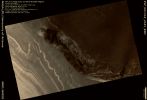
PSP_001334_2645_RED_abrowse-00.jpgNorth Polar Layered Deposits in Head Scarp of Chasma Boreale (CTX Frame - Natural Colors; credits: Lunexit)55 visitenessun commentoMareKromium
|
|

OPP-SOL012-1M129248078EFF0224P2939M2M1.jpgSmashed-up Berries - Sol 12 (False Colors; credits: Lunexit)55 visitenessun commentoMareKromium
|
|
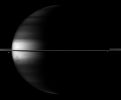
Saturn-PIA11649.jpgOut of the Darkness...55 visiteCaption NASA:"Dramatic differences between dark and light embellish this Cassini Spacecraft image of Saturn, its rings and its moons Dione and Enceladus.
Saturn's Northern and Southern Latitudes appear dark in this image because of the camera filter used. This view uses a spectral filter sensitive to absorption of certain wavelengths of light by Methane in Saturn's Atmosphere. The cloud tops in the Northern and Southern Latitudes are at a slightly greater depth than in the Equatorial Region, and are underneath a layer of Methane. This means that light travels along a longer path compared to the Equatorial Region as it enters the Atmosphere, reflects off the cloud tops, and returns through the Upper Atmosphere to enter the camera.
The light at Near-InfraRed wavelengths thus passes through more light-absorbing Methane at the Northern and Southern Latitudes than at the Equator, and so these Latitudes appear darker.
Dione (approx 1123 Km, or about 698 miles across) can be seen on the left of the image. Enceladus (approx. 504 Km, or about 313 miles across) is visible on the right.
This view looks toward the Northern, sunlit side of the Rings from just above the Ring-Plane.
The image was taken with the Cassini Spacecraft wide-angle camera on Oct. 21, 2009 using a spectral filter sensitive to wavelengths of Near-InfraRed Light centered at 890 nanometers. The view was obtained at a distance of approx. 2,5 MKM (such as about 1,6 MMs) from Saturn and at a Sun-Saturn-Spacecraft, or Phase, Angle of 104°.
Image scale is roughly 143 KM (such as about 89 miles) per pixel".MareKromium
|
|
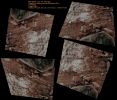
SOL533-2M173683780EFFACAQP2957M2M1_rgb_3d-MF1.jpgCristal-like Substance near semi-transparent Rock and Pebbles - Sol 533 (CTX Frames - Superdefinition and possible True Colors; credits: Dr M. Faccin - Lunexit Team)55 visitenessun commentoMareKromium
|
|
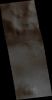
Gullies-ArgyrePlanitia-PIA12408.jpgDeep Gullies on the Western Rim of Argyre Basin (Natural Colors; credits: Dr Paolo C. Fienga - Lunexit Team)55 visiteThe Gullies seen in this VIS image are located on the Western Rim of the Argyre Basin.
Coord.: 47,6 ° South Latitude and 305,2° East Longitude
Resolution: approx. 40 meter/pixel.MareKromium
|
|

OPP-SOL553-FullPanorama-MF.jpgThe Sandy Waves of Meridiani - Sol 533 (IR View - credits: Dr M. Faccin - Lunexit Team)55 visitenessun commentoMareKromium
|
|
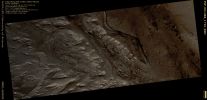
PSP_001488_1750_RED_abrowse.jpgEdge along Gale Craters's Interior Mound (Natural Colors; credits: Dr Paolo C. Fienga - Lunexit Team)55 visiteGale Crater is one of several craters around the Equator that show the presence of Light-Toned Layered Deposits (or LTLD). This HiRISE image covers the northern edge of the LTLD in the Central Mound of Gale Crater, as well as a small portion of the Crater Floor. The right side of the image shows a relatively flat surface with some Impact Craters.
Moving to the left (Southward), there is a large Canyon where Dark Sands have accumulated and formed Ripples and Dunes.
As one moves further to the South, the LTLD rises upward in topography and Layering is visible in some locations. The Surface of the LTLD is very fractured, producing meter-size blocks.
The fact that we don't see many loose rocks along the Surface suggests that the rocks are quickly being destroyed by winds due to their fragile nature.
Resistant Hills, on the other side, tend to be elongated, which is consistent with upslope or downslope winds eroding the rocks themselves.MareKromium
|
|
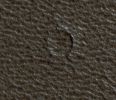
PSP_001406_2680_red-01.jpgLonely and (almost) buried crater in the North Polar "Permanent Cap" (EDM - Natural Colors; credits: Dr Paolo C. Fienga - Lunexit Team)55 visitenessun commentoMareKromium
|
|

PSP_001406_2680_red-00.jpgLonely and (almost) buried crater in the North Polar "Permanent Cap" (CTX Frame - Natural Colors; credits: Dr Paolo C. Fienga - Lunexit Team)55 visitenessun commentoMareKromium
|
|
| 25353 immagini su 2113 pagina(e) |
 |
|
|
|
|
1846 | |
|
|
|
|





