| Piú viste |
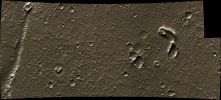
PSP_001578_2000-MF-LXT.jpgFaulting in Amazonis Planitia (Natural Colors; credits: Dr M. Faccin & Lunexit)55 visiteThis HiRISE image is centered on a long "Strike-Slip Fault" on the Young Plains of the Amazonis Planitai Region.
The most famous example of a Strike-Slip Fault on Planet Earth is probably the San Andreas Fault in California.
The Plains of Amazonis, as seen here, show only a few large and medium-sized craters, indicating that the Surface has been "remodeled" relatively recently.
The fact that the Fault visible here has cut the Plains, indicates that tectonic processes (as well as Marsquakes) have occurred even more recently (whereas that the word "recently", on Mars, is a relative term - since it is likely that both the Surface and the Fault are more than a billion years old.
Other interesting features that can be seen in this frame are "Moats" (---> fossi e fossati) - visible around Knobs (---> colline a ceppo) - and a few Impact Craters.MareKromium
|
|

PSP_001602_1700_red_01~0.jpgThe "Central Uplift" of Oudemans Crater (EDM - possible Natural Colors; credits: Lunexit)55 visiteThis HiRISE image covers a portion of the Central Uplift of the 120-Km diameter Oudemans Crater.
Oudemans is located at the Western end of Valles Marineris and just South of the Great Canyon System by the Noctis Labyrinthus.
Images from the Mars Orbital Camera (MOC) were the first to reveal that this large impact crater exposed Layered Rock in its Central Uplift Feature.
Such beautifully preserved Layered Rocks, although rare, are no surprise to planetary scientists.
First, Layered Rocks exposed in the Central Uplifts are common in terrestrial impact structures. Secondly, there is abundant layering exposed in the nearby Valles Marineris Canyon System — a gash that exposes layering down to 7 Km beneath the mean Surface.
This suggests that Layered Materials exist to great depths in the Subsurface, which is supported by the Oudemans Central Uplift observation. MareKromium
|
|

SOL2090-2113-MF.jpgThe "Buried Wheel" - Soles 2090 and 2113 (an Image-Composite in Natural Colors by Dr M. Faccin)55 visitenessun commentoMareKromium
|
|

OPP-SOL2086-GB.jpgErratic Boulder and debris - Sol 2086 (possible True Colors - credits: Dr M. Faccin & Lunexit)55 visitenessun commentoMareKromium
|
|

Mimas-PIA11642.jpg"Oblate" Mimas (Possible Natural Colors; credits: Lunexit)55 visiteCaption NASA:"The Cassini Spacecraft reveals the cratered surface of Mimas, a moon whose shape is flattened at the Poles. (see PIA07534 to learn more about why the moon has this oblate shape)
This view looks toward the Trailing Hemisphere of Mimas (approx. 396 Km, or about 246 miles, across). North on Mimas is up and rotated 1° to the left.
The image was taken in Visible Green Light with the Cassini Spacecraft narrow-angle camera on Oct. 14, 2009. The view was acquired at a distance of approx. 273.000 Km (such as about 170.000 miles) from Mimas and at a Sun-Mimas-Spacecraft, or Phase, Angle of 5°.
Image scale is roughly 2 Km (about 1,4 miles) per pixel".MareKromium
|
|

Rhea_and_Titan-EB.jpgJewels, in the Space of Saturn: Rhea and Titan (Natural Colors; credits: Elisabetta Bonora)55 visiteUn lavoro assolutamente PERFETTO e, detto sinceramente, di qualità mediamente superiore ai Lavori di colorizzazione "Made by NASA".
Complimenti vivissimi alla nostra Amica e Partner, Elisabetta Bonora!MareKromium
|
|

Rhea_and_Titan-MF.jpgRhea and Titan (NIR View; credits: Dr M. Faccin)55 visite...Una "Visione" davvero splendida, da lasciare con il fiato sospeso...MareKromium
|
|

Tethys_and_Rhea-N00147318-N00147337.gifSilent Running: Tethys and Rhea (GIF-Movie; credits: Elisabetta Bonora)55 visitenessun commentoMareKromium
|
|
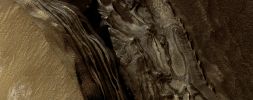
PSP_001334_2645_RED_abrowse-01.jpgNorth Polar Layered Deposits in Head Scarp of Chasma Boreale (EDM - Natural Colors; credits: Lunexit)55 visiteThis EDM shows the NPLD at top and darker materials at bottom exposed in a Scarp at the head of Chasma Boreale, a large canyon eroded into the Layered Deposits.
The Polar Layered Deposits appear of a brown/reddish color because of dust mixed within them, but they are ice-rich as indicated by previous observations. The water ice in the Layered Deposits is probably responsible for the pattern of fractures seen near the top of the scarp.
The darker material below the Layered Deposits may have been deposited as sand dunes, as indicated by the cross-bedding (truncation of curved lines) seen near the middle of the Scarp.
It appears that brighter, ice-rich layers were deposited between the dark dunes in places.
Exposures such as these are useful in understanding the recent climate variations that are likely recorded in the Polar Layered Deposits.MareKromium
|
|
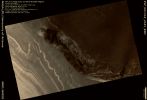
PSP_001334_2645_RED_abrowse-00.jpgNorth Polar Layered Deposits in Head Scarp of Chasma Boreale (CTX Frame - Natural Colors; credits: Lunexit)55 visitenessun commentoMareKromium
|
|

OPP-SOL012-1M129248078EFF0224P2939M2M1.jpgSmashed-up Berries - Sol 12 (False Colors; credits: Lunexit)55 visitenessun commentoMareKromium
|
|

Saturn-PIA11649.jpgOut of the Darkness...55 visiteCaption NASA:"Dramatic differences between dark and light embellish this Cassini Spacecraft image of Saturn, its rings and its moons Dione and Enceladus.
Saturn's Northern and Southern Latitudes appear dark in this image because of the camera filter used. This view uses a spectral filter sensitive to absorption of certain wavelengths of light by Methane in Saturn's Atmosphere. The cloud tops in the Northern and Southern Latitudes are at a slightly greater depth than in the Equatorial Region, and are underneath a layer of Methane. This means that light travels along a longer path compared to the Equatorial Region as it enters the Atmosphere, reflects off the cloud tops, and returns through the Upper Atmosphere to enter the camera.
The light at Near-InfraRed wavelengths thus passes through more light-absorbing Methane at the Northern and Southern Latitudes than at the Equator, and so these Latitudes appear darker.
Dione (approx 1123 Km, or about 698 miles across) can be seen on the left of the image. Enceladus (approx. 504 Km, or about 313 miles across) is visible on the right.
This view looks toward the Northern, sunlit side of the Rings from just above the Ring-Plane.
The image was taken with the Cassini Spacecraft wide-angle camera on Oct. 21, 2009 using a spectral filter sensitive to wavelengths of Near-InfraRed Light centered at 890 nanometers. The view was obtained at a distance of approx. 2,5 MKM (such as about 1,6 MMs) from Saturn and at a Sun-Saturn-Spacecraft, or Phase, Angle of 104°.
Image scale is roughly 143 KM (such as about 89 miles) per pixel".MareKromium
|
|
| 25353 immagini su 2113 pagina(e) |
 |
|
|
|
|
1843 | |
|
|
|
|





