| Piú viste |
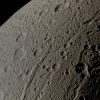
Dione-PIA12663.jpgDione (Absolute Natural Colors; credits for the additional process. and color.: Dr Paolo C. Fienga - Lunexit Team)55 visiteCaption NASA:"The Cassini Spacecraft swooped in for a close-up of the cratered, fractured surface of Saturn's moon Dione in this image taken during the Spacecraft's Jan. 27, 2010, non-targeted Fly-By.
Cassini came within about 45.000 Km (approx. 28.000 miles) of the moon during the Fly-By, and this image was acquired at a distance of approx. 46.000 Km (about 29.000 miles).
This view looks toward the Leading Hemisphere of Dione. North on Dione is up. The image was taken in Visible Light with the Cassini Spacecraft narrow-angle camera.
The view was acquired at a Sun-Dione-Spacecraft, or Phase, Angle of 108°. Image scale is roughly 270 meters (886 feet) per pixel".MareKromium
|
|

ESP_017897_2045_RED_abrowse-PCF-LXTT.jpgMawrth Vallis (Absolute Natural Colors; credits: Dr Paolo C. Fienga - Lunexit Team)55 visitenessun commentoMareKromium
|
|
Saturnian_Space-N00156094-N00156177.gifCosmic Shower (GIF-Movie; credits: Dr Gianluigi Barca - Lunexit Team)55 visitenessun commentoMareKromium
|
|

SOL0401-2P161961441EFFA600P2664L4M1.jpgMorning Fog over Gusev - Sol 401 (Absolute Natural Colors; credits for the additional process. and color.: Dr Paolo C. Fienga - Lunexit Team)55 visitenessun commentoMareKromium
|
|

ESP_017736_1550_RED-EB-PCF-LXTT1.jpg15-Km Diameter Unnamed Impact Crater (Absolute Natural Colors; credits: Dr Paolo C. Fienga - Lunexit Team)55 visitenessun commentoMareKromium
|
|

Marte_Vallis-PIA13249.jpgMarte Vallis (Natural Colors; credits for the additional process. and color.: Dr Paolo C. Fienga - Lunexit Team)55 visitenessun commentoMareKromium
|
|
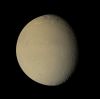
Enceladus-PIA12673.jpgEnceladus (possible Natural Colors; credits for the additional process. and color.: Dr Paolo C. Fienga - Lunexit Team)55 visiteCaption NASA:"The Cassini Spacecraft examines old and new terrain on Saturn's fascinating Enceladus, a moon where jets of water ice particles and vapor spew from the South Pole.
Newly created terrain is at the bottom, in the center and on the left of this view. Older, cratered terrain is on the right. See PIA11685 for another view of this area and more information about its geology. This image was captured during Cassini's Nov. 21, 2009, flyby of the moon. This view looks toward the Leading Hemisphere of Enceladus.
North on Enceladus is up and rotated 3° to the right.
The image was taken in Visible Light with the Cassini Spacecraft narrow-angle camera. The view was obtained at a distance of approx. 133.000 Km (such as about 83.000 miles) from Enceladus and at a Sun-Enceladus-Spacecraft, or Phase, Angle of 46°.
Image scale is roughly 796 meters (2612 feet) per pixel".MareKromium
|
|
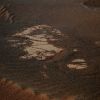
OPP-SOL2283-GB-PCF-LXTT.jpgRipple's Crest and Paving - Sol 2283 (True Colors; credits for the additional process. and color.: Drr Gianluigi Barca and Paolo C. Fienga - Lunexit Team)55 visitenessun commentoMareKromium
|
|
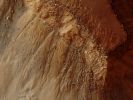
Gullies-_Gorgonum_Chaos-PIA13267.jpgGullies in Gorgonum Chaos (Natural Colors; credits for the additional process. and color.: Dr Paolo C. Fienga - Lunexit Team)55 visiteThis observation from NASA's Mars Reconnaissance Orbiter (MRO) shows part of Gorgonum Chaos, a large cluster of Chaotic Terrain found in the Southern Hemisphere.
Many Regions of Chaotic Terrain are found at the head of large Outflow Channels that were scoured by ancient floods. Gorgonum Chaos is one Region that is NOT associated with an Outflow Channel.
Chaotic Terrain can form when Subsurface Volatiles (such as water) are catastrophically released and the overlying surface collapses. It is not known whether isolated Chaotic Terrain -- such as that shown in this image -- formed in the same way that the ones near the Outflow Channels did. However, some wind-erosion activity might have played a role in their formation.
Gorgonum Chaos is an especially interesting area because Gullies thought to have been eroded by liquid water are located on its Mesas. The Gullies have a wide range of orientations and many appear to emanate from a distinct layer in the Mesas. It is not known why Gullies form on one slope rather than another, but the "Insolation" (sucgh as the amount of sunlight received), availability of water, and regional slope are possible contributing factors.MareKromium
|
|

Titan-Lakes-Ontario_Lacus-01-PIA13173.jpgOntario Lacus55 visiteThis is Ontario Lacus, the largest lake on the Southern Hemisphere of Saturn's moon Titan. It is based on overlapping radar images obtained by NASA's Cassini Spacecraft on June 22, 2009, July 8, 2009 and Jan. 12, 2010. The images were synthesized into stereoscopic images by the Cassini radar team.
The Northern Shoreline features low Hills, probably about 1 Km (3000 feet) in altitude, and flooded River Valleys. A smooth, wave-sculpted Shoreline, like that seen on the South-Eastern side of Lake Michigan, can be seen on the North-Eastern side of the Lake.
The South-Eastern shore features a round-headed bay intruding into the shore. The middle part of the Western Shoreline shows the first well-developed delta observed on Titan.
Topography has been vertically exaggerated by a factor of roughly 10 times. Titan's solid Surface and Atmosphere are portrayed in shades of brown, approximating their appearance as measured by the descent imager and spectral radiometer on board the Huygens probe, which landed on Titan in 2005. Scientists surmise the liquid Methane, ethane and propane in the lake would look black to the human eye, but this is a hypothesis based on the best available data.
The Sun was placed low on the horizon, at an angle similar to where it was during the Cassini Fly-Bys.MareKromium
|
|
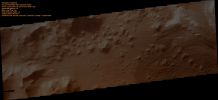
Ganges_Chasma-PIA13279.jpgFeatures of Ganges Chasma (Natural Colors; credits: Dr Paolo C. Fienga - Lunexit Team)55 visitenessun commentoMareKromium
|
|

PSP_002946_1765_RED_abrowse-00.jpgInterior Layered Deposits (ILD) in Juventae Chasma (CTX Frame - Natural Colors; credits for the additonal process. and color.: Dr Paolo C. Fienga - Lunexit Team)55 visiteThis observation shows a portion of some Interior Layered Deposits (ILD) in Juventae Chasma.
Juventae Chasma is a large depression near the Equatorial Canyon System known as Valles Marineris. The scene is along the top of a Mound of Layered Deposits on the Floor of Juventae Chasma.
Dunes are seen in the low-lying, darker regions. Very fine Layers are also visible. Understanding what kinds of materials formed the Layers, how they were set in place, and how they have evolved will provide insight into Martian Geologic History.
Many of the Martian Chasmata (----> plural of Chasma) contain ILD like these. The ILD were deposited a long time ago, but the actual method is unknown. It has been suggested that sedimentary layers in standing bodies of water or volcanic ash deposits comprise the ILD. The alternating layers could indicate regular, repeating cycles of deposition. It is also possible that these layers once covered the entire chasma floor.
The IDL shown here have been modified by wind erosion.
The Yardangs visible near the top right of the full image are evidence for wind sculpting of the Deposits. It is interesting to note that there are very few craters in this scene, especially in the areas with visible Layers.
One crater can be found about half-way down the left side of the image amidst Layers and several craters are seen in the dark material on the right side of the image. This suggests that the ILD are eroding here fast enough to erase small craters before large numbers of them can accumulate.MareKromium
|
|
| 25353 immagini su 2113 pagina(e) |
 |
|
|
|
|
1836 | |
|
|
|
|





