| |
| Piú viste |

PSP_009087_2550_RED-PCF-LXTT.jpgUnnamed Crater with Dunefield in Vastitas Borealis (Absolute Natural Colors; credits for the additional process. and color: Dr Paolo C. Fienga - Lunexit Team)55 visiteThis North Polar Dunefield is bounded by a small Unnamed Crater about 11 Km in diameter in the Vastitas Borealis Region. This crater captured deposits of basaltic sand that may have been transported from the North Polar Erg, a massive sea of sand that surrounds the Martian North Pole.
This Region experiences a variety of winds that blow from various directions during different seasons and times of day, and the winds are also affected by the topography of the crater itself. This influences the movement of sand within the crater and the dunes that they shape.
This image shows many transitioning dunes which indicate changes of wind direction. The wind direction can be inferred from the location of the steeper side of the dune (called the slip-face) which is downwind of the dominant wind direction. The barchans and barchanoid dunes form crescent shapes and are consistent with dominant winds from the South-West.
Towards the center of the Dunefield, the barchans transition from crescent shapes into irregular, more elongated dunes and merge.
The more northern part of the Dunefield consists of longitudinal dunes which extend from the horns of the modified barchans residing in its central part.
These longitudinal dunes form along the trend of southerly-southeasterly winds.
Because it is early Summer, solar radiation has heated the sand and there are only a few small patches of frost remaining on the dunes at this season. However, evidence of the arctic climate is visible in the polygons surrounding the dune field.
The polygons, like those found at the Phoenix Mission Landing Site, are produced by freeze-thaw cycles as the polar soil expands and contracts. MareKromium
|
|

SOL0003-ML0000034000E1_DXXX-0003ML0000039000E1_DXXX-GB-LXTT-2.jpgGale's Horizon, part II - Sol 3 (an Image Mosaic in RAW Natural Colors; credits for the additional process. and color.: Dr Gianluigi Barca - Lunar Explorer Italia/Italian Planetary Foundation)55 visitenessun commentoMareKromium
|
|

SOL0003-ML0000010000E1_DXXX-0003ML0000016000E1_DXXX-GB-LXTT-1.jpgGale's Horizon, part I - Sol 3 (an Image Mosaic in RAW Natural Colors; credits for the additional process. and color.: Dr Gianluigi Barca - Lunar Explorer Italia/Italian Planetary Foundation)55 visitenessun commentoMareKromium
|
|

Nereidum_Montes-Dunefield-ESP_029608_1390-PCF-LXTT-IPF-2.jpgDunefield in Nereidum Nontes (EDM - Absolute Natural Colors; credits for the additional process. and color.: Dr Paolo C. Fienga/Lunar Explorer Italia/IPF)55 visiteMars Local Time: 15:43 (Middle Afternoon)
Coord. (centered): 40,495° North Lat. and 309,939° East Long.
Spacecraft altitude: 254,8 Km (such as about 159,3 miles)
Original image scale range: 25,5 cm/pixel (with 1 x 1 binning) so objects ~ 76 cm across are resolved
Map projected scale: 25 cm/pixel
Map projection: EQUIRECTANGULAR
Emission Angle: 1,0°
Phase Angle: 57,3°
Solar Incidence Angle: 56° (meaning that the Sun was about 34° above the Local Horizon at the time the picture was taken)
Solar Longitude: 209,9° (Northern Autumn - Southern Spring)
Credits: NASA/JPL/University of Arizona
Additional process. and coloring: Lunar Explorer ItaliaMareKromium
|
|
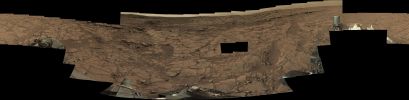
SOL0137-4-GB-LXTT-IPF.jpgLooking at Yellowknife Bay - Sol 127 (an Image-Mosaic in Calibrated Natural Colors; credits for the additional process. and color.: Dr Gianluigi Barca/Lunar Explorer Italia/Italian Planetary Foundation)55 visitenessun commentoMareKromium
|
|

Titan-Fensal_and_Aztlan-PIA07732-PCF-LXTT-IPF-1.jpgFensal (EDM - Absolute Natural Colors; credits for the additional process. and color.: Dr Paolo C. Fienga/Lunar Explorer Italia/Italian Planetary Foundation)55 visiteDuring its September 7, 2005, Fly-By of the Saturnian moon Titan, the NASA - Cassini Spacecraft acquired a series of images of a Territory located on the moon's Saturn-facing Hemisphere that were afterwards assembled so to create this small mosaic: once known only as "The H" (because this whole Region looks something like the letter "H", when oriented on its side), the Surface Features visible here now possess provisional names that were assigned to them by the International Astronomical Union (or "IAU", for short).
The Northern Branch of "The H" (shown in this EDM) is now called "Fensal," while the Southern Branch is known as "Aztlan."
Fensal is littered with small "Island-like Landforms" ranging in size from about 5 to 40 Km (such as from approx. 3,1 to a little less than 25 miles) across. These Landforms currently are thought to be Water-Ice Upland Areas (---> kind of small Hills), surrounded by shallower Terrain that is filled-in with dark Particulate Material probably precipitated from the Lower Atmosphere of Titan. In Western Fensal, a few larger Islands can also be seen, like Bazaruto Facula (visible in the upper right corner here and containing what seems to be an Impact Crater or, maybe, a Volcainc Edifice). When viewed in images of Shangri-La (another Titanian Region located on the opposite side of Titan as to Fensal and Aztlan), the Island-like Landforms of this size tend to occur in "clusters" (---> groups) with an apparent so-called "Preferred Orientation" (perhaps due to the action of the Dominant Winds blowing over those Territories). The small Islands found in Fensal, instead, appear much more scattered (and most of them appear roughly circular), although a few Islands do have (show) an East-West orientation to their long axis.
The mosaic is centered at 7° North Latitude and 21° West Longitude on Titan and the frames composing it were taken by the NASA - Cassini Spacecraft Narrow-Angle Camera using a filter sensitive to Wavelengths of Near-InfrarRed Light centered at 938 nanometers. They were acquired at distances ranging from approximately 200.600 to 191.800 Km (such as from about 124.572 to 119.108 miles) from Titan. The Mean Resolution in the images forming the mosaic is about 2 Km (such as 1,242 miles) per pixel.
This picture (which has been cropped from an Original NASA - Cassini Spacecraft b/w image-mosaic published on the NASA - Planetary Photojournal and identified by the n. PIA 07732) has been additionally processed, magnified, contrast enhanced and then colorized, according to an educated guess carried out by Dr Paolo C. Fienga (LXTT-IPF), in Absolute Natural Colors (such as the colors that a human eye would actually perceive if someone were onboard the NASA - Cassini Spacecraft and then looked outside, towards the Saturnian moon Titan), by using an original technique created - and, in time, dramatically improved - by the Lunar Explorer Italia Team. Different colors, as well as different shades of the same color, mean, among others, the existence of different Elements present in the Atmosphere and on the Surface of Titan, each having a different Albedo (---> Reflectivity) and Chemical Composition.
Note: it is possible (but we, as IPF, have no way to be one-hundred-percent sure of such a circumstance), that the actual luminosity of the Clouds and Hazes (as well as the luminosity of the Surface of Titan itself), as seen in this mosaic, would appear, to an average human eye, way lower than it has been shown (or, better yet: interpreted) here.MareKromium
|
|

ZZ-Mercury-Craters-Damer_Crater-PIA17812-PCF-LXTT-IPF.jpgThe Walls of Damer (Absolute Natural Colors; credits for the additional process. and color. Dr Paolo C. Fienga/Lunar Explorer Italia/Italian Planetary Foundation)55 visiteThe (relatively) steep Walls of the Impact Crater named Damer are well highlighted in today's APOD. Named after the English sculptor, Anne Seymour Damer (née Conway, she was born in Sevenoaks - UK - on November, 8, 1749 and died in London on May, 28, 1828) earlier this year by the International Astronomical Union (or "IAU", for short), this approx. 60-Km diameter (such as about 37,26 miles) Impact Crater is distinguished by a massive and complex Central Peak that is almost completely covered with Hollows.
Date acquired: November, 13th, 2013
Images Mission Elapsed Time (MET): 26687033
Images ID: 5191249
Instrument: Narrow Angle Camera (NAC) of the Mercury Dual Imaging System (MDIS)
Center Latitude: 36,25° North
Center Longitude: 243,40° East
Solar Incidence Angle: 68,3° (meaning that the Sun, at the time that the picture was taken, was about 21,7° above the imaged Local Mercurian Horizon)
Emission Angle: 3,0°
Sun-Mercury-Messenger (or "Phase") Angle: 65,3°
This frame (which is an Original NASA - MESSENGER Spacecraft's b/w and NON Map-Projected image-mosaic published on the NASA - Planetary Photojournal with the ID n. PIA 17812) has been additionally processed, contrast enhanced, magnified to aid the visibility of the details, Gamma corrected and then colorized in Absolute Natural Colors (such as the colors that a human eye would actually perceive if someone were onboard the NASA - MESSENGER Spacecraft and then looked down, towards the Western Edge of the Mercurian Impact Crater "Damer"), by using an original technique created - and, in time, dramatically improved - by the Lunar Explorer Italia Team. Different colors, as well as different shades of the same color, mean, among other things, the existence of different Elements (Minerals) present on the Surface of Mercury, each having a different Albedo (---> Reflectivity) and Chemical Composition.MareKromium
|
|

ZZ-Mercury-Craters-Wang_Meng_Crater-PIA17239-PCF-LXTT-IPF-01.jpgWang Meng Crater, in detail (Possible Absolute Natural Colors; credits for the additional process. and color.: Dr Paolo C. Fienga/Lunar Explorer Italia/Italian Planetary Foundation)55 visiteThe large Wang Meng Impact Basin (whose diameter is approx. 165 Km - such as about 102,465 miles) can clearly be see in this Extra Detail Magnification which is a crop taken mosaic made out of three frames obtained by the NASA - MESSENGER Spacecraft on April, 20, 2013. This Absolute Natural Color view of the Impact Basin shows us, among many other extremely interesting things, the strong contrast between the dark Low Reflectance Material (or "LRM", for short) which is located on the Eastern Portion of Wang Meng's Peak Ring and the brighter Western Portion of the Peak Ring itself, as well as the bright white Rays that spread across the lower right side (---> West) of the picture.
While some of the Hollows existing on and near the Crater's Peak Ring and Outer Rim are, somehow, "associated" (here and there, and always unevenly) with Low Reflectance Material, as evidenced by their bright white halos, the Rays that are visible here (---> such as towards the Western and South/Western sides of the frame) are, in fact, coming from other Impact Craters located in Wang Meng's proximities - including the small, fresh Impact Crater visible towards the upper right corner of the picture, just in betwenn the Peak Ring and the Outer Rim of Wang Meng.
Date acquired: April, 20th, 2013
Images Mission Elapsed Time (MET): 8743264, 8743256, 8743260
Images ID: 3915336, 3915334, 3915335
Instrument: Wide Angle Camera (WAC) of the Mercury Dual Imaging System (MDIS)
Center Latitude: 6,33° North
Center Longitude: 254,10° East
Solar Incidence Angle: 41,6° (meaning that the Sun, at the time that the pictures were taken, was about 48,4° above the imaged Local Mercurian Horizon)
Emission Angle: 0,2°
Sun-Mercury-Messenger (or "Phase") Angle: 41,7°
This frame (which is a crop taken from an Original NASA - MESSENGER Spacecraft's false colors and Map-Projected image-mosaic published on the NASA - Planetary Photojournal with the ID n. PIA 17239) has been additionally processed, contrast enhanced, magnified to aid the visibility of the details, Gamma corrected and then re-colorized in Absolute Natural Colors (such as the colors that a human eye would actually perceive if someone were onboard the NASA - MESSENGER Spacecraft and then looked down, towards the Mercurian Impact Crater "Wang Meng"), by using an original technique created - and, in time, dramatically improved - by the Lunar Explorer Italia Team. Different colors, as well as different shades of the same color, mean, among other things, the existence of different Elements (Minerals) present on the Surface of Mercury, each having a different Albedo (---> Reflectivity) and Chemical Composition.MareKromium
|
|

ZZ-Mercury-Rupes-Terror_Rupes-PIA17881-PCF-LXTT-IPF-00.jpgTerror Rupes (CTX Frame - Absolute Natural Colors; credits for the additional process. and color.: Dr Paolo C. Fienga/Lunar Explorer Italia/Italian Planetary Foundation)55 visiteThis is certainly not the first time that we can take a look at the Limb of Mercury and, just as usual, we have to underline that these kind of images never fail to showcase the Geological Diversities of the Innermost Planet of the Solar System. This time, something fills the scene with "terror" and that is, to be clear and precise, the "Terror Rupes", such as the long, Cliff-like Landform visible almost at (better yet to say "near"...) the center of the scene. Terror Rupes is one of Mercury's most prominent Lobate Scarps, and it was so named after the HMS (---> Her Majesty's Ship) Terror: an eighteenth-century warship that, later, participated in Scientific Polar Explorations.
Date acquired: February, 4th, 2012
Image Mission Elapsed Time (MET): 236853865
Image ID: 1353252
Instrument: Wide Angle Camera (WAC) of the Mercury Dual Imaging System (MDIS)
Center Latitude: 69,30° South
Center Longitude: 96,00° East
Solar Incidence Angle: 80,3° (meaning that the Sun, at the time that the picture was taken, was about 9,7° above the imaged Local Mercurian Horizon)
Emission Angle: 50,9°
Sun-Mercury-Messenger (or "Phase") Angle: 114,5°
This picture (which is an Original NASA - MESSENGER Spacecraft's b/w and NON-Map-Projected image published on the NASA - Planetary Photojournal with the ID n. PIA 17881) has been additionally processed, contrast enhanced, Gamma corrected, magnified to aid the visibility of the details and then colorized in Absolute Natural Colors (such as the colors that a human eye would actually perceive if someone were onboard the NASA - MESSENGER Spacecraft and then looked outside, towards the Southern Limb of Mercury), by using an original technique created - and, in time, dramatically improved - by the Lunar Explorer Italia Team. Different colors, as well as different shades of the same color, mean, among other things, the existence of different Elements (Minerals) present on the Surface of Mercury, each having a different Albedo (---> Reflectivity) and Chemical Composition.MareKromium
|
|

SATURN.jpgSaturn54 visitenessun commento
|
|

PIA05406-Clouds.jpgSaturn's swirls and clouds from approx. 22.000.000 Km54 visitenessun commento
|
|

PIA05076-Color Rings.jpgThe Rings of Saturn in ultraviolet (detail)54 visitevedi il commento al frame che precede
|
|
| 25353 immagini su 2113 pagina(e) |
 |
|
|
|
|
1832 | |
|
|
|
|
|
|





