| Piú viste |

PSP_001970_1655_RED_abrowse.jpgLandslide in Coprates Chasma (Natural Colors; credits for the additional process. and color.: Dr Paolo C. Fienga - Lunexit Team)55 visiteThis observation shows a Landslide in the Coprates Chasma Region of Valles Marineris that occurred when a large unstable area of rock broke away from the Cliffs that can be seen on the right side of the frame. This mass of falling rock broke into many small pieces as it slid downhill and came to rest at the base of the Cliff, forming the Lobate (curved) Mound visible on the left part of the image.
The smooth textured Ripples that can be seen in the central part of the frame are Sand Dunes. Sand Dunes form as wind-blown particles roll across the Surface and accumulate. Since the air on Mars is very thin, Sand Dunes take much longer to form on Mars than they do on Earth.
The presence of large Sand Dunes - along with many small Impact Craters - on top of this Landslide indicates that movement of the slide occurred a very long time ago; perhaps hundreds of millions of years.
This Landslide was probably caused by a strong Marsquake, but a nearby (significant) impact could have generated a deep shock-wave that was sufficiently strong to cause it. Alternatively, movement along nearby Faults may have triggered the Landslide.
The Valles Marineris Region is cut by many Faults and in fact contains many more Landslides such as this one. Some scientists believe that these Landslides represent a record of seismic activity in this area.
It is obvious that a better understanding of the history of seismic activity in this specific Region may help scientists to predict the likelihood that Marsquakes still occur on the Planet.MareKromium
|
|

PSP_001910_2215_RED_abrowse-00.jpgUnnamed Crater in Utopia Planitia (Natural Colors; credits for the additional process. and color.: Dr Paolo C. Fienga - Lunexit Team)55 visiteThis observation shows an Unnamed Impact Crater located in Utopia Planitia; this Crater is more than 10 Km (6,25 miles) in diameter and approx. 700 meters (765 yards) deep. Different features in and around this Crater may indicate the presence of fluid beneath the Surface.
Linear features radiating outward from the Crater's Rim are evident. Closer examination shows these features are formed by rocks and finer soils that are located along a straight line; technically, they are "Spokes" produced immediately after the impact by very fast outward-moving materials ejected from the contact-zone. Because these Ejecta came from deep under the Crater, their composition will tell us what type of rocks are under the Surface.
A MOC context image of this Crater shows its Ejecta Materials form an elevated "Pedestal," shaped like a pancake. The Pedestal is approx. 20 Km (about 12,5 miles) in diameter. "Pedestal craters" such as this may have formed because ice beneath the Surface melted when the impact occurred.MareKromium
|
|

ESP_018522_2270-7-EB-LXTT.jpgBull's Eye Impact Crater (RAW Natural Colors; credits for the additional process. and color.: Elisabetta Bonora - Lunexit Team)55 visiteWhat caused the Central Pit within this Impact Crater: unusual Subsurface Layering or a lucky second impact? Impacts into layers of alternately strong and weak material – for example, ice rich versus non-ice-rich – produce terracing such as that seen between the Inner Pit and the Outer Rim. Scientists have used Terraced Craters to estimate the thickness of Lava Flows on the Moon and elsewhere. Uneven Sublimation and Periglacial Erosion of exposed ice-rich material in the interior of the Crater may explain why the small Central Pit is slightly offset from center relative to the Terrace and Rim of the larger Crater.
The Pit in the center of the main feature could also be from a later Impact Crater striking inside and slightly off-center from the original. It has a Raised Rim, which is characteristic of impact craters and is difficult to explain with a layered target. While no ejecta from this later impact can be seen, the ejecta could have been removed by extensive periglacial modification.
Additionally the Floor Fill around the Inner Crater resembles impact ejects elsewhere at this latitude, and some of the "Landslides" to the East could be flow-back of ejecta off the Walls of the larger crater.
MareKromium
|
|
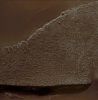
PSP_002892_1760_RED_abrowse-01.jpgLayered Deposits in Aureum Chaos (EDM - Absolute Natural Colors; credits: Dr Paolo C. Fienga - Lunexit Team)55 visitenessun commentoMareKromium
|
|
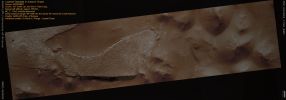
PSP_002892_1760_RED_abrowse-00.jpgLayered Deposits in Aureum Chaos (CTX Frame - Absolute Natural Colors; credits: Dr Paolo C. Fienga - Lunexit Team)55 visiteThis observation shows an Outcrop of a large slab of Layered Deposits in Aureum Chaos.
Chaotic Terrains on Mars are disorganized regions of Blocks and Large Mounds which appear to have been produced by the collapse of pre-existing terrain. They are often associated with giant Outflow Channels, and they may have been the source of the water that carved the Channels.
This link is an important part of understanding the history of water on Mars. One way to address this is to study the rocks left behind in the Chaotic Terrains.
The Outcrop shown in the following EDM is several kilometers across and light-toned. It has a slab-like appearance, with relatively steep edges and a flat top, although the top has many small Knobs and Spires. In places, particularly along the West edge of the main slab, it is clear that the light material is composed of many fine layers, which are eroding in a stepped fashion due to the variable resistance of the layers. The flat surface of the Outcrop is partially coated with Dark Dust, obscuring its light tone.
Along the edges, the Outcrop is breaking into boulders and eroding away, but it is strong enough that it preserves steep Slopes, particularly on the Eastern Edge.
Away from the large slab, the image consists of Hills and Mounds characteristic of Chaotic Terrain. Little detail is visible on the Mounds. The low areas have been partially covered by wind-blown Sand or Dust, forming the pervasive Ripples seen in the image. Light material can be seen under the Ripples in a few places, indicating that the light layered deposits extend farther than just the slab.MareKromium
|
|

Pandora-PIA12690.jpgPandora55 visiteCaption NASA:"The Cassini Spacecraft captured this close view of Saturn's moon Pandora during the Fly-By on June, 3, 2010.
Pandora is approx. 81 Km (a little mora than 50 miles) across and orbits beyond Saturn's thin F-Ring, which is shepherded by Pandora and Prometheus.
This view looks toward the Saturn-facing side Pandora. North on Pandora is up and rotated 20° to the left.
The image was taken in Visible Light with the Cassini Spacecraft narrow-angle camera. The view was obtained at a distance of approx. 101.000 Km (about 63.000 miles) from Pandora and at a Sun-Pandora-Spacecraft, or Phase, Angle of 28°.
Image scale is 603 meters (1980 feet) per pixel".MareKromium
|
|
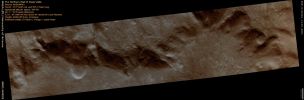
ESP_018492_2120_RED_abrowse-PCF-LXTT3.jpgThe Northern Wall of Kasei Valles (Natural Colors; credits for the additional process. and color.: Dr Paolo C. Fienga - Lunexit Team)55 visitenessun commentoMareKromium
|
|

SOL317-2N154515963EFF9400P0745R0M1.jpgBrown Landscape and missing data... - Sol 317 (Natural Colors; credits for the additional process. and color.: Dr Paolo C. Fienga - Lunexit Team)55 visitenessun commentoMareKromium
|
|

Rhea-EB-LXTT2.jpgLarge Crater and Crater Clusters (Absolute Natural Colors; credits for the additional process. and color.: Elisabetta Bonora and Paolo C. Fienga - Lunexit Team)55 visitenessun commentoMareKromium
|
|

Rhea-EB-LXTT.jpgCratered Terminator (Absolute Natural Colors; credits for the additional process. and color.: Elisabetta Bonora and Paolo C. Fienga - Lunexit Team)55 visitenessun commentoMareKromium
|
|

Saturnian_Sky-N00166739-47-EB-LXTT.jpgSaturnian Sky (Superdefinition - credits for the additional process.: Elisabetta Bonora - Lunexit Team)55 visitenessun commentoMareKromium
|
|

Northern_Dunes-PIA13797-1.jpgSeasonal Changes in a Dune of the North Polar Erg55 visiteThree images of the same location taken at different times on Mars show seasonal activity causing Sand Avalanches and Ripple changes on a Martian Dune. Time sequence of the images progresses from top to bottom. Each image covers an area of 285 meters (312 yards) by 140 meters (153 yards). The Crest of a Dune curves across the upper and left portions of the image.
The High Resolution Imaging Science Experiment (HiRISE) camera on NASA's Mars Reconnaissance Orbiter took these images. The site is at about 84° North Latitude and 233° East Longitude, in a vast Region of Dunes at the Edge of Mars' North Polar Ice Cap. The area is covered by Carbon-Dioxide (CO2) Ice in Winter but is Ice-free in Summer. The top and bottom images show part of one Dune about one Mars Year apart, at a time of the year when all the Seasonal Ice has disappeared: in late Spring of one year (top) and early Summer of the following year (bottom). The middle image is from the second year's mid-Spring, when the Region was still covered by Seasonal CO2 Ice.
Spring evaporation of the Seasonal Layer of Ice is manifested as Dark Streaks of fine particles carried to the top of the Ice Layer by escaping gas. The bottom of the Ice Layer, in contact with the Dark Ground, warms faster than the top of the Ice does in the Spring. Carbon-Dioxide gas produced by the thawing (----> disgelo) of the bottom Ice is temporarily trapped under the top Ice.
As the Ice evaporates from the bottom, flow of gas under the Ice destabilizes the Sand on the Dune, thus causing the Sand itself to avalanche down the Dune "Slipface".
A before-and-after comparison of the Dune shows new Alcoves and extension of the Debris Apron on the Slipface of the Dune caused by descending Grains of Sand. New Wind Ripples appear on the Debris Apron.
The top image is a portion of the HiRISE observation catalogued as PSP_008867_2640, taken on June 17, 2008.
The middle image is a portion of the HiRISE observation catalogued as ESP_016779_2640, taken on Feb. 23, 2010.
The bottom image is a portion of the HiRISE observation catalogued as ESP_018427_2640, taken on July 2, 2010.MareKromium
|
|
| 25353 immagini su 2113 pagina(e) |
 |
|
|
|
|
1824 | |
|
|
|
|





