| Piú viste |

Dione-PIA06626.jpgSaturnshine54 visiteCaption NASA originale:"This Cassini image shows the night side of Saturn's moon Dione, dimly lit by "Saturnshine": that is, reflected light from the planet lying off to the left in Cassini's field of view when this image was taken.
The image was taken in visible green light with the Cassini spacecraft narrow-angle camera on Feb. 18, 2005, at a distance of about 1,3 MKM (approx. 808.000 miles) from Dione and at a phase angle of 118°. The image scale is 8 Km (approx. 5 miles) per pixel".
|
|
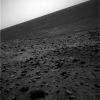
SOL453-2N166584374EFFA9BGP1795L0M1.jpgPanorama - Sol 453 (3)54 visitenessun commento
|
|
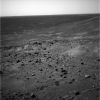
SOL453-2N166584713EFFA9BGP1795R0M1.jpgPanorama - Sol 453 (5)54 visitenessun commento
|
|
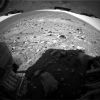
SOL453-2R166581683EFFA9BGP1313L0M1.jpgA little "flash" on the Martian surface? (1)54 visiteFra le possibili Anomalie di Superficie che abbiamo incontrato in questo anno di "passeggiate Marziane" ne esiste un tipo che, a nostro modo di vedere, pur non essendo (in sè) "eclatante" e pur risultando davvero difficile da scoprire ed ambigua da identificare, risulta tuttavia estremamente interessante da investigare.
Parliamo dei cosiddetti "small flashes" (o "lampetti") che, di tanto in tanto, sembrano illuminare piccole aree di Marte. Molti pensano che si possa trattare di semplici photographic artifact (i quali sono sicuramente "colpevoli" di svariati falsi allarmi).
Altri ritengono, invece, che questi flash sìano il prodotto del riflesso dei raggi del Sole su una superficie metallica o cristallina e tal'ultima ipotesi, in tutta sincerità, la riteniamo anche noi largamente condivisibile.
Ricorderete sicuramente la Silver Sphere (vedi la Sez. "Mars Spirit Anomalies & Maps") oppure il presunto Heat-Shield sul ciglio di Bonneville Crater.
|
|

SOL454-2R166675070EFFA9C2P1312L0M1.jpgPanorama - Sol 454 (5)54 visitenessun commento
|
|

SOL455-2N166771658EFFA9DWP0603L0M1.jpgHorizon - Sol 455 (2)54 visitenessun commento
|
|

Rhea-PIA06630.jpgRhea, from 1,8 MKM54 visiteCaption NASA originale:"The ancient and battered surface of Saturn's moon Rhea shows a notable dark swath of territory near the eastern limb in this image from Cassini.
This view shows principally the Saturn-facing hemisphere on Rhea (1.528 Km across). North is up and tilted 40° to the right.
The image was taken with the Cassini spacecraft narrow-angle camera on March 7, 2005, through a filter sensitive to wavelengths of ultraviolet light centered at 338 nnmts. The view was acquired at a distance of approx. 1,8 MKM (approx. 1,1 MMs) from Rhea and at a phase angle of 30°. Resolution in the original image was 10 Km per pixel.
The image has been contrast-enhanced and magnified by a factor of two to aid visibility".
|
|

Tethys-PIA06632.jpgTethys (infrared vision) from approx. 1,4 MKM54 visiteCaption NASA originale:"In this infrared view, Saturn's cratered moon Tethys shows a faint, dark band across its equatorial region. North is up in this view.
The image was taken with the Cassini spacecraft narrow-angle camera on March 11, 2005, through a filter sensitive to wavelengths of infrared light centered at 930 nnmts. The view was acquired at a distance of approximately 1,4 MKM from Tethys and at a phase angle of 80°. Resolution in the original image was 8 Km per pixel.
The image has been contrast-enhanced and magnified by a factor of two to aid visibility".
|
|

Titan-3-PIA06229.jpgTitan in three different wavelenghts: the strange Titan (3)54 visiteCaption NASA originale:"This false-color composite was created with images taken during the Cassini spacecraft's closest flyby of Titan on April 16, 2005.
It was created by combining 2 infrared images (taken at 938 and 889 nnmts) with a visible light image (taken at 420 nnmts). Green represents areas where Cassini is able to see down to the surface. Red represents areas high in Titan's stratosphere where atmospheric methane is absorbing sunlight. Blue along the moon's outer edge represents visible violet wavelengths at which the upper atmosphere and detached hazes are better seen.
A similar false-color image showing the opposite hemisphere of Titan was created from images taken during Cassini's first close flyby of the smoggy moon in October 2004 (see PIA06139). At that time, clouds could be seen near Titan's South Pole, but in these more recent observations no clouds are seen. North on Titan is up and tilted 30° to the right".
|
|

OPP-SOL446-1N167782661EFF55DIP1893R0M1.jpgAn unusual Side-Winder on Sol 446 (2)54 visiteOcchio Dx della NavCam di Opportunity, mentre guarda uno dei più interessanti rilievi disegnati dalla cresta di un Side-Winder.
Si tratta di una immagine necessaria se volete provare a crearVi uno "stereo-pair" con il Vostro pc.
|
|

SOL468-2P167913982ESFA9I4P2560R7M1.jpgParallel cracks on a flat rock (3)54 visiteIl filtro impiegato in questo terzo frame è il n. 7 (e cioè il filtro che 'esalta' i contrasti e spesso inganna gli occhi): le impressioni che avevamo ricavato dalle prime due immagini, comunque, non cambiano.
|
|
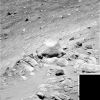
SOL472-2P168264761EFFA9I4P2564L3M1.jpgIs this a "rock"?!? (2)54 visiteImmagine ottenuta con il filtro/colore n. 3.
L'ombra anomala rimane in situ e la nostra sensazione è che si tratti di una 'cancellatura' fatta di proposito.
Cancellatura di cosa?
E se lo sapessimo...
|
|
| 25353 immagini su 2113 pagina(e) |
 |
|
|
|
|
1821 | |
|
|
|
|





