| Piú viste |

Japetus-N00026392.jpgJapetus' limb (from 58.000 Km)54 visiteDettaglio del bordo (limb) di Giapeto che evidenzia un "mare" di dimensioni piuttosto consistenti e quindi l'area attorno al terminatore, ricca di rilievi e di crateri da impatto i quali, grazie al gioco di luce ed ombra, acquisiscono profondità e dimensioni. Non è da escludere che l'area fortemente craterizzata visibile proprio sul terminatore (e su cui contiamo almeno 11 crateri di notevoli dimensioni e, almeno apparentemente, di età similare) sia il risultato di una serie di impatti sequenziali (una cometa andata in pezzi?) oppure - anche se appare meno probabile - una serie di impatti simultanei (meteor shower?).
|
|

Japetus-N00026332.jpgSurface features and "photographic artifacts" on Japetus54 visiteUn esempio (anzi: un campionario) di "artefatti fotografici", ossia di "imperfezioni" dell'immagine le quali suggeriscono la presenza di luci ed oggetti nelle prossimità di Giapeto i quali, invece, non esistono. Considerate questo frame in correlazione con il frame ANOMALY - Streak of light, per poter cogliere le sostanziali diversità fra i "tipi" di tracce" lasciate sui due frames.
|
|

Japetus-N00026442.jpgJapetus from about 108.000 Km54 visitenessun commento
|
|

SOL351-2R157532301EFFA269P1314R0M1.jpgRear view from Spirit on Sol 35154 visiteLe ruote del Rover Spirit disegnano rette, curve e, in generale, profondi solchi sulla superficie di Marte. L'idea, nata già diversi mesi orsono (guardando queste immagini), che tutto il suolo Marziano sia "umido", ne esce ogni giorno rafforzata. Ma il Centro Controllo Missione continua - forse agendo saggiamente e forse no - a tacere ed a riempirci gli occhi con tantissime immagini spettacolari ed enigmatiche; con qualche informazione tecnica sostanzialmente priva di valore (o di valore scarsissimo) ed infine, last but not least, con le "facce sorridenti" dei membri del Mars Rovers Team, i quali sono sempre contenti e sempre entusiasti, come bambini ai quali sia stato regalato un giocattolo nuovo... Scusateci la ripetitività, ma questo "corso" che la NASA ha preso a noi sembra davvero subdolo e periglioso, nonostante le sue "rassicuranti" apparenze...
|
|

Rhea-PIA06555_modest.jpgRhea's craters54 visiteCaption NASA originale: "The sunlight angle in this sharp view of Saturn's second-largest moon, Rhea, highlights the moon's crater-strewn surface. Cassini will fly past Rhea on Nov. 26, 2005, at a distance of only 500 Km (such as 311 miles) and will obtain very high resolution images at that time. Rhea's diameter is 1.528 Km(or 949 miles).
This view shows mainly the hemisphere of Rhea that faces away from Saturn. The image was taken in visible light with the Cassini spacecraft narrow angle camera on Nov. 1, 2004, at a distance of 1,6 MKM (or 994.000 miles) from Rhea and at a Sun-Rhea-spacecraft, or phase, angle of 102°. North is up. The image scale is about 10 Km (6 miles) per pixel. The image has been slightly contrast enhanced to aid visibility of surface features.
|
|

OPP-SOL340-1N158367146EFF40CUP1911R0M1.jpgPanorama on Sol 340: around the man-made impact crater54 visitenessun commento
|
|

OPP-SOL340-1N158367309EFF40CUP1911R0M1.jpgPanorama on Sol 340: around the man-made impact crater54 visitenessun commento
|
|

OPP-SOL340-1N158367588EFF40CUP1911R0M1.jpgPanorama on Sol 340: around the man-made impact crater54 visiteDa notare, in questo frame molto bello e ad elevata definizione, un rottame a forma tubolare - di colore argenteo e visibile quasi al centro dell'immagine - il quale ci ricorda un'Anomalia di superficie che avevamo incontrato nell'area Gusaev Crater, durante il viaggio di Spirit verso il Bonneville Crater. Si tratta in entrambi i casi di un "rottame"? In questo frangente - ossìa per Opportunity - diremmo di si: le circostanze (in particolare quelle relazionate al luogo di riptrovamento), sono quasi univocamente a favore del "rottame"; ma nel caso di Spirit...I due oggetti argentei si assomigliano - e questo è un fatto - ma Spirit, quando si è imbattuto nell'Anomalia di superficie, era - a quanto ci è dato vedere e valutare (mappe NASA alla mano) - ancora piuttosto lontano (anzi: molto lontano) dal luogo di impatto dell'Heat-Shield.
Dunque? Dunque si tratta di un altro piccolo mistero per il quale le informazioni NASA non ci forniscono alcun aiuto (anzi...).
|
|

OPP-SOL340-1N158368088EFF40CUP1911R0M1.jpgPanorama on Sol 340: around the man-made impact crater54 visitenessun commento
|
|

OPP-SOL340-1P158369122EFF40CUP2583L7M1.jpgClose view of the Heat-Shield (2)54 visitevedi commento al frame precedente
|
|
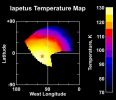
Japetus-temp.2-PIA07005_modest.jpgJapetus Temperature Map54 visiteCaption NASA originale:"Temperatures reach nearly 130 Kelvin (-226 F) at noon on the equator on the dark material that covers most of this side of Japetus, making high noon on Japetus's dark side probably the warmest place in the Saturn System. This is much warmer than temperatures on the moon Phoebe - as measured by the composite infrared spectrometer in June 2004 - which peaked near 112 Kelvin (-258 F). That's because, although Phoebe is almost as dark as Japetus's dark material and absorbs nearly as much sunlight, Phoebe rotates much more quickly (once every 9 hours, compared to 79 days for Japetus). That means the surface has less time to heat up during the day. Temperatures on Japetus' bright material are much colder, peaking near 100 Kelvin (-280 F), both because the bright material absorbs less sunlight and because it is further from the equator on this side of Japetus".
|
|
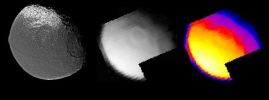
Japetus-temp.3-PIA07004_modest.jpgJapetus Thermal Radiation Image54 visiteCaption NASA originale:"This image of the infrared heat radiation from Saturn's moon Japetus was obtained by the Cassini composite infrared spectrometer instrument 16 hours before Cassini's closest approach to this mysterious moon, on December 31, 2004. The thermal radiation is shown as both a grayscale image, equivalent to what we would see if our eyes were sensitive to infrared wavelengths near 15 microns and as a color-coded temperature map. A previously-released mosaic obtained by Cassini's imaging camera shortly before the composite infrared spectrometer observation, with similar scale and orientation, is also shown for comparison. Temperatures in the large crater near the center of the disc are slightly different from those in surrounding areas, because sloping surfaces within the crater are warmer where they are tilted towards the Sun and cooler when tilted away from the Sun".
|
|
| 25353 immagini su 2113 pagina(e) |
 |
|
|
|
|
1820 | |
|
|
|
|





