| Piú viste |

Dione-EB-4311210639_db673f3300_b.jpgA Beautiful "Slice" of Dione (by Elisabetta Bonora - Lunexit Team)55 visitenessun commentoMareKromium
|
|

Prometheus_and_Friends-EB.gifSingle Tone (GIF-Movie; credits: Elisabetta Bonora - Lunexit Team)55 visitenessun commentoMareKromium
|
|

PSP_001370_2505_RED_abrowse.jpgIce Patch or Frozen Lake? (Natural Colors; credits: Dr Paolo C. Fienga - Lunexit Team)55 visitenessun commentoMareKromium
|
|
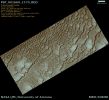
PSP_001660_2570_RED_abrowse.jpgFrost-covered Dunes (Natural Colors; credits: Dr Paolo C. Fienga - Lunexit Team)55 visiteThis image shows Dunes on the Northern Plains of Mars, and appears similar to images taken when the Surface was covered by Frost.
However, CRISM spectra taken at the same time do not show evidence for either water or CO2 frost here. Possibly, and consistent with the CRISM spectra, this area is covered by Dust, obscuring the dark material that is typically present in Dunes of this type.
The orientation of the Dunes indicates that they were formed by winds blowing generally from upper right to lower left. Ripples on the Dunes show that the wind patterns that formed them are more complex, with the dune shapes affecting the wind direction.
It is not known whether these Dunes are currently active (such as if thy're being moved by wind still today) or have been in this location for a very long time; however, if they are indeed covered by Dust, the they cannot have been recently active.
Between the Dunes, the underlying Surface of the Northern Plains can be seen. In places, it has been fractured into polygonal blocks, suggesting that water ice is or was present below the Surface. Meter-size blocks are also seen in places in this image and elsewhere on the Northern Plains.
The origin of these blocks is not known, but they may be remnants of erosion of material that once covered this Region.MareKromium
|
|

Pluto-421596main_s1006ay-1.jpgSurface Color-Variations on Pluto55 visiteSince its discovery in 1930, Pluto has been a speck of light in the largest ground-based telescopes. But NASA's Hubble Space Telescope has now mapped the Dwarf Planet in never-before-seen detail. The new map is so good, astronomers have even been able to detect changes on the Dwarf Planet's Surface by comparing Hubble images taken in 1994 with the newer images taken in 2002-2003. The task is as challenging as trying to see the markings on a soccer ball 40 miles away.
Hubble's view isn't sharp enough to see craters or mountains, if they exist on the surface, but Hubble reveals a complex-looking and variegated world with white, dark-orange, and charcoal-black terrain. The overall color is believed to be a result of UltraViolet radiation from the distant Sun breaking up Methane that is present on Pluto's Surface, leaving behind a dark, molasses-colored, carbon-rich residue.
Astronomers were very surprised to see that Pluto's brightness has changed — the Northern Pole is brighter and the Southern Hemisphere is darker and redder. Summer is approaching Pluto's North Pole, and this may cause surface ices to melt and refreeze in the colder shadowed portion of the Planet. The Hubble pictures underscore that Pluto is not simply a ball of ice and rock but a dynamic world that undergoes dramatic atmospheric changes.MareKromium
|
|

Pluto-421596main_s1006ay-2.jpgSurface Color-Variations on Pluto55 visiteNASA today released the most detailed set of images ever taken of the distant dwarf planet Pluto. The images taken by NASA's Hubble Space Telescope show an icy and dark molasses-colored, mottled world that is undergoing seasonal changes in its surface color and brightness. Pluto has become significantly redder, while its illuminated Northern Hemisphere is getting brighter. These changes are most likely consequences of surface ices sublimating on the sunlit Pole and then refreezing on the other Pole as the dwarf planet heads into the next phase of its 248-year-long seasonal cycle. The dramatic change in color apparently took place in a two-year period, from 2000 to 2002.
The Hubble images will remain our sharpest view of Pluto until NASA's New Horizons probe is within 6 months of its Pluto flyby. The Hubble pictures are proving invaluable for picking out the planet's most interesting-looking hemisphere for the New Horizons spacecraft to swoop over when it flies by Pluto in 2015.
Though Pluto is arguably one of the public's favorite planetary objects, it is also the hardest of which to get a detailed portrait because the world is small and very far away. Hubble resolves surface variations a few hundred miles across, which are too coarse for understanding Surface Geology. But in terms of surface color and brightness Hubble reveals a complex-looking and variegated world with white, dark-orange, and charcoal-black terrain. The overall color is believed to be a result of UltraViolet radiation from the distant Sun breaking up Methane that is present on Pluto's Surface, leaving behind a dark and red carbon-rich residue.
When Hubble pictures taken in 1994 are compared with a new set of images taken in 2002 to 2003, astronomers see evidence that the northern polar region has gotten brighter, while the southern hemisphere has gotten darker. These changes hint at very complex processes affecting the visible surface, and the new data will be used in continued research.
The images are allowing planetary astronomers to better interpret more than three decades of Pluto observations from other telescopes, says principal investigator Marc Buie of the Southwest Research Institute in Boulder, Colo. "The Hubble observations are the key to tying together these other diverse constraints on Pluto and showing how it all makes sense by providing a context based on weather and seasonal changes, which opens other new lines of investigation."
The Hubble pictures underscore that Pluto is not simply a ball of ice and rock but a dynamic world that undergoes dramatic atmospheric changes. These are driven by seasonal changes that are as much propelled by the Planet's 248-year elliptical orbit as its axial tilt, unlike Earth where the tilt alone drives seasons. The seasons are very asymmetric because of Pluto's elliptical orbit. Spring transitions to Polar Summer quickly in the Northern Hemisphere because Pluto is moving faster along its orbit when it is closer to the Sun.
Ground-based observations, taken in 1988 and 2002, show that the mass of the atmosphere doubled over that time. This may be due to warming and sublimating Nitrogen ice. The new Hubble images from 2002 to 2003 are giving astronomers essential clues about how the seasons on Pluto work and about the fate of its atmosphere.
The images, taken by the Advanced Camera for Surveys, are invaluable to planning the details of the New Horizons flyby in 2015. New Horizons will pass by Pluto so quickly that only one hemisphere will be photographed in the highest possible detail. Particularly noticeable in the Hubble image is a bright spot that has been independently noted to be unusually rich in carbon monoxide frost. It is a prime target for New Horizons. "Everybody is puzzled by this feature," says Buie. New Horizons will get an excellent look at the boundary between this bright feature and a nearby region covered in pitch-black surface material.
"The Hubble images will also help New Horizons scientists better calculate the exposure time for each Pluto snapshot, which is important for taking the most detailed pictures possible," says Buie. With no chance for re-exposures, accurate models for the surface of Pluto are essential in preventing pictures that are either under- or overexposed.
The Hubble images are a few pixels wide. But through a technique called dithering, multiple, slightly offset pictures can be combined through computer-image processing to synthesize a higher-resolution view than could be seen in a single exposure. "This has taken four years and 20 computers operating continuously and simultaneously to accomplish," says Buie, who developed special algorithms to sharpen the Hubble data.
The Hubble research results appear in the March 2010 issue of the Astronomical Journal. Buie's science team members are William Grundy of Lowell Observatory in Flagstaff, Ariz., and Eliot Young, Leslie Young, and Alan Stern of Southwest Research Institute in Boulder, Colo.
Buie plans to use Hubble's new Wide Field Camera 3 to make further Pluto observations prior to the arrival of New Horizons.MareKromium
|
|

FIGURA_26.jpgStaff Personnel on board Santa Rita 155 visiteUna bellissima e tranquilla immagine che ci ricorda una semplice, ma mai realmente appresa, Lezione di Vita: quando si lavora in Pace, costruttivamente e con un Obbiettivo Comune, la Cultura ed il Colore della Pelle non contano veramente nulla. Mai.MareKromium
|
|

FIGURA_23.jpgThey seemed close, but they were Not!55 visiteIn questa bellissima e solare istantanea, un'immagine "Di Gruppo" delle piattaforme San Marco (a Sx) e Santa Rita (Dx).
Ebbene, notate che anche se le due piattaforme appaiono vicine, in realtà distano circa 1 miglio l'una dall'altra!
MareKromium
|
|

FIGURA_29.jpgSegment of the Land Portion of the "Broglio Space Center", in 200355 visitenessun commentoMareKromium
|
|

FIGURA_28.jpgThe Scout's Rocket Assembly-line55 visiteAssemblaggio di un missile Scout all'interno dell'hangar, sulla piattaforma San Marco; Broglio avrebbe voluto proseguire il suo programma con una versione tutta italiana del vettore, capace di portare 500 Kg di payload in orbita bassa, ma il progetto venne messo da parte in favore dell’ESA. Nostra opinione? Pessima idea, pessimo affare.
MareKromium
|
|

FIGURA_27.jpgInside Santa Rita 155 visitenessun commentoMareKromium
|
|

The_Rings-ERing-EB.jpgLuminescence in the E-Ring (by Elisabetta Bonora - Lunexit Team)55 visite...una Visione suggestiva e bellissima...MareKromium
|
|
| 25353 immagini su 2113 pagina(e) |
 |
|
|
|
|
1813 | |
|
|
|
|





