| Piú viste |
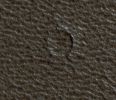
PSP_001406_2680_red-01.jpgLonely and (almost) buried crater in the North Polar "Permanent Cap" (EDM - Natural Colors; credits: Dr Paolo C. Fienga - Lunexit Team)55 visitenessun commentoMareKromium
|
|

PSP_001406_2680_red-00.jpgLonely and (almost) buried crater in the North Polar "Permanent Cap" (CTX Frame - Natural Colors; credits: Dr Paolo C. Fienga - Lunexit Team)55 visitenessun commentoMareKromium
|
|

Titan_and_Tethys-N00147394-96-EB-LXTT.jpgSaturnian Gems: Titan and Tethys (Natural Colors; credits: Elisabetta Bonora - Lunexit Team)55 visitenessun commentoMareKromium
|
|
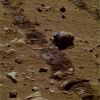
SOL203-PanCamA-LXTT.jpgBlueish Reflections in the Tracks - Sol 203 (Natural Colors; credits: Elisabetta Bonora - Lunexit Team)55 visitenessun commentoMareKromium
|
|

ZW-Mercury-PIA12397.jpgMercury55 visiteToday (December, 15th, 2009), the first High-Resolution Global Map of Mercury was made publicly available. Members of the MESSENGER team and experts from the U. S. Geological Survey (USGS) used images from MESSENGER's three Mercury flybys and from the Mariner 10 Mission in 1974-75 to create a Global Mosaic that covers 97,7% of Mercury's Surface at a resolution of 500 meters/pixel (0,31 miles/pixel).
The above image shows the full global Mercury mosaic but at a greatly reduced scale of only 5% of the HR version. The full HR mosaic by can be seen at the USGS Map-a-Planet website.
Date Mercury Fly-By 1: January 14, 2008
Date of Mercury Fly-By 2: October 6, 2008
Date of Mercury Fly-By 3: September 29, 2009
Instrument: Narrow Angle Camera (NAC) of the Mercury Dual Imaging System (MDIS)
Scale: Mercury's diameter is approx. 4880 Km (such as about 3030 miles)MareKromium
|
|

Prometheus-091227-N00148969-EB.jpgPrometheus adrift... (possible Natural Colors; credits: Elisabetta Bonora - Lunexit Team)55 visiteNulla di artefatto o manipolato digitalmente, in questo frame prodotto dalla nostra Elisabetta Bonora!
La colorazione rosacea di Prometheus, infatti, potrebbe e dovrebbe dipendere, a nostro modo di vedere, dal Saturnshine (o "Chiaro di Saturno").
E non è neppure inutile rammentare che Prometheus non è la sola Luna Saturniana ad avere un colore simile!
Esso, infatti, forma uno splendido "Space Duo" con Hyperion la cui Superficie, sempre secondo la NASA (e ad eccezione di quanto contenuto nei bizzarri crateri che lo ricoprono quasi per intero), sarebbe di color rosa pallido, con sfumature grigie e bianco/verdastre.MareKromium
|
|

FIGURA_03.JPGLifting-up of a "Scout" missile55 visiteSollevamento di un razzo "Scout" sulla rampa della piattaforma San Marco.MareKromium
|
|

FIGURA_07.JPGThe "San Marco - Broglio Space Center"55 visiteIngresso del Centro Spaziale San Marco, poi rinominato Luigi Broglio Space Center.MareKromium
|
|

FIGURA_06B.jpgThe "San Marco 3" Satellite55 visitenessun commentoMareKromium
|
|

Hestia_Rupes-PIA00469.jpgComplex Network of Narrow Fractures near Hestia Rupes Region (possible Natural Colors; credits: Dr Paolo C. Fienga - Lunexit Team)55 visiteThis is a Magellan radar image covering an about 105- Km (approx. 63-mile) by 45-Km (approx. 27-mile) Region near Hestia Rupes on the North-Western corner of Aphrodite Terra.
The complex network of narrow (such as <1 Km) Fractures in the center of the image extends for approx. 50 Km (about 31 miles). This network exhibits tributary-like branches similar to those observed in river systems on Earth. However, the angular intersections of the tributaries suggest tectonic control.
These features appear to be due to drainage of lava along preexisting fractures and subsequent collapse of the Surface. The underlying tectonic fabric can be observed in the North-East trending Ridges which predate the Plains.MareKromium
|
|
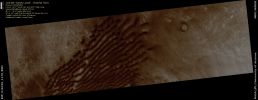
ESP_016036_1370_RED_abrowse-00.jpgDunes in Noachis Terra (CTX Frame - Natural Colors; credits: Dr Paolo C. Fienga - Lunexit Team)55 visiteDunes of sand-sized materials have been trapped on the floors of many Martian Craters.
This is one example, from an Unnamed Crater located in Noachis Terra, West of the giant Hellas Impact Basin.
The most extensive Linear Dunefields known in the Solar System are on Saturn's largest moon Titan.
But Titan, as to Mars, has a very different environment and composition and so, at a meter-scale resolution (not available yet, unfortunately) the Titanian Dunes should look (better yet: they certainly ARE) very different from the Martian ones.MareKromium
|
|

FIGURA_11.JPGThe interior of the Santa Rita Platform55 visitenessun commentoMareKromium
|
|
| 25353 immagini su 2113 pagina(e) |
 |
|
|
|
|
1810 | |
|
|
|
|





