| Piú viste |

SubsurfaceIce-PIA12218.jpgSubsurface Ice (Natural Colors; credits: Lunexit)55 visiteThis 6-meter-wide (20-foot-wide) Impact Crater located in Mid-Latitude Northern Mars was created by an impact that occurred between Jan. 22, 2008, and Sept. 15, 2008, as bracketed by before-and-after images (not shown here).
The images shown here were taken by the High Resolution Imaging Science Experiment camera on NASA's Mars Reconnaissance Orbiter on Oct. 29, 2008, (left) and on Jan. 4, 2009. Each image is about 35 meters (115 feet) across.
The crater's depth is estimated to be 1,76 meters (5,8 feet).
The impact that dug the Crater excavated water ice from beneath the Surface. It is the bright material visible in this pair of images. A change in appearance from the earlier image to the later one resulted from some of the ice sublimating away during the Northern-Hemisphere Summer, leaving behind dust that had been intermixed with the ice. The thickening layer of dust on top obscured some of the remaining ice.
This crater is at 45,05° North Latitude and 164,71° East Longitude.MareKromium
|
|
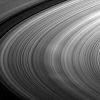
The_Rings-PIA11587.jpgSpokes on the B-Ring55 visiteCaption NASA:"Saturn's B-Ring shows off bright Spokes in the middle of this image taken at high phase.
This image was captured at a Phase Angle of 119°. To learn more about these ghostly radial markings, see PIA10567 and PIA11144.
This view looks toward the northern, sunlit side of the Rings from about 10° above the Ring-Plane. The image was taken in Visible Light with the Cassini Spacecraft narrow-angle camera on Aug. 20, 2009. The view was acquired at a distance of approx. 2,3 MKM (such as about 1,4 MMs) from Saturn.
Image scale is roughly 13 Km (about 8 miles) per pixel".MareKromium
|
|
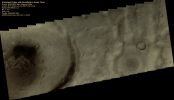
Craters-UnnamedCrater-Aonia_Terra-20091005a.jpgUnnamed Crater in Aonia Terra (False Colors; credits: Lunexit)55 visitenessun commentoMareKromium
|
|

ZZ-Mercury-Craters-Unnamed_Double-Ring_Basin.jpgDouble "Concentric" Basin on Mercury (Natural Colors; credits: Lunexit)55 visiteCaption NASA, da "NASA - Picture of the Day" del giorno 7 Ottobre 2009:"What created the internal second ring of this Double Ringed Basin on Mercury?
No one is sure.
The unusual feature spans approx. 160 Km and was imaged during the robotic MESSENGER Spacecraft's swing past our Solar System's innermost planet. Double and Multiple Ringed Basins, although rare, have also been imaged in years past on Mars, Venus, Earth and Earth's Moon.
Mercury itself has several doubles, including huge Caloris Basin, Rembrandt Basin and enigmatic Raditladi Basin. Most large circular features on planets and moons are caused initially by a forceful impact by a single asteroid or comet fragment. Since it is unlikely that a second impact would occur right in the center of the first, large double rings are usually attributed to a subsequent volcanic lava flow inside the impact crater.
Possibly, though, a second ring could be caused by the melting and flowing of material upon impact. One clue to the origin of the above-imaged double ring is that the basin center appears much smoother than the region between the rings. MESSENGER has now completed its last flyby of Mercury but will return and attempt to enter orbit in March 2011".MareKromium
|
|
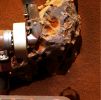
OPP-SOL2031-MF-LXT-ALLFILTERS-raw.jpgMetal v/s Metal - Sol 2031 (ALL Filters/RAW Natural Colors - credits: Dr M. Faccin)55 visitenessun commentoMareKromium
|
|
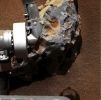
OPP-SOL2031-MF-LXT-ALLFILTERS-edited.jpgMetal v/s Metal - Sol 2031 (ALL Filters/Calibrated Natural Colors - credits: Dr M. Faccin & Lunexit)55 visitenessun commentoMareKromium
|
|

OPP-SOL937-1P211364839EFF75__P2629L5M1.jpgClear Horizon - Sol 937 (RAW-Natural Colors; credits: Lunexit)55 visitenessun commentoMareKromium
|
|

ESP_014339_1710_RED_abrowse.jpgLight-Toned Units along the Wallrock and Floor of Melas Region (Natural Colors; credits: Lunexit)55 visitenessun commentoMareKromium
|
|

ESP_014333_1715_RED_abrowse.jpgTerra Tyrrhena: Unnamed Crater with Central Uplift and Hydrated Minerals (Natural Colors; credits: Lunexit)55 visitenessun commentoMareKromium
|
|
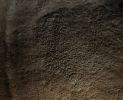
PSP_004867_1220_RED_abrowse-01.jpgIce Processes in Amphitrites Patera (EDM - Natural Colors; elab. Lunexit)55 visiteThe Martian Atmosphere was dusty at the time this image was acquired, so small imperfections in the processing are very visible in the standard image products.
MareKromium
|
|
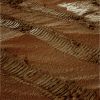
OPP-SOL2008-GB.jpgRover Tracks - Sol 2008 (Natural Colors; credits: Dr G. Barca)55 visitenessun commentoMareKromium
|
|

Solar_Prominence-STEREO.jpgHuge Solar Prominence55 visiteCaption NASA:"What does a Solar Prominence look like in three dimensions? To help find out, NASA launched the STEREO satellites to keep a steady eye on the Sun from two different vantage points.
The STEREO satellites orbit the Sun nearly along Earth's orbit, but one (dubbed "Ahead" ---> Avanti) currently leads the Earth, while the other (dubbed "Behind" ---> "Dietro") currently trails. Three weeks ago, a powerful Prominence erupted and remained above the Sun for about 30 hours, allowing the STEREO satellites to get numerous views of it from different angles.
Pictured above is a High-Resolution image of the event from the STEREO "Ahead" satellite.
A video of the Prominence erupting as seen from both Spacecrafts can be found at http : // www . youtube . com / watch?v = _RjswBx6ysQ.
The unusually quiet nature of the Sun over the past two years has made large prominences like this relatively rare. The combined perspective of STEREO will help astronomers better understand the mechanisms for the creation and evolution of Prominences, Coronal Mass Ejections, and Solar Flares".
MareKromium
|
|
| 25353 immagini su 2113 pagina(e) |
 |
|
|
|
|
1808 | |
|
|
|
|





