| Piú viste |
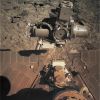
SOL1504-2N259890637EFFAY00P1938L0M1.jpgReddish Dust on the Solar Panels - Sol 1504 (MULTISPECTRUM - credits: Lunexit)55 visitenessun commentoMareKromium
|
|

Animazione_SOL626.gifLevitation? (GIF-Movie from frames taken during Sol 626; credits: Dr Gianluigi Barca)55 visite...Succede che Spirit continua a cercare il suo "vantage point" e, per farlo, continua a "spingere in avanti" (to push forward) ma...Le sue ruote anteriori restano perfettamente IMMOBILI.
Che ne pensate?
CONGRATULAZIONI al Dr Gianluigi Barca per l'occhio, la splendida intuizione e la provocazione: ma Spirit "levita", di quando in quando?!?...
E per gli Amici "scettici", che volessero controllare di persona, eccoVi i seriali dei frames usati per il GIF-Movie in questione (estratti dall'Archivio "Front Haz-Cam", per il "Sol 626" del "MER Spirit" - http://marsrovers.jpl.nasa.gov/gallery/all/spirit_f626_text.html):
2F181938396EFFAEUWP1205L0M1.JPG
2F181938455EFFAEUYP1206L0M1.JPG
2F181938816EFFAEV4P1206L0M1.JPG
2F181939108EFFAEV6P1206L0M1.JPG
2F181939506EFFAEVCP1205L0M1.JPG
2F181939798EFFAEVEP1206L0M1.JPG
2F181940195EFFAEVKP1206L0M1.JPG
2F181940480EFFAEVLP1206L0M1.JPG
2F181940831EFFAEVOP1214L0M1.JPGMareKromium
|
|
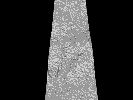
SHARAD-1.gifUnder the Ice... (1)55 visiteRadar Sounder Instruments orbiting Mars have looked beneath the Martian Surface and opened up the Third Dimension for Planetary Exploration.
The technique's success is prompting scientists to think of all the other places in the Solar System where they would like to use Radar Sounders.
The first Radar Sounder at Mars was the Mars Advanced Radar for Subsurface and Ionospheric Sounding (MARSIS) on the European Space Agency's Mars Express Orbiter. It has been joined by the complementary Shallow Subsurface Radar (SHARAD), operating at a different wavelength aboard NASA's Mars Reconnaissance Orbiter.
The data in this animation are from SHARAD.MareKromium
|
|
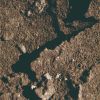
SOL177.jpgLayered Surface Feature - Sol 177 (True Colors + MULTISPECTRUM; credits: Dr G. Barca & Lunexit)55 visitenessun commentoMareKromium
|
|

SOL196.jpgDigging in the "Dry Mud" - Sol 196 (Superdefinition; credits: Dr G. Barca)55 visitenessun commentoMareKromium
|
|
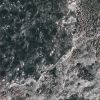
SOL354-MF-LXTT-3.jpgThere's a "Cristal" under the Dust? - Sol 354 (Superdefinition + MULTISPECTRUM; credits: Dr M. Faccin & Lunexit)55 visitenessun commentoMareKromium
|
|

UnknownObject-N00107570.jpgUnknown Object in the Space of Saturn55 visiteUna sorta di "Space Flare" si accende per pochi istanti nello Spazio di Saturno ed il "Caso" ha voluto che Cassini fosse lì, con gli "occhi aperti", pronto a fotografare.
Il risultato è questo: un curioso "flash" nel buio, dalla forma indefinibile e sulla cui Natura non ci è possibile investigare.
Forse non era nulla di importante, o forse si: ma comunque fosse, noi non lo sapremo mai.
Notate, infine, la curiosa (e sostanziale!) specularità dei corpi puntiformi ripresi.MareKromium
|
|
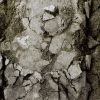
SOL314.jpgDry Terrain?!? - Sol 314 (Superdefinition + MULTISPECTRUM; credits: Dr G. Barca & Lunexit)55 visitenessun commentoMareKromium
|
|

SOL171.jpgGreenish "dust" or Martian Moss? - Sol 171 (Superdefinition; credits: Dr G. Barca)55 visitenessun commentoMareKromium
|
|
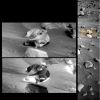
SOL364-2.jpgExtremely Unusual Landform (credits: Dr Marco Faccin)55 visitenessun commentoMareKromium
|
|
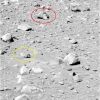
SOL106-2P135779309EFF3100P2294L5M1-1.jpgExtremely Unusual Landforms near Spirit (context-frame; credits: Dr G. Barca)55 visiteDal sempre più attento ed acuto occhio del nostro Dr Gianluigi Barca, due rilievi rocciosi davvero inusuali riemergono dalle "nebbie" dell'ormai lontano Sol 106 del Rover Spirit: li abbiamo battezzati "The Fin" (La Pinna) e "The Eel" (L'Anguilla).
Il motivo per cui abbiamo scelto questi nomi lo capirete osservando gli extra-detail mgnf che seguono...
Complimenti e nuove (ma sempre meritate!) Congratulazioni al Dr Barca!MareKromium
|
|
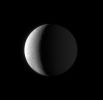
Enceladus-PIA09882.jpgEnceladus55 visiteCaption NASA:"The Cassini spacecraft acquired this view 15 hours before closest approach to Enceladus as the Spacecraft dove toward its thrilling March 2008 encounter with the ice-particle-spewing moon. The cratered terrain of the North is seen at top, and is even dimly visible on the moon's night side, which is lit by reflected sunlight coming from Saturn.
North on Enceladus (505 Km, or approx. 314 miles across) is up and rotated 22° to the left. The North Pole is tilted slightly toward Cassini.
The image was taken in visible green light with the Cassini spacecraft narrow-angle camera on March 12, 2008. The view was acquired at a distance of approx. 612.000 Km (about 380.000 miles) from Enceladus and at a Sun-Enceladus-Spacecraft, or Phase, angle of 114°.
Image scale is roughly 4 Km (about 2 miles) per pixel".MareKromium
|
|
| 25353 immagini su 2113 pagina(e) |
 |
|
|
|
|
1807 | |
|
|
|
|





