| Piú viste |
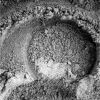
SOL830-2M200053418EFFAR00P2956M2M1.jpgThe "Mark" (4) - Sol 83055 visiteCaption NASA originale:"Microscopic Imager Non-linearized Full frame EDR acquired on Sol 830 of Spirit's mission to Gusev Crater at approximately 13:56:52 MLT; Microscopic Imager dust cover commanded to be OPEN".
|
|

SOL830-2M200053513EFFAR00P2956M2M1.jpgThe "Mark" (5) - Sol 83055 visiteCaption NASA originale:"Microscopic Imager Non-linearized Full frame EDR acquired on Sol 830 of Spirit's mission to Gusev Crater at approximately 14:00:04 MLT; Microscopic Imager dust cover commanded to be OPEN".
|
|

OPP-SOL811-1M200179735EFF69__P2957M2M1.jpgGranules (2) - Sol 81155 visitePer la NASA, tutte le "sferette" che Opportunity incontra durante il suo viaggio, sono "berries" (frutti di bosco). Secondo noi la questione è un pizzico più complessa e di "berries" ce ne sono di diversi tipi:
1) berries peduncolati: sono delle sferule di diametro apparente intorno ai 2/3 cm, dotate di una sorta "stelo" e che costuituiscono un tutt'uno con le rocce su cui si trovano (da una certa distanza possono sembrare dei "funghetti"; vedi "Pilbara Rock" - "Fram Crater");
2) berries liberi: sono delle sferule senza stelo, di diametro variabile (dai 2 o 3 mm e sino ad 1/1,5 cm) le quali sono semplicemente "poggiate" sul suolo di Meridiani;
3) berries vincolati: sono delle sferule senza stelo, di diametro variabile (idem c.s.) ed attaccate alle rocce (ai Rock Outcrops o Pavimenti Marziani, per la precisione);
4) granuli: sono quelli che vediamo in questo frame e nel precedente. Diversi dai berries, sono molto più compatti (come "accatastati" gli uni sugli altri) ed hanno forme e dimensioni variabili.
|
|
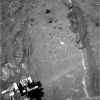
SOL834-2N200402546EFFAR00P1970L0M1.jpgTracks and "The Mark" - Sol 83455 visitenessun commento
|
|
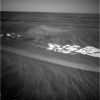
OPP-SOL813-1N200362517EFF7000P0685L0M1.jpgRipples and Paving (1) - Sol 81355 visitenessun commento
|
|

OPP-SOL813-1N200362568EFF7000P0685L0M1.jpgRipples and Paving (2) - Sol 81355 visitenessun commento
|
|

OPP-SOL813-1N200362604EFF7000P0685R0M1.jpgRipples and Paving (3) - Sol 81355 visitenessun commento
|
|

Comets-Schwassmann_Wachmann_1-07.jpgComet Schwassmann-Wachmann 3: the whole "crumbling" Comet (1)55 visiteThis false-color mosaic of crumbling Comet Schwassmann-Wachmann 3 spans about 6° (about 12 full moons) along the Comet's orbit. Recorded on May 4-6, 2006, by an infrared camera on board the Spitzer Space Telescope, the picture captures about 45 of the 60 or more alphabetically cataloged large Comet Fragments. The brightest fragment at the upper right of the track is Fragment "C" (frame 1). Bright Fragment "B" is below and left of center (frame 2). Looking for clues to how the Comet broke up, Spitzer's infrared view also captures the trail of dust left over as the Comet deteriorated during previous passes. Emission from the dust particles warmed by sunlight appears to fill the space along the cometary orbit. The fragments are near their closest approach in the coming days, about 10 MKM away, and none pose any danger to our fair Planet.
|
|

Saturn&Titan-N00060957.jpgSo close and yet so far...55 visitenessun commento
|
|
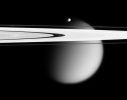
Saturn&Titan-PIA07786.jpgSo close and yet so far...55 visiteThe Cassini spacecraft delivers this stunning vista showing small, battered Epimetheus and smog-enshrouded Titan, with Saturn's A and F Rings stretching across the scene. The prominent dark region visible in the A-Ring is the Encke Gap, in which the moon Pan and several narrow ringlets reside. Moon-driven features that mark the A-Ring are easily seen to the left and right of the Encke Gap. The Encke Gap is about 325 Km (approx. 200 miles) wide. Pan is approx. 26 Km (about 16 miles) across. In an optical illusion, the narrow F-Ring, outside the A-Ring, appears to fade across the disk of Titan. A couple of bright clumps can be seen in the F-Ring. Epimetheus is approx. 116 Km (about 72 miles) across and giant Titan is roughly 5.150 Km (about 3.200 miles) across.
The image was taken in visible light with the Cassini spacecraft narrow-angle camera on April 28, 2006, at a distance of approx. 667.000 Km(about 415.000 miles) from Epimetheus and 1,8 MKM (about 1,1 MMs) from Titan. The image captures the illuminated side of the rings. The image scale is 4 kilometers (2 miles) per pixel on Epimetheus and 11 kilometers (7 miles) per pixel on Titan.
|
|

Channels-Auqakuh_Vallis-PIA08465-02.jpgFeatures of Auqakuh Vallis (Original NASA/JPL/ASU b/w Frame)55 visiteImage information: VIS instrument;
Latitude: 31,0° North;
Longitude: 60,6° East;
Resolution: 19 meter/pixel.
|
|
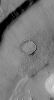
Craters-Unnamed_Crater-Deuteronilus_Mensae-PIA08472-00.jpgAlmost Buried Unnamed Crater in Deuteronilus Mensae (Original NASA/JPL/ASU b/w Frame)55 visiteCaption NASA originale:"This Unnamed Crater appears to be in the process of being covered over by downslope movement of material. These large slopes of material are common in Deuteronilus Mensae".
Image information: VIS instrument;
Latitude: 41,1° North;
Longitude: 17,8° East;
Resolution: 19 meter/pixel.
|
|
| 25353 immagini su 2113 pagina(e) |
 |
|
|
|
|
1802 | |
|
|
|
|





