| Piú viste |

OPP-SOL727-1M192731304EFF64LOP2956M2M1.jpgMartian "Corals" (2) - Sol 72755 visiteCaption originale:"Microscopic Imager Non-linearized Full frame EDR acquired on Sol 727 of Opportunity's mission to Meridiani Planum at approximately 13:56:01 MLT, Microscopic Imager dust cover commanded to be OPEN".
|
|
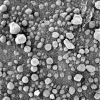
OPP-SOL727-1M192736838EFF64LOP2936M2M1.jpgMartian "berries" or...Martian "eggs"? - Sol 72755 visiteCaption originale:"Microscopic Imager Non-linearized Full frame EDR acquired on Sol 727 of Opportunity's mission to Meridiani Planum at approximately 15:25:49 MLT.
Microscopic Imager dust cover commanded to be OPEN".
|
|

Titan-Full_Disk-PIA02145-2.jpgTitan: Visual + IMS (2)55 visiteIn the December (2) mosaic, a North Polar hood that is bright at 5 microns is visible. Its composition is unknown.
The North Polar hood is barely seen in the October (1) and January (3) data.
Visible in the October and December images just South of the Equator is Tui Reggio, a Region nicknamed the "chevron". This Region is very bright at 5 microns and is among the brightest features on Titan at that wavelength.
Tui Reggio is thought to be a surface deposit, probably of volcanic origin, and may be water and/or carbon dioxide frozen from the vapor.
The December flyby data show that the western margins of Tui Reggio have a complex flow-like character consistent with eruptive phenomena.
|
|
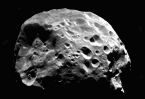
Phoebe.jpgPhoebe (Original NASA/JPL/ASU b/w Image-Mosaic)55 visiteWas Saturn's moon Phoebe once a comet? Images from the Cassini spacecraft taken two years ago (early 2004) when entering the neighborhood of Saturn, indicate that Phoebe may have originated in the outer Solar System.
Phoebe's irregular surface, retrograde orbit, unusually dark surface, assortment of large and small craters, and low average density appear consistent with the hypothesis that Phoebe was once part of the Kuiper Belt of icy comets beyond Neptune before being captured by Saturn. Visible in the above image of Phoebe are craters, streaks, and layered deposits of light and dark material. The image was taken from around 30.000 Km out from this 200-Km diameter moon.
Two weeks after taking the above image, Cassini fired its engines to decelerate into orbit around Saturn.
|
|
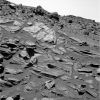
SOL748-4-2P192766906EFFAO55P2271L7M1.jpgThe "Burns Cliff of Gusev Crater" (1) - Sol 74855 visiteAfter several months of driving, Spirit finally reached the semicircular geologic feature dubbed "Home Plate" in Gusev Crater. Spirit first got a good view of Home Plate in late August, after cresting Husband Hill.
After that, the Rover made scientific observations near the Summit before commencing an ambitious drive of 848 mt (about 2.782 feet, a little more than half a mile) in 94 Soles, to get to Home Plate. Spirit is now studying a rock target called "Barnhill" just below the tabletop-like surface of Home Plate using instruments on the Rover's RA. Science Team members have begun calling Home Plate the "Burns Cliff of Gusev" because of its layered appearance and steep slopes, which is reminiscent of, but smaller than, Endurance Crater, explored by Spirit's twin, Opportunity, on the opposite side of Mars in 2004.
|
|
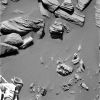
SOL748-5-2P192767424EFFAO55P2271L7M1.jpgThe "Burns Cliff of Gusev Crater" (2) - Sol 74855 visitenessun commento
|
|
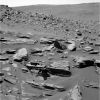
SOL748-6-2P192767805EFFAO55P2271L7M1.jpgThe "Burns Cliff of Gusev Crater" (3) - Sol 74855 visitenessun commento
|
|
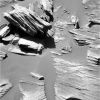
SOL748-7-2P192768196EFFAO55P2271R1M1.jpgThe "Burns Cliff of Gusev Crater" (4) - Sol 74855 visitenessun commento
|
|

Titan-PIA07700.jpgThe Atmosphere of Titan55 visiteThe view of Titan (almost natural colors) has been greatly contrast-enhanced to better show some intriguing structure in the North of the Planet; such intriguing "clouds-structure" is also clearly visible in a violet light view (PIA07701) taken at about the same time.
The color view was created by combining images taken using red, green and blue spectral filters. The images were taken with the Cassini spacecraft wide-angle camera on Dec. 26, 2005, at a distance of approx. 193.000 Km (about 120.000 miles) from Titan and at a phase angle of 29°. The image scale is about 11 Km (roughly 7 miles) per pixel.
|
|

OPP-SOL731-1R193086932EFF64NKP1301R0M1.jpgRear-View - Sol 73155 visiteCaption originale:"Right Rear HazCam Non-linearized Full frame EDR acquired on Sol 731 of Opportunity's mission to Meridiani Planum at approximately 14:05:57 MLT".
|
|

SaturnStorm-PIA07788.jpgTurbulence... (1)55 visiteThis image shows a rare and powerful storm on the Night-Side of Saturn.
Light from Saturn's Rings (called "Ringshine") provided the illumination, allowing the storm and other cloud features to be seen.
The storm is a possible source of radio emissions believed to come from electrical discharges (lightning) deep in Saturn's atmosphere. Cassini began detecting the radio emissions, which are like those from lightning, on January 23, 2006. At about the same time, amateur astronomers reported that a storm had appeared in Saturn's Southern Hemisphere at Lat. - 35°. Cassini was in the wrong place to take good images of the storm on the day side, since the Planet showed only a thin crescent to the spacecraft, but night side imaging was possible using light from the Rings.
The image shows the storm as it appeared to the Cassini imaging system on January 27, 2006, and the storm's North-South dimension is about 3.500 Km (approx. 2.175 miles).
|
|

SaturnStorm-PIA07789.jpgTurbulence... - detail mgnf (2)55 visiteNo lightning flashes are visible in the image (they would look like medium-sized bright spots, since the light would spread out before it reaches the cloud tops), but non-detection does not mean that lightnings are absent, however. Lightning might be too faint to stand out above background or too deep to be seen through the thick clouds. Bad luck is another possibility: the camera might have missed the strong flashes during the 10' that the shutter was open. A narrow-cloud band crosses the storm from left to right. It is illuminated by the Rings from the North and is brighter on that side. Cassini scientists are looking forward to an extensive Night Side image set, designed to look for lightning. That set will be collected during the first half of 2006.
The view was obtained in visible light with the Cassini spacecraft narrow-angle camera at a distance of approx. 3,5 MKM (about 2,2 MMs) from Saturn. The image scale is approx. 20 Km (about 12 miles) per pixel.
|
|
| 25353 immagini su 2113 pagina(e) |
 |
|
|
|
|
1800 | |
|
|
|
|





