| Piú viste |
OPP-SOL2795-1N376319693EFFBR00P0745R0M1-PCF-LXTT.jpgEndeavour's Horizon with the "White Wave" - Sol 2795 (Natural Colors; credits for the additional process. and color.: Dr Paolo C. Fienga - Lunexit Team)200 visitenessun commentoMareKromium
|
|

Luna-08.jpegWhat a color!200 visiteNone of the pictures taken by Chang'E-4 Chinese Lunar Lander in January 2019 have colors similar to the photos taken by Armstrong, Aldrin and the other 10 astronauts. The question is why?MareKromium
|
|

APOLLO 12 AS 12-46-6793.jpgAS 12-46-6793 - A very strange mound (1)199 visiteUna prima immagine di una possibile struttura superficiale "anomala". Perchè "anomala"? Per la (quantomeno apparente) esistenza di simmetrie bilaterali, decisamente chiare in questa immagine scattata da una distanza di circa 20/25 metri (forse anche qualcosa di più...) dal target. Un lato della "collinetta" appare leggermente più liscio dell'altro. Ma siamo ancora troppo lontani per avanzare ipotesi. Avviciniamoci ancora un poco...
|
|

SOL010.jpgSunset on Mars - Sol 10 (Natural Colors; credits: NASA/JPL-Caltech)199 visitenessun commento
|
|
M-060-1.jpgM 60 (NGC 4649) - Elliptical Galaxy199 visite"...Sevocatus animus a societate et a contagione corporis, tum meminit paraeteritorum, praesentia cernit, futura praevidet..."
(Cicerone)
"...L'Animo che sia capace di distaccarsi dalla fragile miseria della (derivante dalla) fisicità può (davvero, veracemente) ricordare ciò che è accaduto, comprendere quello che accade e precognizzare ciò che accadrà..."
|
|
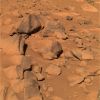
SOL220-mera_220_p2565_toltecs_L456_cb-A223R1_br2.jpgIs there anything under the big stone? (3) in almost-true colors199 visiteLa stessa immagine di cui al frame precedente, ma questa volta a colori quasi-veri. Due immagini identiche eppure profondamente diverse! E' un fatto indubitabile che la visione a colori di un qualsiasi oggetto (o di un suo dettaglio, o di uno scorcio di paesaggio ecc.), modifichi radicalmente l'impressione che di esso si ricava in rapporto alla corrispondente visione in b/n: crediamo che questo faccia parte delle nostre abitudini percettive. Voi cosa ne dite?
|
|

HD 70642.jpgPlanetary System around Star HD 70642199 visite"...Una volta, in gioventù, durante una lezione di Religione, il Professore ci parlò - e non so proprio per quale motivo egli si sentì in dovere di addentrarsi in un simile labirinto concettuale - dei Dogmi.
Fu una lunghissima prolusione e alla fine, dopo aver a lungo e faticosamente peregrinato intorno a questi astrusi principii, ci chiese se, prendendo spunto da quanto aveva detto lui, noi ci fossimo fatti una qualche idea.
Magari quella di un "Nuovo Dogma", da aggiungere agli altri.
Io alzai la mano.
Il Professore sorrise, si avvicinò e mi chiese se avevo pensato bene, prima di propinare al resto della classe un possibile "Nuovo Dogma". Gli dissi che ci avevo pensato benissimo, e parlai: "credo - dissi - che il Dogma di cui lei si è dimenticato di parlarci attenga la "Inverificabilità" di tutti gli altri Dogmi".
Il Professore rimase completamente inerte, come folgorato..."
"E poi? Che cosa successe?"
"Successe che mi diede uno schiaffo e mi buttò fuori dall'aula...".
P.C. Floegers - "Conversations"
|
|

APOLLO 15 AS 15-M-R50-1853.jpgAPOLLO 15 AS 15-M-R50-1853 - Unusually shaped hills on the Moon199 visiteIn questo frame vediamo una collina dalla forma vagamente (ed apparentemente) piramidale - con base triangolare - posta sul margine di un cratere. Sarebbe interessante riuscire ad acquisire qualche versione originale ed uncompressed di questi "metric frames" i quali, a nostro parere, ci permetterebbero di ricostruire mappe dettagliatissime di ampie aree della Luna.
Certo, si tratterebbe di un lavoro immenso, ma meraviglioso ed utilissimo. Ci proveremo...
|
|

ZL-SOL324_travDEM-A332R1_br2.jpgDigital Elevation Map of Spirit's Trek199 visiteCaption NASA originale: "The blue area represents the basaltic plains on the floor of Gusaev Crater, about 20 meters below the Rover's present location. Spirit crossed those plains for several months after landing to the west, off the left edge of this image. The greenish-blue area is the "West Spur" of the "Columbia Hills," which Spirit reached on sol 156 (June 11, 2004). Since then, Spirit has been gradually ascending the slopes of the "West Spur" in an east-northeasterly direction. Southeast of the Rover's current position is a brighter green area that represents an abrupt increase in slope where the "West Spur" meets the steeper flanks of the "Columbia Hills." The yellow and red areas represent the highest slopes and peaks. A steep valley east of the Rover's location appears, from orbiter images, to have layered outcrops. Scientists are directing the Rover to a ridge overlooking the valley to get a better look at what lies ahead".
|
|

APOLLO_17_-_AS_17-146-22420-21-MF-LXTT.jpgAS 17-146-22420 and 22421 - Gnomon and Surface (an Image-Mosaic in Natural Colors by Dr M. Faccin - Lunexit Team)199 visitenessun commentoMareKromium
|
|

Titan-PIA12817-PCF-LXTT.jpgTitanian "Arrow-shaped Storm" (Natural Colors; credits for the additional process. and color.: Dr Paolo C. Fienga - Lunexit Team)199 visiteCaption NASA:"A huge arrow-shaped Storm blows across the Equatorial Regions of Titan in this image from NASA's Cassini Spacecraft, chronicling the Seasonal Weather Changes on Saturn's largest moon.
This Storm created large effects in the form of dark -- likely wet -- areas on the Surface of Titan, as better visible in later images. After this Storm dissipated, Cassini observed significant changes on Titan's Surface at the Southern Boundary of the Dunefield named Belet.
Those changes covered an area of approx. 500.000 square Km (310.500 square miles), or roughly the combined area of Arizona and Utah in the United States.
The part of the Storm that is visible here measures approx. 1200 Km (745,2 miles) in length East-to-West. The wings of the Storm that trail off to the North/West and South/West from the Easternmost point of the storm are each approx. 1500 Km (931,5 miles) long.
Titan's weather has been changing since the August 2009 Equinox, when the Sun lays directly over the Equators of Saturn and its moons, and Storms at low Latitudes are now more common.
This image is a mosaic of two Cassini images. Most of this view is from an image of the storm captured on Sept. 27, 2010. However, because that image's framing cut off the South Polar Region of the Planet, a second image of Titan, taken on July 9, 2010, was used to fill in that portion of the celestial body. This second image was re-projected to the same Viewing Geometry as the first.
Lit Terrain seen here is in the area between the Trailing Hemisphere, which is the side of Titan that faces backward in its orbit around Saturn, and the side of Titan that always faces away from Saturn. North on Titan is up.
The images were taken with the Cassini Spacecraft narrow-angle camera using a spectral filter of Near-InfraRed Light centered at 938 nanometers. The view was acquired at a distance of approx. 1,3 MKM (807.300 miles) from Titan and at a sun-Titan-Spacecraft, or Phase, Angle of 44°.
Image scale is roghly 8 Km (4,968 miles) per pixel".MareKromium
|
|
OPP-SOL2529-1P352699143EFFB1F8P2382R2M1-PCF-LXTT.jpgPiana Meridiani (Absolute Natural Colors; credits for the additional process. and color.: Dr Paolo C. Fienga - Lunexit Team)199 visitenessun commentoMareKromium
|
|
| 25353 immagini su 2113 pagina(e) |
 |
|
|
|
|
180 | |
|
|
|
|





