| Piú viste |
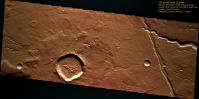
Channels-Unnamed_Channel_and_Graben-20080617a.jpgUnnamed Channel (Natural Colors/Tri-Chromatic Version; credits: Dr Paolo C. Fienga - Lunexit Team)56 visitenessun commentoMareKromium
|
|
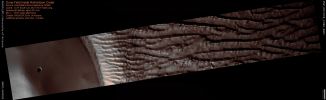
PSP_007078_1080_RED_abrowse.jpgThe Dunes of Richardson Crater (MULTISPECTRUM; credits: Lunexit)56 visitenessun commentoMareKromium
|
|
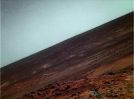
SOL1559-2.jpgHorizon - Sol 1559 (Superdefinition + MULTISPECTRUM; credits: Dr M. Faccin & Lunexit)56 visitenessun commentoMareKromium
|
|

PSP_008199_1910_RED_abrowse.jpgFeatures of Cerberus Fossae (Enhanced Absolute Natural Colors; credits for the additional process. and color.: Dr Paolo C. Fienga - Lunexit Team) 56 visitenessun commentoMareKromium
|
|
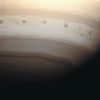
Saturn-PIA10411.jpgStorm Alley (MULTISPECTRUM-2; credits: Lunexit)56 visiteCaption NASA:"A line of dark vortices charge through Saturn's "Storm Alley" — such as a Region that has seen intensive storm activity since the Cassini Spacecraft began its observations of the Planet in early 2004.
The image was taken with the Cassini Spacecraft wide-angle camera on May 19, 2008 using a spectral filter sensitive to wavelengths of infrared light centered at 728 nanometers. The view was obtained at a distance of approx. 863.000 Km (about 536.000 miles) from Saturn.
Image scale is roughly 48 Km (about 30 miles) per pixel".MareKromium
|
|
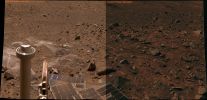
SOL422-L257_ca.jpgColor Comparison: "Paso Robles" - Sol 422 (Sx credits: Lyle.org; Dx credits: Lunexit)56 visiteUn piccolo confronto cromatico che NON HA lo scopo di dire "questa elaborazione è più bella/brutta" oppure "quella elaborazione è più verosimile/inverosimile". Certamente no. L'unico scopo di questa comparazione è didattico: nei frames prelevati dalle Gallerie Lyle.org dedicate ai MER Opportunity e Spirit - Radiometrically Calibrated Imagery - emergono con evidenza tre fatti:
1) i frames sono tutti molto luminosi (spesso ai limiti della over-saturation);
2) la Dominante Cromatica appare esasperata e tendente al rosa pallido con qualche bizzarra nuance giallastra e/o violacea;
3) l'O.A. (o Tau) è presente e visibile anche sulla brevissima distanza (tutti o quasi tutti i frames, insomma, appaiono opacizzati o leggermente fuori fuoco).
ATTENZIONE: il Lavoro svolto da Lyle.org - se non altro da un profilo volumetrico - è, dal nostro punto di vista, assai stimabile e noi lo apprezziamo (e Ve ne mostreremo anche una porzione qui, sulle pagine di Lunexit).
Ma, da un punto di vista concettuale e, se così possiamo esprimerci, "metodologico", come ovvio a nostro modestissimo parere, esso è clamorosamente errato e creatore di errori e malintesi.
Pensate un pò a questi dati:
La Luminosità di Fondo di Marte: è eccessiva. Superiore anche a quella Terrestre (e questo è un fatto improponibile).
La Dominante Cromatica: veramente esagerata (abbiamo fatto un paio di simulazioni e, nei frames Lyle, è come se il Sole splendesse di un bel color salmone).
I Contrasti: nulli, o quasi (specie per i frames relativi a Meridiani Planum).
L'Opacità Atmosferica: siamo d'accordo che, in giornate di Tau elevata, essa possa diventare ben percepibile nelle riprese tarate su obbiettivi posti a medio-lunga distanza (diciamo oltre i 50/60 metri dai Rover), ma che essa - e per giunta sempre - si riveli in forma eclatante anche su target posti solo a pochi cm dalle loro ottiche...no, questo è davvero poco credibile. Anzi: questo è un vizio interpretativo.
Nota positiva: il Cielo di Marte. Molto ben calibrato e, di fatto, probabilmente ancora più realistico di quello che tentiamo (faticosamente) di proporre noi qui, su Lunexit.
Insomma: massimo rispetto per il Lavoro di Lyle.org MA, un consiglio, quando osservate le loro Color Galleries, siate prudenti nelle valutazioni e tenete ben presente almeno tre fattori:
1) Marte è più lontano dal Sole rispetto alla Terra;
2) Marte non è un Mondo Monocromatico (come dimostrano ampiamente le immagini HST e quelle orbitali - e comunque non è certo un Pianeta color "rosa salmone"...) e, infine,
3) Marte muta le sue nuances con il passare delle ore del giorno e, quindi, al variare delle relative condizioni di luminosità (le interpretazioni Lyle, invece, sembrano essere tutte state calibrate su uno Standard di Luminosità Media - ed anche questo è un errore concettuale che poi, alla fine, si riflette e si risolve in un errore di metodo e di realismo).
Ora giudicate Voi.MareKromium
|
|

OPP-SOL065-1P133952981RAD08AQP2574L234567C1.jpgMonochrome Mars - Sol 65 (Multispectral Color Imagery; credits: Lyle.org)56 visitenessun commentoMareKromium
|
|
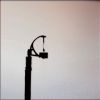
PHOE-SOL031-lg7754-7770-7771-2.jpgAnemometer - Sol 31 (natural colors; credits: Dr G. Barca)56 visitenessun commentoMareKromium
|
|
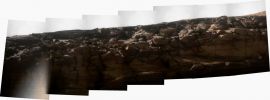
OPP-SOL1571-Panoramic-4.jpgThe "Inner Rim" of Victoria - Sol 1571 (Photomosaic + MULTISPECTRUM; credits: Dr G. Barca & Lunexit)56 visitenessun commentoMareKromium
|
|
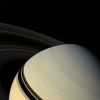
Saturn-PIA08414.jpgPerspectives... (natural colors; credits: NASA)56 visiteCaption NASA:"The Ringed Planet sits in repose, the center of its own macrocosm of many rings and moons and one artificial satellite named Cassini. Mimas (approx. 397 Km, or about 247 miles across) is visible at upper left. Although unseen in this view, Enceladus (approx. 504 Km, or about 313 miles across) casts its shadow upon the Planet. The Rings also block the Sun's light from the low Latitudes of the Northern Hemisphere.
During Cassini's extended mission, dubbed the Cassini Equinox Mission, which begins on July 1, 2008, the Ring shadows will slip past the Planet's Equator and into the Southern Hemisphere as Saturn passes through its Northern Vernal Equinox on August 11, 2009, and the Sun moves northward through the Ring-Plane.
This view looks down on the unilluminated side of the Rings, from about 22° above (such as North of) the Ring-Plane. Images taken using red, green and blue spectral filters were combined to create this natural color view. The images were obtained with the Cassini Spacecraft wide-angle camera on Dec. 16, 2007, at a distance of approx. 1,4 MKM (such as about 900,000 miles) from Saturn.
Image scale is roughly 86 Km (about 53 miles) per pixel".MareKromium
|
|
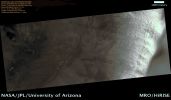
PSP_007153_2505_RED_abrowse.jpgDunes in Vastitas Borealis (MULTISPECTRUM; credits: Lunexit)56 visiteWindblown sand can be used to tell us the wind direction on Mars. Small-scale features, such as Ripples and Wind Tails, indicate the most recent wind directions.
Wind-Tails may be the remnants of a formerly widespread mantle of sediment that has been removed. Alternatively, they may have formed when aeolian sediment is deposited in the wind-shadow zone behind obstacles such as the 1,5 mt diameter boulders on the crater rim (Sx of the image). Their orientation points in the downwind direction and in this frane you can see two wind tails that extend from some boulders, thus indicating winds blowing from at least two different directions.
Ripples occur on the surface of all dunes imaged at HiRISE resolution on Mars and the alignment of Ripples often results from the influence of more than one wind direction.
In this frame, the Ripples are superimposed on a low dome dune.
On Earth, ripples on the surface of sand dunes may re-orientate in a matter of hours, but the time required to re-orientate Ripples on Mars is unknown.MareKromium
|
|
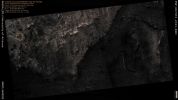
PSP_007055_2015_RED_abrowse-0.jpgVolcanic and Clay Materials near Nili Fossae (ctx frame - MULTISPECTRUM; credits: Lunexit)56 visiteThis image is located West of the Nili Fossae Trough, one of the proposed Landing Sites for the Mars Science Laboratory. Here, we combine information from two other MRO instruments, the Context Camera (CTX) and the Compact Reconnaissance Imaging Spectrometer for Mars (CRISM), to provide insight into the geology of the Region.
Nota Lunexit: sicuramente le informazioni NASA su questo frame sono interessanti e preziose, ma noi Vi invitiamo a prestare un PARTICOLARE ATTENZIONE alla struttura ed alla configurazione superficiale delle dune che caratterizzano tutta la zona ripresa.
Si tratta, in effetti, di dune che, in passato, a causa della loro conformazione ed albedo, hanno ingannato innumerevoli Ricercatori i quali le avevano scambiate per "tubazioni" affioranti.
L'edt n. 3 (elaborato in colori naturali) Vi permetterà di cogliere al meglio non solo la - riteniamo incredibile - conformazione di queste mega-dune, ma anche la loro del tutto peculiare colorazione.MareKromium
|
|
| 25353 immagini su 2113 pagina(e) |
 |
|
|
|
|
1780 | |
|
|
|
|





