| Piú viste |
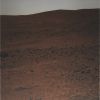
SOL1392-2P249936344EFFAWTNP2427L7M1.jpgDaylight Panorama - Sol 1392 (3 - MULTISPECTRUM; elab. Lunexit)56 visitenessun commentoMareKromium
|
|
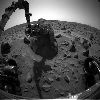
SOL051-Humphrey.gif"Scrubbing" Humphrey... - Sol 51 (GIF-Movie; credits: Dr Marco Faccin)56 visiteUno splendido GIF-Movie ci mostra, oltre alla (leggera) "grattatina" che il RAT (Rock Abrasion Tool) di Spirit diede all'enigmatico (pseudo)macigno conosciuto come Humphrey, anche un suggestivo (e davvero quasi impercettibile) "lampo di luce" che arriva dall'orizzonte.
Ma attenzione: il "lampo" non dovrebbe essere un image-artifact: secondo noi, infatti, correlando lo spostamento dell'ombra (visibile in basso) all'istante del flash (visibile in alto a Dx dell'Osservatore, tra ore 02:00 e 03:00), possiamo ragionevolmente ritenere che si tratti del riflesso dei raggi del Sole sull'ancora lontano Heat-Shield di Spirit - il quale, come ricorderete, si trovava (e si trova tutt'ora, riteniamo...) proprio sul bordo (rim) del medio-piccolo cratere Bonneville.
Se l'ipotesi "riflesso" non Vi convincesse, noi siamo open verso nuove teorie ed ipotesi: basta che scriviate...
Bellissimo filmato, comnque, e grandi complimenti al Dr Faccin!MareKromium
|
|

OPP-SOL1377-3.jpgSolar Panels and Paving - Sol 1377 (natural colors e MULTISPECTRUM; credits: Dr Gianluigi Barca e Lunexit)56 visitenessun commentoMareKromium
|
|

OPP-SOL1379-2.jpgSolar Panels and Paving - Sol 1379 (natural colors + MULTISPECTRUM; credits: Dr Gianluigi Barca e Lunexit)56 visitenessun commentoMareKromium
|
|

OPP-SOL1379-1.jpgOpportunity: circuits, Solar Panels and Paving (natural colors + MULTISPECTRUM; credits: Dr G. Barca e Lunexit)56 visitenessun commentoMareKromium
|
|
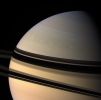
Saturn-PIA09793.jpgThe Northern Hemisphere of Saturn (natural colors; credits: NASA/Space Science Inst.)56 visiteCaption NASA:"Dark ring shadows adorn the Northern Hemisphere of Saturn.
The shadows have loosened their grip on the North compared to when Cassini arrived in 2004, and presently continue to slide farther South.
This view looks toward the unilluminated side of the rings from about 5° above the Ring-Plane. Images taken using red, green and blue spectral filters were combined to create this Natural Color View. The view was acquired with the Cassini spacecraft wide-angle camera on Oct. 22, 2007, at a distance of approx. 1,3 MKM (such as about 839.000 miles) from Saturn.
Image scale is roughly 77 Km (about 48 miles) per pixel".MareKromium
|
|
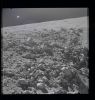
as16-107-17477.JPGAS 16-107-17477 - Station 4 Crater (ejecta crater)56 visitenessun commentoMareKromium
|
|
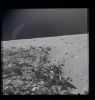
as16-107-17483.JPGAS 16-107-17483 - Station 4 Crater (ejecta crater)56 visiteStation 4 crater. Note that there is very little debris on the Western (right) side of the Crater. As John Young recognized in the field, this crater was almost certainly formed by a large piece of highly-shocked ejecta from South Ray Crater which plowed into the side of Stone Mountain at relatively low velocity and came apart.
Hence, this is a Secondary Crater.
Notes (from "Glossary of Geology", 2nd Edition, American Geological Inst., Falls Church (VA) - 1980)
Ejecta — The material thrown out of an impact crater by the shock pressures generated during the impact event. Ejecta generally covers the surface around an impact crater to a distance of at least one crater diameter, with individual streamers of material extending well beyond this distance ("rays"). The ejecta blanket of a crater becomes less visible with increasing age of the crater.
Secondary craters — Craters produced by the impact of debris thrown out by a large impact event. Many secondary craters occur in clusters or lines where groups of ejecta blocks impacted almost simultaneously.MareKromium
|
|

as16-107-17560.JPGAS 16-107-17560 - Station 9 "Sneak" Boulder56 visiteJohn Young stepped back to get this "locator" of the "Sneak" Boulder at Station 9.
MareKromium
|
|
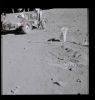
as16-107-17537.JPGAS 16-107-17537 - The "Rake Site"56 visite"After" of the Station 8 Rake Site, showing Charlie Duke at the back of the Rover with the double core.
MareKromium
|
|
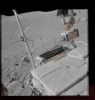
as16-107-17581.JPGAS 16-107-17581 - Slightly Sunstruck56 visite148:24:47 MT - John Young took this excellent picture of the front of the Rover before changing film magazines. It shows the dustbrush, the closed battery covers, the uncovered LCRU mirrors, and the TV, which is pointed at John himself.MareKromium
|
|

as16-113-18295.JPGAS 16-113-18295 - Teophilus Crater56 visiteOblique view of Theophilus Crater.
MareKromium
|
|
| 25353 immagini su 2113 pagina(e) |
 |
|
|
|
|
1773 | |
|
|
|
|





