| Piú viste |

Enceladus-N00055966.jpgThe "Fountain" of Enceladus (from 1,8 MKM!)56 visiteDel super-geyser di Encelado, se verificate andando a ritroso, sino a pochissimo tempo fa (giusto qualche mese) nessuno si era mai accorto – anche se di immagini ne erano già arrivate tante...Ora, come testimonia questo bel frame, la “Fontana” che sprizza cristalli d’acqua, polveri e fango si vede anche da considerevoli distanze. Come mai?
Si tratta di una fotografia ottenuta in condizioni di particolare favore, oppure questo fenomeno – che si supponeva debole e transitorio – si sta invece rinforzando nel tempo, acquisendo dimensioni sempre più spettacolari?
E se così fosse, a che cosa dovremmo far risalire questa “eruzione”?
Encelado è un mondo geologicamente attivo?
La Luna di Neve e Ghiaccio – così Encelado è stato battezzato dalla NASA – si sta sciogliendo in maniera eclatante?
O forse, anche in questo caso, l’eruzione – la quale era sfuggita al Voyager, negli Anni ’80, solo perché, forse...non c’era! – è una conseguenza (almeno parziale) della rinvigorita attività solare degli ultimi anni?
|
|

Rhea&Dione-N00056089.jpgIn-transit: Dione and Rhea (3)56 visitenessun commento
|
|

Saturn-PIA08143.jpgThe texture of the Rings and Northern Regions of Saturn56 visiteShadows drape Saturn's Northern Hemisphere, providing a different kind of look at prominent features in the Rings. From the lower left corner upward, the visible features are: the shadow of the outer B-Ring, followed by the wide, bright Cassini Division, then the A-Ring with the embedded thin, bright Encke Gap and finally the dark, narrow, F-Ring.
The image was taken with the Cassini spacecraft narrow-angle camera on Feb. 18, 2006, using a filter sensitive to wavelengths of infrared light centered at 750 nnmts, and at a distance of approx. 2,8 MKM (such as about 1,7 MMs) from Saturn. The image scale is roughly 16 Km (about 10 miles) per pixel.
|
|

Atlas-PIA08147.jpgAtlas56 visiteCaption NASA originale:"The Cassini spacecraft looks up from beneath the ringplane to spy Atlas, hugging the outer edge of the A-Ring, above center.
The image was taken in visible light with the Cassini spacecraft narrow-angle camera on Feb. 23, 2006, at a distance of approx. 1,1 MKM (such as about 700.000 miles) from Atlas (32 Km, or 20 miles across).
The image scale is roughly 7 Km (about 4 miles) per pixel on Atlas".
|
|

NGC-0281-3.jpgBok Globules in NGC 28156 visite"...Vos vestros servate, meos mihi linquite mores..."
(Petrarca)
"...Voi conservate le vostre (abitudini), (ed) a me lasciate le mie..."
|
|

Saturn-PIA08151.jpgSaturn's Southern Restlesness56 visiteThis view of high Southern Latitudes on Saturn shows very linear clouds at top, usually indicative of stable prevailing winds, and two turbulent, swirling features farther South. It is possible that these features merged some time after this image was taken.
The image was taken with the Cassini spacecraft narrow-angle camera on March 6, 2006, using a filter sensitive to wavelengths of infrared light centered at 750 nnmts. The image was acquired at a distance of approximately 2,8 MKM (about 1,8 MMs) from Saturn. The image scale is approx. 16 Km (roughly 10 miles) per pixel.
|
|
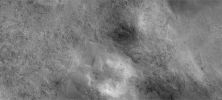
Q-S-HalleyCrater-PIA08048_modest-1.jpgIn the vicinities of Halley Crater (1)56 visiteThis image shows a landscape West of Mars' Argyre impact basin and North-East of Halley Crater. The large but faint circular feature near the center of the image is an unnamed impact crater about 7,5 Km (about 4,7 miles) in diameter. It has been all but erased by geological (and probably ice-related) processes. In fact, the majority of impact craters in this image have been modified from their original shapes, some undoubtedly beyond recognition. Only a few small craters remain pristine. The most prevalent surface type in this image is rough, dissected terrain, which is characterized by a complex pattern of knobs, pits, ridges and valleys. In places the rough terrain has been covered by a younger material that appears flat, smooth and nearly featureless. The smooth material may have been emplaced as muddy or icy debris. It filled low-lying areas (most notably craters) and surrounded higher features, preserving islands of rough terrain. Wind-formed dunes have formed atop some of the smooth material and diagonal streaks on the right side of the image may be due to the winds. Images such as this show the importance of water (liquid and/or ice), wind, and impacts in shaping the surface of Mars.
|
|

Q-U-Bosporus Planum (IR-VIS)-02.jpgBosporus Planum - detail mgnf (2)56 visiteCaption originale NASA, riferita al full-frame:"Large-scale streaks in the northern half are due to the action of wind on surface materials. The blankets of material ejected from the many small fresh craters are generally brighter and redder than the surrounding surface, but a few are darker and less red. Two greenish spots in the middle right of the scene may have an unusual composition, and are good future targets for the Compact Reconnaissance Imaging Spectrometer for Mars, a mineral-identifying instrument on MRO (http://crism.jhuapl.edu/). In the bottom half of the image we see a redder color in the rough areas, where wind and sublimation of water or carbon dioxide ice have partially eroded patches of smooth-textured deposits".
|
|

Q-U-Bosporus Planum (IR-VIS)-03.jpgBosporus Planum - detail mgnf (3)56 visiteCaption NASA originale, riferita al full-frame:"This image was taken by HiRISE on March 24, 2006.
The image is centered at 33,65° South Latitude and 305,07° East Longitude. It is oriented such that North is 7° to the left of up.
The range to the target was 2.493 Km (about 1.549 miles) and at this distance the image scale is 2,49 mt (such as approx. 8,17 feet) per pixel, so objects as small as 7,5 mt (about 24,6 feet) are resolved. In total this image is 49,92 Km (such as about 31,02 miles) or 20.081 pixels wide and 23,66 Km (about 14,70 miles) or 9.523 pixels long. The image was taken at a MLT of 07:33 and the scene is illuminated from the upper right with a solar incidence angle of 78° (this meaning that the Sun, at the time the picture was taken, was 12° above the local horizon).
At an Ls of 29° (with Ls an indicator of Mars' position in its orbit around the Sun), the season on Mars is Southern Autumn".
|
|

Saturn-PIA08154.jpgOne "Eye" of Saturn!56 visiteGaseous Saturn rotates quickly - once every approx. 10,8 hours - and its horizontal cloud bands rotate at different rates relative to each other. These conditions can cause turbulent features in the atmosphere to become greatly stretched and sheared, creating the beautiful patterns that the Cassini spacecraft observes. This turbulence and shear is particularly notable at those boundaries where the different bands slide past each other.
Vortices like the one seen here are long-lived dynamical features that are part of the general circulation of Saturn's atmosphere. They are counterparts to the East-West flowing jets and can last for months or years. They probably grow by merging with other vortices until a few dominate a particular shear zone between two jets.
This image was taken in polarized infrared light with the Cassini spacecraft narrow-angle camera on March 7, 2006, at a distance of approximately2,9 MKM (such as about 1,8 MMs) from Saturn. The image scale is 17 Km (about 10 miles) per pixel.
|
|
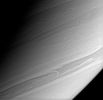
Saturn-PIA08153.jpgSaturnian Clouds56 visiteLong, thin streamers of cloud arc gracefully across this view of Saturn's Southerly Latitudes.
Analysis of images like this should lead scientists to a new understanding of cloud height variations on this complex gas giant world.
The image was taken in polarized green light with the Cassini spacecraft narrow-angle camera on March 7, 2006, at a distance of approx. 2,9 MKM (about 1,8 MMs) from Saturn. The image scale is 17 Km (about 10 miles) per pixel.
|
|

Saturn-PIA08156.jpgCat's Eyes on Saturn!56 visiteCaption originale:"Bright, high altitude clouds, like those imaged here, often appear more filamentary or streak-like than clouds imaged at slightly deeper levels in Saturn's atmosphere. This view also shows one of the many sp-called 'Cat's Eye' vortices that swim through the Southern Latitudes.
The image was taken in polarized infrared light with the Cassini spacecraft narrow-angle camera on March 7, 2006, at a distance of approx. 2,9 MKM (about 1,8 MMs) from Saturn. The image scale is about 17 Km (roughly 10 miles) per pixel".
|
|
| 25353 immagini su 2113 pagina(e) |
 |
|
|
|
|
1769 | |
|
|
|
|





