| Piú viste |

OPP-SOL1043-1N220787889EDN7800P1585L0M1.jpgBright Sun, Dark Sky... - Sol 104356 visiteSe l'atmosfera di Marte è realmente sottile come dice la NASA, allora, già a "mezzo cielo" - e cioè intorno ai 45° dall'orizzonte - il cielo di Marte dovrebbe diventare scuro, molto scuro, così come appare in questa immagine elaborata da noi, su frame NASA-Opportunity, e così come appare anche sulla Terra, in montagna, ad altezze superiori ai 5000 metri.
L'unica differenza è che, sulla Terra, la dominante - anche in caso di cielo molto scuro, è l'azzurro; su Marte, è l'arancio.
|
|

The_Rings-N00073991.jpgSomething's in the Rings...56 visitenessun commento
|
|

OPP-SOL108-1NN108EFF23CYL00P1981L000M1-B110R1-00.jpgEarly morning on Mars (after a sand storm)56 visiteInterpretazione di fantasia sul come dovrebbe apparire Marte (Regione di Meridiani Planum, prossimità del Cratere Endurance) nelle prime luci dell'alba e subito dopo la fine di una tempesta di polveri.MareKromium
|
|

McNaught-04.jpgComet McNaught (5)56 visiteCaption NASA:"The brightest comet of recent decades was a surprising first sight for a new camera in space.
The Sun Earth Connection Coronal and Heliospheric Investigation (SECCHI) instrument onboard the Solar TErrestrial RElations Observatory (STEREO) satellite had just opened up on January 11, 2007, when it snapped the above image of Comet McNaught. Visible was a spectacular view of the ion tail of Comet McNaught being swept away from the Sun by the solar wind in filamentary rays. The comet tail is seen to extend at least seven degrees across the above image, while the central coma is so bright it saturates. Comet McNaught is now reportedly so bright that it is visible even in broad daylight by blocking out the Sun with your hand.
Comet McNaught has rounded the Sun and will slowly fade away for observers in Earth's Southern Hemisphere as it recedes from the Sun".
|
|

McNaught-03.jpgComet McNaught (4)56 visiteCaption NASA:"This past weekend Comet McNaught peaked at a brightness that surpassed even Venus. Fascinated sky enthusiasts in the Earth's Northern Hemisphere were treated to an instantly visible comet head and a faint elongated tail near sunrise and sunset. Recent brightness estimates had Comet McNaught brighter than magnitude - 5 (minus five) over this past weekend, making it the brightest comet since Comet Ikeya-Seki in 1965, which was recorded at - 7 (minus seven). The Great Comet of 2007 reached its brightest as it rounded the Sun well inside the orbit of Mercury. Over the next week Comet McNaught will begin to fade as it moves south and away from the Sun. The unexpectedly bright comet should remain visible to observers in the Southern Hemisphere with unaided eyes for the rest of January.
The above image, vertically compressed, was taken at sunset last Friday from mountains above Catalonia, Spain".
|
|

McNaught-02.jpgComet McNaught (3)56 visiteCaption NASA:" Bright Comet McNaught (C/2006 P1) graced the twilight this week, seen by many and often described with superlatives. Watching the skies over Krakow, Poland, Andrzej Sawow recorded this view on Wednesday - with an ordinary handheld digital camera. He notes that "... astronomy is really for everyone who loves to look at the night sky. And fortunately (sometimes) the sky generously rewards its observer". Now very close to the Sun, Comet McNaught (along with Mercury) is visible in realtime images from the SOHO spacecraft. Otherwise, skywatchers will find the comet hard to see this weekend. But southern hemisphere observers could be rewarded next week as Comet McNaught begins to climb higher in southern skies".
|
|
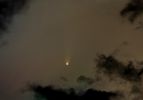
McNaught-00.jpgComet McNaught (1)56 visiteCaption NASA:"Early morning risers with a clear and unobstructed eastern horizon can enjoy the sight of Comet McNaught (C/2006 P1) in dawn skies over the next few days. Discovered in August by R. H. McNaught (Siding Spring Survey) the comet has grown bright enough to see with the unaided eye but will soon be lost in the glare of the Sun. Still, by January 11 sun-staring spacecraft SOHO should be able to offer web-based views as the comet heads toward a perihelion passage inside the orbit of Mercury. This image captures the new naked-eye comet at about 2nd magnitude in twilight skies near sunset on January 3rd. After rounding the Sun and emerging from the solar glare later this month, Comet McNaught could be even brighter".
|
|

Milky_Way.gifSetting Milky Way56 visite"...Non c'è via che porti alla sopravvivenza cosciente dell'Anima, se non quella del lento, spesso doloroso, ma certo consapevole, abbandono delle cose terrene..."
P.C. Floegers - "Conversations for Tomorrow"
|
|

as09-23-3512.jpgAS 09-23-3512 - Reflection in the window?!?56 visiteC'è una sorta di "ombra" color ambra ed a forma di "U", inclinata verso la Dx di chi osserva, in posizione centrale ed appena al di sopra dell'orizzonte terrestre. Di che cosa si tratta?
Abbiamo questa "U" che appare, in diversi colori e con diverse caratterizzazioni, in tanti altri Apollo frames. A volte essa ci è sembrata - decisamente - un qualcosa di vero, di alieno e di esterno alla Navicella Americana; altre volte, invece, ci è parso piuttosto evidente che si trattava del riflesso di un qualcosa che si trovava all'interno dell'astronave. E adesso?
E adesso...guardate e decidete Voi!
|
|
as09-22-3429.jpgAS 09-22-3429 - Somewhere...in the Ocean56 visitenessun commento
|
|

as10-29-4299.jpgAS 10-29-4299 - Lunar Limb56 visitenessun commento
|
|

as10-29-4263.jpgAS 10-29-4263 - Lunar Limb56 visitenessun commento
|
|
| 25353 immagini su 2113 pagina(e) |
 |
|
|
|
|
1765 | |
|
|
|
|





