| Piú viste |
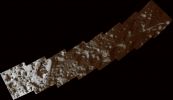
Japetus-PIA08380.jpgThe "Transition Region of Japetus" (possible natural colors - elab. Lunexit)56 visiteSoaring above the alien, icy wastelands of Saturn's moon Japetus, NASA's Cassini spacecraft captured a series of HR images of the Transition Region from dark to bright terrain at Southern Middle Latitudes that have been mosaicked together in this view.
An important characteristic of the terrain in the boundary region is that the isolated bright patches are mainly found on slopes facing toward the bright Trailing Hemisphere or toward the South Pole. The same polarity is found within the bright terrain, where the dark material can be seen at the bottom of craters and on Equator-facing slopes. These indicate that thermal effects are at play in painting the surface of Japetus.
The mosaic consists of 8 image footprints across the surface of Japetus. The view is centered on terrain near 38,6° South Latitude, 171,3° West Longitude. Image scale is approx. 52 meters (171 feet) per pixel.
The clear spectral filter images in this mosaic were obtained with the Cassini spacecraft narrow- angle camera on Sept. 10, 2007, at a distance of approx. 5,000 Km (about 3.100 miles) from Japetus.
MareKromium
|
|
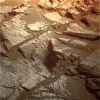
OPP-SOL1319-1P245281492EFF8700P2376R1M1-1.jpgLayers inside Victoria's Paving (possible natural colors; elab. Lunexit)56 visitenessun commentoMareKromium
|
|
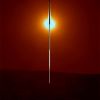
OPP-SOL1318-1N245205615EDN8700P1550L0M1-2.jpgSunset... - Sol 131856 visitenessun commentoMareKromium
|
|
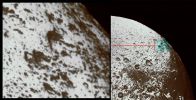
Japetus-SquaredTerrain.jpgSquares on Japetus?56 visiteUno splendido, inquietante ed...illusorio profilo individuato dal sempre bravissimo Marco Faccin. Strutture squadrate su Giapeto? Evidenze di "artificialità"?...
Ovviamente no: questo frame (e relativo detail mgnf) rappresentano solo un modo per vedere - e per far vedere! - come, volendo, si possono trovare "strutture regolari" su altri Corpi Celesti.
Illusioni determinate dalla distanza, dall'angolo di ripresa, dalla qualità del frame e dalla voglia di vedere "segni tangibili di intelligenza (passata o presente) altrove": trovare queste strutture (che appartengono alla Classe delle Strutture "Effimere") è un gioco; evidenziarle è una curiosità; spiegarle per quello che sono (senza costruirci sopra delle eso-archeo-baggianate) è, secondo noi, un dovere.
Un grazie di cuore (ed un grande BRAVO!) al Dr Faccin per aver individuato un dettaglio (comunque) intrigante e per lo spunto di riflessione che, con esso, ci ha voluto dare.MareKromium
|
|
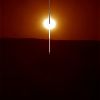
OPP-SOL1321-1N245476033EDN8736P1550L0M1.jpgSunset... - Sol 132156 visitenessun commentoMareKromium
|
|

APOLLO_10_AS_10-35-5222.jpgAS 10-35-5222 - Earthrise with "something flying away"... (2)56 visitenessun commentoMareKromium
|
|
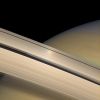
Saturn-PIA08393.jpgThe "Opposition Effect" (again)56 visiteThe Opposition Effect, a brightness surge that is visible on Saturn's Rings when the Sun is directly behind the Spacecraft, is captured here as a colorful halo of light moving across Saturn's Sunlit Rings. The rainbow of color seen here is actually an artifact and a by-product of the spot's movement and the way the color image was produced. Cassini acquires color images by taking sequential exposures using red, green and blue spectral filters, which are then composited together to form a color view. The bright patch traveled across the Rings between exposures taken for this view, creating a series of 3 colorful spots showing its position at 3 separate moments.
This view looks toward the Sunlit side of the Rings from about 9° below the Ring-Plane.
The images in this view were acquired with the Cassini spacecraft wide-angle camera on June 12, 2007, at a distance of approx. 523.000 Km (such as about 325.000 miles) from Saturn.
Image scale is roughly 31 Km (about 19 miles) per pixel.
MareKromium
|
|

Saturn-PIA08392.jpgShadows on the Giant56 visiteLike a silvery pearl, an icy moon crosses the face of Saturn, while 2 of its siblings cast shadows onto the Planet.
Rhea hangs in the foreground. Near upper left on Saturn is the small shadow of Mimas. Near lower right is the penumbral shadow of Japetus - the part of the moon's shadow where Japetus does not completely block the Sun.
This view looks toward the unilluminated side of the Rings from less than 1° above the Ring-Plane. The Rings' shadows drape across the Northern Hemisphere. Images taken using red, green and blue spectral filters were combined to create this natural color view. The images were obtained with the Cassini spacecraft wide-angle camera on June 15, 2007, at a distance of approx. 1,2 MKM (such as about 744.000 miles) from Rhea and 1,7 MKM (1,1 MMs) from Saturn.
Image scale is roughly 71 Km (about 44 miles) per pixel on Rhea and 103 Km (about 64 miles) on Saturn.MareKromium
|
|

Saturn-PIA08390.jpgMirrors of Darkness...56 visiteOur robotic explorer Cassini regards the shadow-draped face of Saturn.
This view looks toward the unilluminated side of the Rings from about 14° above the Ring-Plane. In this viewing geometry all of the Main Rings, except for the B-Ring, appear transparent. The Rings cast their mirror image onto the Planet beyond.
Images taken using red, green and blue spectral filters were combined to create this natural color view. The images were acquired with the Cassini spacecraft wide-angle camera on June 9, 2007, at a distance of approx. 1,6 MKM (about 972.000 miles) from Saturn.
Image scale is roughly 90 Km (about 56 miles) per pixel. MareKromium
|
|

Tethys-PIA08400.jpgOdysseus is looking up!56 visiteThe vast expanse of the crater Odysseus spreads out below Cassini in this mosaic view of Saturn's moon Tethys.
The crater (about 450 Km or approx. 280 miles across) is a remarkably well-preserved example of an ancient multi-ringed impact basin: the outer ring is defined by steep, cliff-like walls that descend to generally broad internal terraces. The inner ring is formed by a prominent, crown-shaped, 140-Km (88-mile) diameter circular band of icy mountains. Multi-ring basins are seen on rocky bodies as well as icy ones.
The complex internal structure and multi-ringed nature of these very large basins are believed to arise from the rebound of intense shock waves that penetrated the body at the time of impact.
This mosaic was assembled from four clear filter, narrow-angle camera images. The view is an orthographic projection centered on 3° South Latitude, 119° West Longitude and has a resolution of 572 meters (0,35 mile) per pixel. An orthographic view is most like the view seen by a distant observer looking through a telescope. North is up.
The view was obtained by the Cassini spacecraft on Aug. 30, 2007, from a distance of approximately 97.000 Km (about 60.000 miles) and at a Sun-Tethys-Spacecraft, or phase, angle of 51°.MareKromium
|
|
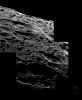
Japetus-PIA08403.jpgMiddle Northern Latitudes of Japetus56 visiteCassini soars above the many pits and basins in the rolling landscape of Saturn's moon Japetus. This mosaic view looks out onto an area close to the Northern bright/dark boundary, but still within the Dark Region, Cassini Regio.
Near upper left is a large crater with terraced walls, a mostly flat floor and a prominent group of peaks in its center. The sharp features make this likely one of the youngest craters in this area of Japetus. Cassini imaged another similarly flat-floored and relatively fresh crater during its Dec. 2004 Japetus flyby.
The mosaic consists of 3 image footprints across the surface of Japetus. The view is centered on terrain near 43,3° North Latitude, 138° West Longitude. Image scale is approx. 75 meters (246 feet) per pixel.
The clear spectral filter images in this mosaic were obtained with the Cassini spacecraft narrow-angle camera on Sept. 10, 2007, at a distance of approx. 13.500 Km (about 8.400 miles) from Japetus and at a Sun-Japetus-Spacecraft, or phase, angle of 139°.MareKromium
|
|
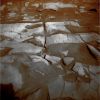
OPP-SOL1329-1N246174167EFF8788P0175L0M1.jpgPaving and Razorblades inside Victoria (2 - possible natural colors; light-blue color filter on; elab. Lunexit)56 visitenessun commentoMareKromium
|
|
| 25353 immagini su 2113 pagina(e) |
 |
|
|
|
|
1762 | |
|
|
|
|





