| Piú viste |
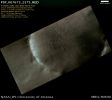
PSP_007673_2575_RED_abrowse.jpgFrosted North Polar Crater (MULTISPECTRUM; credits: Lunexit)56 visiteThis image was taken over the North Polar Region of Mars, just South of the Layered Ice Cap.
The image shows a 10 Km diameter impact crater during Northern Spring, still covered by Carbon Dioxide ice/frost, and perhaps some water ice/frost.
There are color variations due to the presence of reddish dust mixed with the ice/frost in different proportions, and the dark and relatively blue spots form when CO2 is released in small jets from beneath the ice.
There are no clear examples of small impact craters superimposed on the large crater, although there are many shallow depressions that might be degraded craters.
This seems puzzling because small (approx. 10 meters in diameter) craters form much more frequently than 10 Km craters.
In fact, they form about a billion times more frequently! The reason why there aren’t any sharp small craters is due to the fact that the ice destroys them, and does so rapidly, compared with the cratering rate.
Ice on Mars does not melt in the current climate, but it does expand and contract with temperature variations and it can flow.MareKromium
|
|

OPP-SOL069.jpgGreenish "dust" or "spores"? - Sol 69 (Superdefinition; credits: Dr G. Barca)56 visitenessun commentoMareKromium
|
|

PHOE-SOL001-PIA10682.jpgThe soil of Vastitas Borealis - Sol 1 (Approximate Colors; credits: NASA/JPL-Caltech/University of Arizona )56 visiteCaption NASA:"This image shows a polygonal pattern in the ground near NASA's Phoenix Mars Lander, similar in appearance to icy ground in the arctic regions of Earth.
Phoenix touched down on the Red Planet at 4:53 p.m. Pacific Time (7:53 p.m. Eastern Time), May 25, 2008, in an arctic region called Vastitas Borealis, at 68° North Latitude and 234° East Longitude.
This is an approximate-color image taken shortly after landing by the spacecraft's Surface Stereo Imager, inferred from two color filters, a violet, 450-nanometer filter and an infrared, 750-nanometer filter".
Nota Lunexit: una nuova "dizione" NASA. Ora questi (semi-assurdi) colori non sono più Approximate True o Approximate Natural: adesso sono SOLO "Approximate".
Beh, visti i quattrini, i mezzi, le tecnologie, le menti ed il tempo che si ritrovano a disposizione i nostri Amici di Pasadena, scusateci se, dopo aver visto questa (a nostro parere "quasi inguardabile") elaborazione, non ci sentiamo di fargli i complimenti...MareKromium
|
|

PHOE-SOL002-lg_458.jpgShadows on an orange-greenish soil - Sol 2 (MULTISPECTRUM; credits: Lunexit)56 visitenessun commentoMareKromium
|
|

PSP_008591_2485_cut_e.jpgPhoenix Lander "Hardware" (Day-Time Frame; MULTISPECTRUM process.)56 visitenessun commentoMareKromium
|
|

PHOE-SOL003-lg_766-1.jpgSlightly Over-exposed... - Sol 3 (Superdefinition + MULTISPECTRUM; credits: Dr M. Faccin & Lunexit)56 visiteL'immagine, come Voi stessi potete facilmente valutare, è leggermente sovraesposta. Ma sin qui, passi...La verità è che questo frame, prima dell'additional processing (riallineamento dei frames che formano la fotocomposizione incluso) il quale è stato posto in essere dal nostro eccezionale Dr Faccin, era praticamente inguardabile.
Qualcuno dei "vizi" in oggetto?
Lasciamo che sia lo stesso Marco a raccontarceli:"...sono intervenuto per tentare di migliorare la foto-composizione (collage) operata dalla Nasa. Se si guardano i frames originali - e specie i photo-composites -, non si può non notare che essi fanno semplicemente schifo. Ma "caspita" (!), dico: qui abbiamo dei frames che ci mostrano un altro Pianeta, che sono costati MILIONI DI DOLLARI, che potrebbero fornire indizi preziosissimi ed i Signori della NASA e della University of Arizona che fanno? Li incollano alla "come viene, viene": sommariamente. Male.
Allora, qui bisogna intendersi: la mia non è pignoleria fine a se stessa ma, in questi casi (visto il valore, Storico e Scientifico dei frames e valutati i costi per AVERE questi frames) un pò di precisione è ESSENZIALE.
Questa è ormai una questione di Professionalità...che manca! E che diavolo. E' come se portassi la mia macchina dal carozziere per una revisione e riverniciatura ed il lavoro venisse poi fatto - ripeto - "sommariamente"; alla "speriamo che non se ne accorga". Ma io me ne accorgo, ed a quel punto che faccio? Prendo per il collo il carrozziere e lo trito!
Ok, fine dello sfogo.
Lasciamo anche stare i "carrozzieri" (quelli che fanno il loro lavoro onestamente, intendo...), ma qui la verità va detta AD ALTA VOCE ED UNA VOLTA PER TUTTE: io (tutti noi) mi sento insultato e preso in giro da questa gente. Ma che cosa pensano? Che il "resto dell'Umanità" sia composto da fessi certificati?
Prova a notare: quando (ri)compongono i 3 frames RGB, neppure li allineano correttamente - infatti, se noti, la porzione superiore del frame è pateticamente fatta male.
La mia opinione? a Pasadena stanno davvero esagerando: stanno fornendo spazzatura al Mondo.
Ci danno da mangiare (sorry: da analizzare) gli scarti e pretendono che noi li si veda per pietanze sopraffine. Ma per favore!...".
Lo "sfogo" del Grande Marco Faccin è lo sfogo di tutti noi. E non è neppure uno sfogo "nuovo": pensate ai fotomosaici Apollo e Soujourner-Pathfinder (atroci); alle colorizzazioni psichedeliche Viking, Opportunity e Spirit (folli e brutte).
Il materiale che viene messo in Rete è, oltre che incompleto - quasi sempre -, pure rappresentativo dello "scarto dello scarto". Insomma: viene dato al Pubblico lo strettissimo indispensabile per non spingerlo a dire "quanti miliardi gettati via per nulla".
Ora, come Voi sapete bene, noi rispettiamo profondamente la NASA. Da sempre. E come scrivemmo in un articolo di qualche tempo fa, "...se la NASA non esistesse, bisognerebbe inventarla...". Tutto vero.
Noi rispettiamo l'Ente Spaziale più grande e più efficiente del Mondo, il quale ci permette di eseguire - ogni giorno - il nostro Lavoro di Ricercatori e Divulgatori.
Ma questo Rispetto ci farebbe piacere che venisse contraccambiato.
E si: perchè se la NASA e l'Esplorazione Spaziale hanno un "seguito", è (anche) grazie al Lavoro (ingrato e non retribuito) svolto da Istituti di Ricerca e di Divulgazione come il nostro.
E' (anche) grazie alla Passione, alla Curiosità ed all'Entusiasmo di decine di migliaia di "Space-Fans".
E' (anche) grazie al Lavoro - anch'esso ingrato e non retribuito - che MIGLIAIA di free-researchers ed anomaly hunters svolgono ogni giorno, 365 giorni l'anno.
Insomma: la NASA - e per questo noi non possiamo far altro che esserle GRATI - ci fornisce PREZIOSISSIMI SPUNTI ed ELEMENTI DI STUDIO tutti i giorni.
Ma, per favore, che non ci tratti da stupidi, perchè - ironicamente, anche grazie agli Amici di Pasadena - noi non lo siamo.
Amen.MareKromium
|
|

PHOE-SOL004-lg_877-B.jpgHalf-Dusty and Half-Clean... - Sol 4 (detail mgnf/Superdefinition; credits: Dr M. Faccin)56 visitenessun commentoMareKromium
|
|

PHOE-SOL005-lg_1015.jpgSmall Rocks in a Greenish/Reddish Soil - Sol 5 (MULTISPECTRUM; credits: Lunexit)56 visitenessun commentoMareKromium
|
|
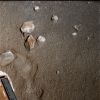
PHOE-SOL005-233915main_SS005EFF896647184_1170ER1M1-2-3.jpgSmall Rocks in a Greenish/Reddish Soil - Sol 5 (Superdefinition; credits: Dr G. Barca)56 visitenessun commentoMareKromium
|
|

PHOE-SOL005-PIA10741.jpgIce under Phoenix?!? - Sol 556 visiteCaption NASA:"The Robotic Arm Camera on NASA's Phoenix Mars Lander captured this image underneath the Lander on the fifth Martian Day, or Sol, of the mission. Descent thrusters on the bottom of the Lander are visible at the top of the image.
This view from the north side of the Lander toward the southern leg shows smooth surfaces cleared from overlying soil by the rocket exhaust during landing. One exposed edge of the underlying material was seen in Sol 4 images, but the newer image reveals a greater extent of it.
The abundance of excavated smooth and level surfaces adds evidence to a hypothesis that the underlying material is an ice table covered by a thin blanket of soil. The bright-looking surface material in the center, where the image is partly overexposed, may not be inherently brighter than the foreground material in shadow".MareKromium
|
|

PHOE-SOL006-lg_1300.jpgIn the Sky over Vastitas Borealis... - Sol 6 (MULTISPECTRUM; credits: Lunexit)56 visiteM.L.S.T. (Mars Local Solar Time): 12:59:34
Camera Elevation: 83,7873°
Azimuth: 208,49°
MareKromium
|
|

PHOE-SOL006-lg_1299.jpgIn the Sky over Vastitas Borealis... - Sol 6 (MULTISPECTRUM; credits: Lunexit)56 visiteM.L.S.T. (Mars Local Solar Time): 12:59:34
Camera Elevation: 83,7873°
Azimuth: 208,49°MareKromium
|
|
| 25353 immagini su 2113 pagina(e) |
 |
|
|
|
|
1761 | |
|
|
|
|





