| Piú viste |

PHOE-SOL122-lg36399-36400-36401-2.jpgDisturbed Terrain - Sol 122 (Superdefinition and possible True Colors; credits: Dr G. Barca)56 visitenessun commentoMareKromium
|
|

PHOE-SOL122-lg35987-35988-35989-2.jpgDisturbed Terrain - Sol 122 (Superdefinition and possible True Colors; credits: Dr G. Barca)56 visitenessun commentoMareKromium
|
|

Enceladus-PIA10483.jpgThe Leading Hemisphere of Enceladus56 visiteCaption NASA:"During a distant flyby encounter with Enceladus, Cassini imaged the moon's wrinkled Leading Hemisphere.
At the scale visible here, this region of the surface is generally devoid of impact craters, suggesting that the terrain has been modified and renewed during the moon's history.
To the North lies a heavily cratered and presumably older Region. The sinuous boundary of the geologically active South Polar Region is seen at bottom. North on Enceladus is toward the top of the image.
The image was taken in visible green light with the Cassini Spacecraft narrow-angle camera on Sept. 30, 2007. The view was acquired at a distance of approx. 108.000 Km (such as about 67.000 miles) from Enceladus and at a Sun-Enceladus-Spacecraft, or phase, angle of 75°.
Image scale is 644 meters (2111 feet) per pixel".MareKromium
|
|
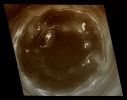
Saturn-SP-PIA11104.jpgSouthern Turbulence (False Colors; credits: Lunexit)56 visiteCaption NASA:"This detailed Cassini view of the monstrous vortex at Saturn's South Pole provides valuable insight about the mechanisms that power the Planet's Atmosphere.
This view is 10 times more detailed than any previous image of the Polar Vortex. See PIA11103 for a more oblique, wide-angle view that provides context for this close-up.
Previous images revealed an outer ring of high clouds surrounding a Region previously thought to be mostly clear air interspersed with a few puffy clouds that circulate around the center. This new image shows that what looked like puffy clouds at lower resolution are actually vigorous convective storms that form yet another distinct, inner ring. In other words, they are deep convective structures seen through the atmospheric haze. One of the deeper structures (at the 10 o'clock position) has punched through to a higher altitude and created its own little vortex. The ring is similar to the eyewall of a terrestrial hurricane, but much larger. The clear air there is warm, like the eye of a terrestrial hurricane, but on Saturn it is locked to the pole, whereas a terrestrial hurricane drifts around.
Convective structures are small regions of intense upwelling air, but the clear air of the vortex eye indicates that this is generally an area of downwelling. Convection is an important part of the planet's energy budget because the warm upwelling air carries heat from the interior. In a terrestrial hurricane, the convection occurs in the eyewall. Here it seems to occur in the eye as well. The camera filter used for this image captures light at wavelengths where atmospheric gases like Methane are fairly transparent, allowing for detailed views of deep cloud features. Other filters (see PIA09859) use light that is strongly absorbed by Methane gas; the light bounces off the high clouds, making them visible, but gets absorbed before it reaches the low clouds. Such "Methane-Band" images of the South Polar Vortex reveal that the convective clouds do not reach up to the base of the stratosphere, as convective clouds on Earth do. This view was acquired from 56° below the Ring-Plane. The image has been digitally reprojected to show the scene as it would appear to an observer positioned directly above the Pole.
The image was taken with the Cassini Spacecraft narrow-angle camera on July 14, 2008, using a combination of two spectral filters sensitive to wavelengths of polarized visible light centered at 617 and infrared light centered at 750 nanometers. The view was obtained at a distance of approx. 392.000 Km (243.000 miles) from Saturn and at a Sun-Saturn-Spacecraft, or Phase, Angle of 60°.
Image scale is roughly 2 Km (a little more than 1 mile) per pixel".MareKromium
|
|

Saturn-SP-PIA11103.jpgSouthern Turbulence (natural colors; credits: Lunexit)56 visiteCaption NASA:"Shadows reveal the topography of Saturn's South Polar Vortex. At high resolution, a new, inner ring of isolated, bright clouds is seen. These clouds are localized regions of convective upwelling, an important clue to understanding how heat energy is transported in Saturn's Atmosphere.
See PIA11104 for a high-resolution Cassini view that looks more directly down onto the vortex, compared to this oblique perspective. Sunlight illuminates the scene from upper right, and the higher altitude rings of clouds surrounding the pole cast shadows toward lower left. North on Saturn is up.
The image was taken with the Cassini Spacecraft narrow-angle camera on July 15, 2008, with a combination of spectral filters sensitive to wavelengths of polarized infrared light centered at 746 and 938 nanometers. The grainy quality of the image is due primarily to the low signal-to-noise ratio of images taken with the 938 nanometer spectral filter, which is near the upper limit of the wavelength range the camera can see. "Signal-to-noise" is a term scientists use to refer to the amount of meaningful or useful information (signal) in their data versus the amount of background noise. A higher signal-to-noise ratio yields sharper, clearer views of features in the atmosphere.
The view was acquired from 24° below the Ring-Plane, at a distance of approx. 778.000 Km (about 483.000 miles) from Saturn.
The Sun-Saturn-Spacecraft, or Phase, Angle is about 30°.
Image scale is 4 Km (about 3 miles) per pixel".MareKromium
|
|

Saturn-RingPlane_cassini_big.jpgAlong the Ring-Plane of Saturn (natural colors; credits: NASA)56 visiteCaption NASA originale:"When Saturn's appendages disappeared in 1612, Galileo did not understand why. Later that century, it became understood that Saturn's unusual protrusions were Rings and that when the Earth crosses the Ring-Plane, the edge-on rings will appear to disappear.
This is because Saturn's Rings are confined to a plane many times thinner, in proportion, than a razor blade. In modern times, the Cassini Spacecraft orbiting Saturn now also crosses Saturn's Ring-Plane. A series of plane crossing images from late February (2006) was dug out of the vast online Cassini raw image archive by interested Spanish amateur Fernando Garcia Navarro.
Pictured above, digitally cropped and set in representative colors, is the striking result. Saturn's thin Ring-Plane appears in blue, bands and clouds in Saturn's Upper Atmosphere appear in gold and dark shadows of the Rings curve across the top of the Gas Giant Planet. Moons appear as bumps in the Rings". MareKromium
|
|

Spirit-OrbitalView-20081009-MRO.jpgGusev Crater and Spirit: Aerial View56 visiteCaption NASA:"Clear skies and low-angle sunlight are an outdoor photographer's dream. On the shortest day of Martian winter, June 24, 2008, Spirit had both. Conditions were ideal for an orbiter's shot of the Mars Rover parked on the sunlit slope of a volcanic plateau.
Shadows outlined shapes in the landscape, such as the upturned edges of the bowl-shaped plateau known as "Home Plate". Shadows also reveal nearby ridges, slopes, and large boulders. Spirit is the dark "bump", marked by a yellow arrow.
Detailed images such as this one will help scientists select a future path for Spirit. For plotting a path on Mars, a powerful orbiting camera, long shadows, and a clear sky are about as good as it gets".MareKromium
|
|

SOL0695-MF.jpgHuge Boulders near Spirit - Sol 695 (Hi-Def3-D - Natural Colors; credits and Copyright: Dr M. Faccin and Lunar Explorer Italia)56 visitenessun commentoMareKromium
|
|
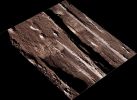
PHOE-SOL138-lg40031-40032-40033-3.jpgThe "Trenches" in Perspective - Sol 138 (Superdefinition and possible True Colors; credits: Dr G. Barca)56 visitenessun commentoMareKromium
|
|
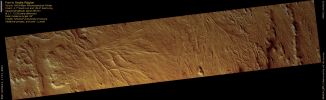
Psp_009623_1755_red.jpgFan in Aeolis Planum Region (natural colors; credits: Lunexit)56 visiteThis image shows a "Fan" of long raised ridges in the Aeolis Region of Mars.
These ridges are thought to be Inverted Stream Channels, where formerly low-lying streambeds have been hardened and then turned into ridges when the surrounding material was eroded.
This can occur if the stream deposited minerals, filling in pore spaces and hardening the streambed.
The assortment of ridges here is extremely complex, with strands cutting across each other. However, the actual stream system here could have been simpler, with ridges preserving different time periods in the history of the system. This possibility is supported by several sites where one ridge runs smoothly across another without disruption. One way for this to occur would be to have one streambed hardened and buried, with the stream subsequently changing course and cutting across its buried old route.
Although not all of the channels were active at once, this site clearly preserves a complex history, probably requiring thousands of years to foMareKromium
|
|

PSP_009708_2205_RED_abrowse-01.jpgHills in Acidalia Planitia (EDM - Enhanced Natural Colors; credits for the additional process. and color.: Dr Paolo C. Fienga - Lunexit Team)56 visiteThis edm frame (375x250 meters, or 410x273 yards) of the HiRISE depicts in detail the rocky layers existing in one of these hills.
CRISM, another of the instruments onboard Mars Reconnaissance Orbiter, has acquired data over this same region showing that the rocky outcrops contain clays. Clays of similar composition form in terrestrial environments favorable for life, where volcanic rocks are in close contact with water.MareKromium
|
|
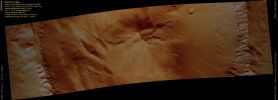
Psp_009677_2135_red.jpgBacolor Crater (natural colors; credits: Lunexit)56 visiteBacolor Crater is a pristine crater in the Northern Hemisphere. The linear striations visible at both sides (Sx and Dx) of the image are from the blast of the formation impact. This crater has a Central Peak, other mounds and terraces on its floor.
All of these features appeared during the final stages of crater formation.
The Northern Wall of the crater has landslides which have sculpted the Crater Rim. The Southern Wall has Gullies, thought to form by fluvial processes.
The Gullies here are more incised (cut into the slope) than the landslides are.MareKromium
|
|
| 25353 immagini su 2113 pagina(e) |
 |
|
|
|
|
1750 | |
|
|
|
|





