| Piú viste |

PHOE-SOL006-lg_1299.jpgIn the Sky over Vastitas Borealis... - Sol 6 (MULTISPECTRUM; credits: Lunexit)56 visiteM.L.S.T. (Mars Local Solar Time): 12:59:34
Camera Elevation: 83,7873°
Azimuth: 208,49°MareKromium
|
|
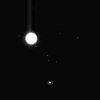
PHOE-SOL006-lg_1084.jpgObjects near the Sun? - Sol 656 visiteStiamo osservando degli (inusuali) image-artifacts accanto al "pallido" Sole che splende sulla Pianura di Vastitas orealis, oppure, oltre a (probabilmente) una delle due Lune Marziane, c'è qualcosa d'altro nel Cielo di Marte? Qualcosa che è stata "catturata" da questi frames?
Voi che dite?...
M.L.S.T.: 15:27:40
Camera elevation: 36,6626°
Azimuth: 243,862°MareKromium
|
|
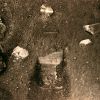
PHOE-SOL007-lg_1601.jpgThat's a "Scoop"! - Sol 7 (MULTISPECTRUM; credits: Lunexit)56 visiteJune 1, 2008 -- TUCSON, Arizona
NASA's Phoenix Mars Lander reached out and touched the Martian Soil for the first time on Saturday, May 31, the first step in a series of actions expected to bring soil and ice to the Lander's experiments.
The lander's Robotic Arm scoop left an impression that resembles a footprint at a place provisionally named Yeti in the King of Hearts target zone, away from the area that eventually will be sampled for evaluation.
The impression in the soil was captured by Phoenix's Stereo Surface Imager. Features and locations around the Phoenix lander are being named for fairy tale and mythological characters.
"This first touch allows us to utilize the Robotic Arm accurately. We are in a good situation for the upcoming sample acquisition and transfer," said David Spencer, Phoenix's surface mission manager from NASA's Jet Propulsion Laboratory in Pasadena, California.
Phoenix's Robotic Arm Camera also took a number of images of the "Snow Queen" site of what is believed to be exposed ice under the lander.
"What we see in the images is in agreement with the notion that it may be ice, and we suspect we will see the same thing in the digging area", said Uwe Keller, Robotic Arm Camera Lead Scientist from the Max Planck Institute for Solar System Research, Katlenburg-Lindau, Germany.MareKromium
|
|
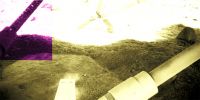
PHOE-SOL007-lg_2289.jpgIce on the Lander - Sol 7 (false colors; credits: Dr M. Faccin)56 visitenessun commentoMareKromium
|
|

PHOE-SOL007-lg_2274-B.jpgIce on the Lander - Sol 7 (false colors; credits: Dr M. Faccin)56 visiteUn frame bellissimo, un detail mgnf quasi inequivocabile, un grandissimo Lavoro del Dr Faccin. Tutto qui. E scusate se è poco...MareKromium
|
|
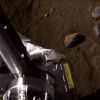
PHOE-SOL007-235099main_SS007EFF896838984_117F8RBM1-2-3.jpgPhoenix and the Landscape in True Colors! - Sol 7 (Superdefinition; credits: Dr Gianluigi Barca)56 visiteUn Lavoro FANTASTICO del Dr Barca: un Lavoro che non ha ASSOLUTAMENTE NULLA da invidiare alle elaborazioni NASA, anzi...Lasciatecelo dire: semmai è vero il contrario!MareKromium
|
|

PHOE-SOL008-MartianWinds.gifMartian Winds - Sol 8 (GIF-Movie; credits: Dr M. Faccin)56 visiteUn GIF-Movie spettacolare (magari la NASA ne facesse di simili!...) il quale ci mostra quanto forte spira il Vento su Vastitas Borealis.
Complimenti e Congratulazioni al Dr Faccin: SPLENDIDO!MareKromium
|
|
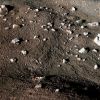
PHOE-SOL008-lg_2330-2331-2334.jpgThe soil of Vastitas Borealis - Sol 8 (Natural Colors + MULTISPECTRUM; credits: Dr Gianluigi Barca & Lunexit)56 visiteDue annotazioni: 1) come aveva già notato il nostro Caro Amico e Socio, Sig. Canobbio, sulla pianura dove Phoenix è scesa non si è ancora riusciti ad individuare alcun "Martian Berry", o "Frutto di Bosco Marziano".
Un fatto, questo, piuttosto curioso e che ci riporta alla nostra vecchia idea (che sarà pure "estrema" e "fantasiosa"...ma a noi piace!) secondo cui i "Martian Berries" non sono affatto "sferule di roccia" le quali sono il risultato di processi vulcanici ed eolici, bensì "fossili" di quelle che potevano essere delle Forme Vitali Indigene che abitavano l'Oceanus Meridiani (oggi: Meridiani Planum). Un Oceano Equatoriale, con clima e caratteristiche ben diverse dalla Regione Nordica di Vastitas. Pensateci sopra...
2) il nostro color processing fa "emergere" costantemente delle aree verdastre, le quali sembrano ricoperte di licheni di un qualche tipo. Aree verdastre che, nel color processing NASA, scompaiono (anzi: proprio non esistono!). Avete delle opinioni in merito?!?MareKromium
|
|
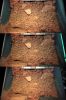
PHOE-SOL009-lg_3068.jpgOne "scoop" of Vastitas... - Sol 9 (Approximate Colors; credits: NASA/JPL/Univ. of Arizona; Texas A&M)56 visiteUn solo commento: colore "falsissimo" (a meno che il terriccio Marziano non sia stato direttamente illuminato da una sorgente ravvicinata di luce).MareKromium
|
|
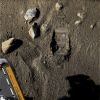
PHOE-SOL010-lg_2881-2882-2883.jpgThe "White Layer" of Ice, according to Lunexit - Sol 9 (Superdefinition; credits: Dr Gianluigi Barca)56 visiteInutile "nascondersi" dietro ad un dito e, almeno in questo caso, permetteteci di dirVi una cosa senza ostentare falsa modestia: la qualità del Color Processing Lunexit è ENORMEMENTE SUPERIORE alla qualità del Color Processing NASA.
Il merito di questo straordinario risultato è dei nostri due Amici e Colleghi, Drr Gianluigi Barca e Marco Faccin, ai quali vanno i nostri più grandi e sinceri COMPLIMENTI (e se gli Amici di Pasadena avessero un pizzico di umiltà e buon senso, avrebbero già dovuto smetterla di pubblicare le loro orribili immagini in "approximate colors", sul cui senso logico e cromatico si stanno già interrogando davvero in tanti...Anche in USA!).MareKromium
|
|
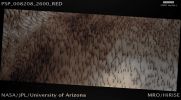
PSP_008208_2600_RED_abrowse-00.jpgAwakening Dunes... (MULTISPECTRUM; credits: Lunexit)56 visiteThis image captures unusual arrow-shaped sand dunes in the north polar Olympia Undae region that may have been formed by changing winds. The dark patches and streaks show sand that has begun escaping from a blanket of seasonal frost.
Many of the typical types of Martian dunes are similar to common dunes on Earth. Transverse dunes have gentle upwind slopes and steep lee sides that are perpendicular to the wind direction. Barchans are crescent-shaped dunes with a gentle upwind slope and steep lee with horns. Other common dunes on Earth and Mars are seif dunes that form sinuous parallel ridges with bi-directional winds forming the slip-faces.
The dune types in this image transition from transverse in the south through tight chains of barchans, to the strange, elongated dunes in the north. These elongated dunes appear to be modified barchans with two slip-faces and asymmetric horns. The drawn out limbs and remnant slip-faces were apparently produced by variations in the wind direction. The winds that created the transverse dunes blow from a single easterly direction, while the modified barchans are shaped by winds from an easterly-northeasterly direction. The elongated horns align parallel to northeasterly winds. These wind variations could be caused by local topography.
Two factors likely contribute to the unique morphology of these dunes. First, the southern horns defrost sooner than the northern horns because they receive sunlight more directly. This enables material to move more easily on their southern side. Second, the changing wind directions may be reorienting the dunes. One idea is that the barchans’ southern horns are being blown downwind into linear (seif-like) dunes, with sinuous crests and steep flanks. Another possible explanation is that they are drifts of sand (lee dunes) that form in the lee of an obstacle. The frozen barchans might act as obstacles to the wind, allowing loose sand to accumulate in their lee. In either case, the interaction between the sand, wind, and seasonal frost sculpts the dunes to their unusual, arrow-like appearance.
MareKromium
|
|
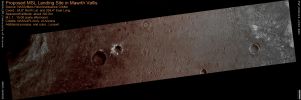
PSP_008324_2050_RED_abrowse.jpgProposed MSL Landing Site in Mawrth Vallis - ellipse 4 (MULTISPECTRUM; credits: Lunexit)56 visiteMawrth Vallis has a rich mineral diversity, including clay minerals that formed by the chemical alteration of rocks by water. The CRISM instrument detects a variety of clay minerals here, which could signify different processes of formation. The high resolution of the HiRISE camera helps us to see and trace out layers, polygonal fractures, and with CRISM, examine the distribution of various minerals across the surface.
This surface is scientifically compelling for the MSL Rover, although some of the terrain can be somewhat rough. Scientists use HiRISE images to find the safest possible Landing Site for the Rover.MareKromium
|
|
| 25353 immagini su 2113 pagina(e) |
 |
|
|
|
|
1743 | |
|
|
|
|





