| Piú viste |

North_Polar_Features-Unconformity-MGS-01.jpgNorth Polar "Unconformity" (Original NASA/MGS/MSSS b/w Frame)56 visiteCaption NASA originale:"This MGS-MOC image shows layered material exposed on a slope in the North Polar Region.
An "unconformity" is visible in the middle/lower left of the image, where layers are abruptly truncated. Unconformities are indicators of drastic change in the Region — the lower layers were deposited first, then eroded, then the upper layers were deposited".
Location near: 81,1° North Lat. and 75,2° West Long.
Image width: ~3 Km (~1,9 mi)
Illumination from: lower left
Season: Northern Spring
|
|

APOLLO 16 AS 16-122-19580.jpgAS 16-122-19580 - King Crater56 visiteThis vertical view of the crater King on the Lunar Far-Side was taken with the Apollo 16 Hasselblad camera. King, approx. 75 Km in diameter and 4 Km deep, is one of the most interesting features on the Far-Side. It is a superb example of a youthful, large crater. It attracted much attention and was the object of numerous scientific studies (Young, Brennan and Wolfe, 1972).
King is the freshest crater on the Far-Side in its size range. Among its many interesting features are:
1) a unique lobster-claw-like central peak;
2) a flat poollike area of dark material on the North rim believed to have once been molten;
3) a very-well-developed field of fine ejecta extending outward for approx. two crater diameters, and
4) a massive landslide on the South-East rim (see arrow).
In this view the Southern part of the central peak has a distinctly ropey appearance and is segmented parallel to the terraces of the adjacent crater wall. The low Sun illumination enhances the fine texture of King's ejecta. Northeast of King the ejecta mantles an old large crater and in the southwest corner of the picture it mantles a relatively smooth terra unit. The slightly raised plateau on which the crater is situated may be part of the ring of an old basin.
|
|
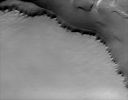
North_Polar_Features-North_Polar_Margin-PIA08705-1.jpgThe North Polar "Margin" (1 - Original NASA/JPL/ASU b/w Frame)56 visiteImage information: VIS instrument;
Latitude: 81,1° North;
Longitude: 299,2° East:
Resolution: 20 meter/pixel.
|
|

Saturn-PIA08253.jpgThe "Ring-Masters"56 visiteCaption NASA:"This view looks down onto the unlit side of Saturn's Ringplane. It nicely shows a near-arm/far-arm brightness asymmetry in the B-Ring: The near arm of the B-Ring (in the lower half of the image) is notably darker from this viewing geometry than is the far arm (above).
Imaging scientists believe this to be a manifestation of the reflection of light from the disk of Saturn falling predominantly on the far arm of the Rings. (At the time this image was taken, Cassini was more or less on the dark side of the Planet.) As the B-Ring is the thickest part of Saturn's Rings, it scatters less sunlight from below, and reflects more Saturnshine from above, than either the A or C-Rings, making the effect look more dramatic in the B-Ring. Two small moons appear in this scene as well: Atlas and Pandora (32 and 84 Km across, respectively); between the two moons lie multiple clumps of material in the F-Ring.
The image was taken in visible light with the Cassini spacecraft wide-angle camera on July 25, 2006 at a distance of approximately 1 million kilometers (600,000 miles) from Saturn and at a Sun-Saturn-spacecraft, or phase, angle of 128 degrees. Image scale is 58 kilometers (36 miles) per pixel.
|
|
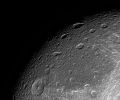
Dione-PIA08256-A.jpgThe "White (and Bright) Cliffs" of Dione (detail mgnf n. 1)56 visitenessun commento
|
|

OPP-SOL926-1M210388086EFF758ZP2936M2M1.jpgThe "texture" of Mars... - Sol 92656 visitenessun commento
|
|

10-vg1_p21231.jpgIn the vicinities of the "Great Red Spot" (natural colors)56 visitenessun commento
|
|

16-vg1_1636548.jpgSwirling Atmosphere...56 visitenessun commento
|
|

30-vg1_1636836.jpgIo and His volcanoes... (1)56 visitenessun commento
|
|

Dione & Rhea-PIA08261.jpgNight-lights, in the Saturnshine...56 visiteCaption NASA originale:"Soft light from Saturn lifts the veil of night from the moons Dione (lower left) and Rhea (upper right).
A scant crescent on each satellite marks the limit of the Sun's direct reach. The remaining light is reflected onto the moons by the Ringed Planet (Saturn-shine).
This view was acquired using an image compression scheme that results in minor artifacts being present - on Rhea in particular.
Rhea (approx. 1.528 Km, or 949 miles across - pictured above) is somewhat bland in appearance at this image scale, although Dione's spectacular fractures stand out marvelously. Dione is approx. 1.126 Km (about 700 miles) across.
North, on both moons, is rotated 45° to the right.
The image was taken in visible light with the Cassini spacecraft narrow-angle camera on Aug. 11, 2006 at a distance of approx. 2,6 MKM (about 1,6 MMs) from Dione and 2.8 MKM (1,7 MMs) from Rhea. Image scale is about 15 Km (approx. 10 miles) per pixel on Dione and about 17 Km (approx. 11 miles) on Rhea".
|
|

61-smart-1_data1002887_030_H.jpgDouble Crater56 visiteCaption ESA originale:"This beautiful oblique view was taken on 2 September 2006 by the AMIE camera on board SMART-1 during the last few orbits prior to Moon impact, and shows a double crater.
This view was captured during the imaging session which took place bewteen 15:19 and 17:34 CEST (17:19 - 19:34 UT)".
|
|

Prometheus.jpgPrometheus: the "Ring-Shaper"...56 visiteCaption NASA originale:"Prometheus zooms across the Cassini spacecraft's field of view, attended by faint streamers and deep gores in Saturn's F-Ring. This frame (taken from a movie sequence of five images) shows the F-Ring shepherd moon shaping the Ring's inner edge.
Note (watching the movie) that the faint ringlet coincident with the orbit of Prometheus (only 102 Km or approx. 63 miles across) decreases sharply in brightness behind the moon in its path. The normally twisted-looking F-Ring core is overexposed in the images, causing its appearance to be more uniform than it usually is.
This image was taken in visible light with the Cassini spacecraft narrow-angle camera on Aug. 11, 2006, at a distance of approx. 2,2 MKM (about 1,4 MMs) from Saturn and at a Sun-Saturn-spacecraft, or phase, angle of 162°. Image scale is roughly 13 Km (about 8 miles) per pixel".
|
|
| 25353 immagini su 2113 pagina(e) |
 |
|
|
|
|
1739 | |
|
|
|
|





