| Piú viste |
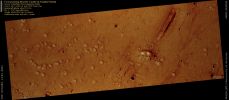
PSP_009485_2185_red.jpgClusters of Mounds at Acidalia Planitia (Extremely Enhanced and Saturated Natural Colors; credits for the additional process. and color.: Dr Paolo C. Fienga - Lunexit Team)56 visiteThis HiRISE image shows clusters of light-colored Mounds poking through the Dark Plains of Acidalia. These Mounds are similar in shape and color to mounds identified elsewhere in the Northern Lowlands.
The mounds imaged here are approximately 250 meters (270 yards) across, and most of them have one or more central crater-like depressed areas, looking like terrestrial cinder cones. Terrestrial cinder cones are formed by loose volcanic fragments, mostly gravel- and boulder-size. In contrast, the surface of these Martian Mounds looks cemented rather than bouldery.
There are several hypothesis to explain the origin of these Martian Mounds; all of them require the presence of fluids near or at the surface.
One hypothesis is that these mounds are Hydrothermal Spring edifices like those at Yellowstone. Terrestrial Hydrothermal Spring Mounds form when hot subsurface fluids, loaded with minerals, reach the surface and deposit their load.
Another possible explanation is that these Mounds are "Mud Volcanoes", similar to those found at Trinidad and Tobago. Mud Volcanism occurs when buried wet sediments are subject to high pressures and squeeze out though weak points at the surface.
Some terrestrial "Pseudocraters" are also similar to these Martian Mounds. Pseudocraters form when lava flows over wet terrains or over water bodies. The lava’s heat vaporizes the fluids, which then burst through the lava, producing small explosions and building conical landforms.MareKromium
|
|

Psp_009474_1705_red.jpgWater Bearing Minerals in Noctis Labyrinthus (natural colors; credits: Lunexit)56 visiteNoctis Labyrinthus consists of a series of Pits on the western end of the large Valles Marineris Canyon System.
The HiRISE camera and the CRISM Spectrometer have revealed that the floors of some of these Pits exhibit layered rocks, or strata, that contain minerals with water. These Pits were formed several billion years ago, therefore the rocks and sediments on their floors record evidence of water during this period of Mars’ history.
The walls of the Pits are commonly covered with dust and other loose sediments that form dunes and dune-like forms, and in many cases the floors of the pits are also covered with these materials. This image shows an example of light-toned layers exposed beneath these sediments and dunes, and CRISM data show that these layers have hydrated minerals.
The dark-brown/orange tones in this natural color image correspond to areas with more Pyroxene, a mineral found in volcanic rocks and Martian Dust. Some Pits, such as this one, appear to have deposits associated with large landslides that are younger than the hydrated minerals and partially bury them.MareKromium
|
|

Psp_009502_1980_red.jpgDark Spot Near Olmpus Mons Volcano (natural colors; credits: Lunexit)56 visiteThis image covers a relatively dark-toned patch of ground West of the Olympus Mons volcano. This spot is one of several "Dark Areas" in this Region of Mars.
These Dark Spots are distinctive because much of the surrounding area appears to be covered by light-toned dust.
In pre-HiRISE images, the origin of this Dark Spot was ambiguous. This HiRISE image reveals that the dark color is likely the result of accumulations of Basaltic Sand (smooth, brown-colored material in this natural color view) on top of otherwise relatively dust-free bedrock.
Evidence of layering is also visible within the dark area. There are alternating bands of lighter- and darker-toned material, consistent with alternating layers of bedrock. These alternating bands are not apparent outside of the Dark Area. This may mean that alternating layers of bedrock only occur within the dark area, or that these bedrock layers occur throughout the region but are covered and obscured by light-toned dust outside of the Dark Area.MareKromium
|
|
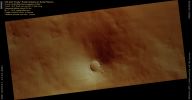
PSP_009527_1670_RED.JPGOld and "Dusty" Volcano in Syria Planum (natural colors; credits: Lunexit)56 visiteThis image shows an old volcano in Syria PlanumRegion, near the edge of the Tharsis volcanic rise. This is a Region where extensive volcanism has occurred; in many places, the upper walls of Valles Marineris have cut through lava flows.
The basic shape of the old volcano is visible here, but the entire region has been coated by dust.
This makes it difficult to learn more about the volcanic processes that have occurred at this site. However, the mantle is interesting by itself. It has probably settled out of the atmosphere, either as dust or possibly volcanic ash, since it seems to coat the entire region uniformly. (Mars has frequent, massive Dust Storms which could create large deposits over time.) This mantle has a regular, scalloped texture that is visible at several scales.
The texture is not well understood; it is common in volcanic terrains, but also occurs on some other rock outcrops.
HiRISE scientists are studying images like this one to determine how it forms.MareKromium
|
|

SOL1657-1.jpgRocky Skyline - Sol 1657 (natural colors; credits: Dr G. Barca)56 visitenessun commentoMareKromium
|
|
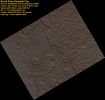
PSP_004000_0945_RED_browse~0.jpgThe "South Polar Residual Cap" (natural colors; credits: Lunexit)56 visite
Like Earth, Mars has concentrations of water ice at both poles. Because Mars is so much colder, however, the seasonal ice that is deposited at high latitudes in the winter and is removed in the spring (generally analogous to winter time snow on Earth) is carbon dioxide ice. Around the south pole there are areas of this carbon dioxide ice that do not disappear every spring, but rather survive winter after winter&emdash;this persistent carbon dioxide ice is called the south pole residual cap.
Relatively high-standing smooth material is broken up by circular, oval, and blob-shaped depressions, forming a pattern called "swiss cheese" terrain. The high-standing areas are carbon dioxide ice with thicknesses probably of several meters. The depressions are thought to be caused by the removal of carbon dioxide ice by sublimation (the change of a material from solid directly to gas). By looking at different sized depressions in an image such as this, and by comparing images of the same place from year to year, the development of "swiss cheese" terrain can be observed.
The sublimation process may begin anywhere as a small depression. Once this small depression is formed, it expands laterally in all directions, creating the rounded depressions we see today. As most depressions seem to have a similar depth and have relatively flat bottoms, there is likely some layer below, possibly of water ice, that cannot be as easily removed by sublimation. Thus, while the south polar residual cap as a whole is present every year, there are certainly annual changes taking place within it.
Especially apparent and interesting in this image are the strips of material that parallel the edges of many depressions. Often there are two or more concentric strips that are smooth like the surrounding surface, but seem to be lower than the surrounding surface and in places appear to be tilted down towards the center of the depression. Inner strips are sometimes broken up into chunks. It may be that the uppermost smooth layer is a bit more resistant to sublimation than the material just below it&emdash;the quicker removal of the underlying material might cause the stronger upper layer to detach from the surrounding terrain and settle down towards the center of the depression.
Alternatively, these ringing strips may indicate that many layers are present within the carbon dioxide ice. Another interesting feature is the faint crisscrossing network of ridges on the upper smooth terrain. These may also be complexly involved in the sublimation and deposition of carbon dioxide ice.
With the high resolution capability of HiRISE, we intend to measure the amount of expansion of the depressions over one or more Mars years. Knowing the amount of carbon dioxide removed can give us an idea of the current atmospheric and climate conditions, and possibly how Mars climate may be changing.
MareKromium
|
|
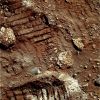
SOL424-MF-LXT.jpgRover Tracks, Dust and soft Soil - Sol 424 (natural colors; credits: Dr M. Faccin & Lunexit)56 visitenessun commentoMareKromium
|
|

SaturnSpace-N00115343-N00115349.gifThrough the "Eyes" of Cassini... (GIF-Movie; credits: Dr G. Barca)56 visiteSuggestivo, affascinante e, alla fine - semplicemente -, bello!MareKromium
|
|

PHOE-SOL122-lg36399-36400-36401-2.jpgDisturbed Terrain - Sol 122 (Superdefinition and possible True Colors; credits: Dr G. Barca)56 visitenessun commentoMareKromium
|
|

PHOE-SOL122-lg35987-35988-35989-2.jpgDisturbed Terrain - Sol 122 (Superdefinition and possible True Colors; credits: Dr G. Barca)56 visitenessun commentoMareKromium
|
|
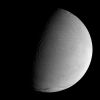
Enceladus-PIA10483.jpgThe Leading Hemisphere of Enceladus56 visiteCaption NASA:"During a distant flyby encounter with Enceladus, Cassini imaged the moon's wrinkled Leading Hemisphere.
At the scale visible here, this region of the surface is generally devoid of impact craters, suggesting that the terrain has been modified and renewed during the moon's history.
To the North lies a heavily cratered and presumably older Region. The sinuous boundary of the geologically active South Polar Region is seen at bottom. North on Enceladus is toward the top of the image.
The image was taken in visible green light with the Cassini Spacecraft narrow-angle camera on Sept. 30, 2007. The view was acquired at a distance of approx. 108.000 Km (such as about 67.000 miles) from Enceladus and at a Sun-Enceladus-Spacecraft, or phase, angle of 75°.
Image scale is 644 meters (2111 feet) per pixel".MareKromium
|
|
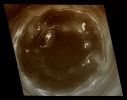
Saturn-SP-PIA11104.jpgSouthern Turbulence (False Colors; credits: Lunexit)56 visiteCaption NASA:"This detailed Cassini view of the monstrous vortex at Saturn's South Pole provides valuable insight about the mechanisms that power the Planet's Atmosphere.
This view is 10 times more detailed than any previous image of the Polar Vortex. See PIA11103 for a more oblique, wide-angle view that provides context for this close-up.
Previous images revealed an outer ring of high clouds surrounding a Region previously thought to be mostly clear air interspersed with a few puffy clouds that circulate around the center. This new image shows that what looked like puffy clouds at lower resolution are actually vigorous convective storms that form yet another distinct, inner ring. In other words, they are deep convective structures seen through the atmospheric haze. One of the deeper structures (at the 10 o'clock position) has punched through to a higher altitude and created its own little vortex. The ring is similar to the eyewall of a terrestrial hurricane, but much larger. The clear air there is warm, like the eye of a terrestrial hurricane, but on Saturn it is locked to the pole, whereas a terrestrial hurricane drifts around.
Convective structures are small regions of intense upwelling air, but the clear air of the vortex eye indicates that this is generally an area of downwelling. Convection is an important part of the planet's energy budget because the warm upwelling air carries heat from the interior. In a terrestrial hurricane, the convection occurs in the eyewall. Here it seems to occur in the eye as well. The camera filter used for this image captures light at wavelengths where atmospheric gases like Methane are fairly transparent, allowing for detailed views of deep cloud features. Other filters (see PIA09859) use light that is strongly absorbed by Methane gas; the light bounces off the high clouds, making them visible, but gets absorbed before it reaches the low clouds. Such "Methane-Band" images of the South Polar Vortex reveal that the convective clouds do not reach up to the base of the stratosphere, as convective clouds on Earth do. This view was acquired from 56° below the Ring-Plane. The image has been digitally reprojected to show the scene as it would appear to an observer positioned directly above the Pole.
The image was taken with the Cassini Spacecraft narrow-angle camera on July 14, 2008, using a combination of two spectral filters sensitive to wavelengths of polarized visible light centered at 617 and infrared light centered at 750 nanometers. The view was obtained at a distance of approx. 392.000 Km (243.000 miles) from Saturn and at a Sun-Saturn-Spacecraft, or Phase, Angle of 60°.
Image scale is roughly 2 Km (a little more than 1 mile) per pixel".MareKromium
|
|
| 25353 immagini su 2113 pagina(e) |
 |
|
|
|
|
1736 | |
|
|
|
|





