| Piú viste |

Dione-N00119793.jpgCross-Worlds! (9)56 visitenessun commentoMareKromium
|
|

Dione-N00119790.jpgCross-Worlds! (6)56 visitenessun commentoMareKromium
|
|

SOL625-MF.jpgVolcanic Outcrop - Sol 625 (natural colors; credits: Dr M. Faccin)56 visitenessun commentoMareKromium
|
|
PHOE-SOL114-lg33801-33802-33803-2.jpgMore "Ice" in the "Trench"? - Sol 114 (Superdefinition and natural colors; credits: Dr G. Barca)56 visitenessun commentoMareKromium
|
|

PSP_005817_1515_RED_abrowse.jpgBedrock (MULTISPECTRUM; credits: Lunexit)56 visite
This frame shows part of the floor of an unnamed crater in the Southern Highlands, near Hellas Planitia. It depicts light-colored bedrock and darker wind deposits. The bedrock appears tan-colored and shows subtle signs of layering in places (...).
Layering in terrestrial formations usually indicates that the rock-forming materials were deposited by wind or water.
The bedrock is crisscrossed by a dense network of rectilinear (lines that are parallel or at right angles) fractures; some can be followed for hundreds of meters.
The fractures look bluish in color, indicating that they are occupied by materials that are somehow different from the bedrock. Perhaps wind-carried materials got trapped in the depressed fracture zones.
MareKromium
|
|
OPP-SOL1633-1.jpgVictoria's Berries - Sol 1633 (possible True Colors; credits: Dr G. Barca - Lunexit Team)56 visitenessun commentoMareKromium
|
|
OPP-SOL1643-2.jpgRover Tracks (2) - Sol 1643 (natural colors; credits: Dr G. Barca)56 visitenessun commentoMareKromium
|
|
OPP-SOL1643-1.jpgRover Tracks (1) - Sol 1643 (natural colors; credits: Dr G. Barca)56 visitenessun commentoMareKromium
|
|
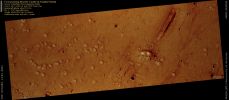
PSP_009485_2185_red.jpgClusters of Mounds at Acidalia Planitia (Extremely Enhanced and Saturated Natural Colors; credits for the additional process. and color.: Dr Paolo C. Fienga - Lunexit Team)56 visiteThis HiRISE image shows clusters of light-colored Mounds poking through the Dark Plains of Acidalia. These Mounds are similar in shape and color to mounds identified elsewhere in the Northern Lowlands.
The mounds imaged here are approximately 250 meters (270 yards) across, and most of them have one or more central crater-like depressed areas, looking like terrestrial cinder cones. Terrestrial cinder cones are formed by loose volcanic fragments, mostly gravel- and boulder-size. In contrast, the surface of these Martian Mounds looks cemented rather than bouldery.
There are several hypothesis to explain the origin of these Martian Mounds; all of them require the presence of fluids near or at the surface.
One hypothesis is that these mounds are Hydrothermal Spring edifices like those at Yellowstone. Terrestrial Hydrothermal Spring Mounds form when hot subsurface fluids, loaded with minerals, reach the surface and deposit their load.
Another possible explanation is that these Mounds are "Mud Volcanoes", similar to those found at Trinidad and Tobago. Mud Volcanism occurs when buried wet sediments are subject to high pressures and squeeze out though weak points at the surface.
Some terrestrial "Pseudocraters" are also similar to these Martian Mounds. Pseudocraters form when lava flows over wet terrains or over water bodies. The lava’s heat vaporizes the fluids, which then burst through the lava, producing small explosions and building conical landforms.MareKromium
|
|

Psp_009474_1705_red.jpgWater Bearing Minerals in Noctis Labyrinthus (natural colors; credits: Lunexit)56 visiteNoctis Labyrinthus consists of a series of Pits on the western end of the large Valles Marineris Canyon System.
The HiRISE camera and the CRISM Spectrometer have revealed that the floors of some of these Pits exhibit layered rocks, or strata, that contain minerals with water. These Pits were formed several billion years ago, therefore the rocks and sediments on their floors record evidence of water during this period of Mars’ history.
The walls of the Pits are commonly covered with dust and other loose sediments that form dunes and dune-like forms, and in many cases the floors of the pits are also covered with these materials. This image shows an example of light-toned layers exposed beneath these sediments and dunes, and CRISM data show that these layers have hydrated minerals.
The dark-brown/orange tones in this natural color image correspond to areas with more Pyroxene, a mineral found in volcanic rocks and Martian Dust. Some Pits, such as this one, appear to have deposits associated with large landslides that are younger than the hydrated minerals and partially bury them.MareKromium
|
|

Psp_009502_1980_red.jpgDark Spot Near Olmpus Mons Volcano (natural colors; credits: Lunexit)56 visiteThis image covers a relatively dark-toned patch of ground West of the Olympus Mons volcano. This spot is one of several "Dark Areas" in this Region of Mars.
These Dark Spots are distinctive because much of the surrounding area appears to be covered by light-toned dust.
In pre-HiRISE images, the origin of this Dark Spot was ambiguous. This HiRISE image reveals that the dark color is likely the result of accumulations of Basaltic Sand (smooth, brown-colored material in this natural color view) on top of otherwise relatively dust-free bedrock.
Evidence of layering is also visible within the dark area. There are alternating bands of lighter- and darker-toned material, consistent with alternating layers of bedrock. These alternating bands are not apparent outside of the Dark Area. This may mean that alternating layers of bedrock only occur within the dark area, or that these bedrock layers occur throughout the region but are covered and obscured by light-toned dust outside of the Dark Area.MareKromium
|
|
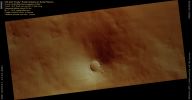
PSP_009527_1670_RED.JPGOld and "Dusty" Volcano in Syria Planum (natural colors; credits: Lunexit)56 visiteThis image shows an old volcano in Syria PlanumRegion, near the edge of the Tharsis volcanic rise. This is a Region where extensive volcanism has occurred; in many places, the upper walls of Valles Marineris have cut through lava flows.
The basic shape of the old volcano is visible here, but the entire region has been coated by dust.
This makes it difficult to learn more about the volcanic processes that have occurred at this site. However, the mantle is interesting by itself. It has probably settled out of the atmosphere, either as dust or possibly volcanic ash, since it seems to coat the entire region uniformly. (Mars has frequent, massive Dust Storms which could create large deposits over time.) This mantle has a regular, scalloped texture that is visible at several scales.
The texture is not well understood; it is common in volcanic terrains, but also occurs on some other rock outcrops.
HiRISE scientists are studying images like this one to determine how it forms.MareKromium
|
|
| 25353 immagini su 2113 pagina(e) |
 |
|
|
|
|
1735 | |
|
|
|
|





