| Piú viste |

Saturn-PIA09734.jpgTurbulences56 visiteCaption NASA:"The Cassini Spacecraft has a peek beneath the hazes in Saturn's Upper Atmosphere at the swirling vortices that lurk below.
Many vortices can be seen in this image, varying in size from small to large.
The largest one in this image exhibits a collar of bright clouds surrounding the central dark core.
The view is centered on a region about 46° South of the Planet's Equator.
The image was taken with the Cassini spacecraft narrow-angle camera on Aug. 12, 2007 using a spectral filter sensitive to wavelengths of infrared light centered at 750 nanometers. The view was acquired at a distance of approx. 4,1 MKM (such as about 2,5 MMs) from Saturn.
Image scale is roughly 24 Km (about 15 miles) per pixel".MareKromium
|
|

Z-111-The_Moon-CraterPentland.jpgIn the vicinities of Crater Pentland (HR)56 visiteCaption ESA:"This HR image, taken by the Advanced Moon Imaging Experiment (AMIE) on board ESA’s SMART-1 spacecraft, shows an area close to crater Pentland on the Moon.
AMIE obtained this sequence on 18 March 2006 from a distance of 573 Km from the surface, with a ground resolution of 52 mt per pixel. The imaged area is centred at a Latitude of 67,7º South and a Longitude of 18,3º East". MareKromium
|
|

Enceladus-N00093658.jpgFountains in the Darkness...56 visitenessun commentoMareKromium
|
|
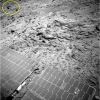
SOL1332-2N244619888EFFAVC8P1940L0M1-001.jpgThe "Wheel in the Ground"... (context frame)56 visiteSempre dall'occhio del Dr Gianluigi BARCA, un nuovo "enigma" per gli Appassionati di possibili Anomalìe e Singolarità Marziane.
Di che cosa si tratta? Cos'è l'oggetto (cerchiato in giallo) che giace semisepolto a pochi metri da Spirit? Si tratta della "solita" pseudo-roccia? E' un "ventifact"? Oppure è un "artifact"?
Se dipendesse dal Prof. Hoagland (& C.), la risposta sarebbe ovvia; ma adesso non stiamo domandando al Prof. Hoagland che cosa pensa di questo rilievo (che noi, provocatoriamente, abbiamo battezzato come "La Ruota Interrata"): adesso, questa domanda (dalla risposta, forse, impossibile...), la stiamo ponendo a Voi!...MareKromium
|
|
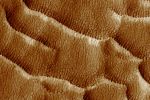
PSP_005419_1380_RED_browse-01.jpgFlow-like Features in Promethei Terra (extra-detail mgnf)56 visiteThe subimage (approx. 390 x 260 meters) shows in detail some of the ridges developed in the slope deposits. Numerous fissures cut through the surface, forming polygons 5 to 10 mt (5,5 to 11 yards) across.
Such well-preserved polygons indicate that the downhill flow had stopped before they formed. Polygonal features similar to these are common in terrestrial periglacial regions such as Antarctica, where ice is present at or near the surface. Antarctica's polygons formed by repeated expansion and contraction of the soil-ice mixture due to seasonal temperature oscillations.MareKromium
|
|
OPP-SOL1311-1F244573659ESF8700P1149R0M1-2.jpgBright Band - Sol 131156 visitenessun commentoMareKromium
|
|
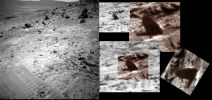
SOL1332-2N244620676EFFAVCBP0715R0M1.jpgThe "Wheel in the Ground"... (photo-mosaic)56 visiteDal bravissimo Amico e Socio, Dr Marco FACCIN, un fotomosaico davvero ben fatto che ci offre l'opportunità e l'occasione di guardare meglio questo incredibile rilievo, individuato dal Dr Barca nella giornata di ieri, 4 Ottobre 2007.
Gli elementi sui quali Vi suggeriamo di concentrarVi per tentare una interpretazione sono, a nostro parere, almeno tre:
1) la forma del rilievo;
2) l'albedo della porzione esterna del rilievo;
3) la texture e le dimensioni della porzione esterna del rilievo.
Onde evitare malintesi o valutazioni istintive tanto fantastiche, quanto azzardate, Vi suggeriamo di tener ben presente, durante l'analisi dell'immagine, che, come ci ha ben detto il nostro Carissimo Amico e Socio, Lorenzo Leone, questo frame potrebbe risultare particolarmente ingannevole non solo a causa di un vizio di iper-compressione dal quale esso potrebbe essere affetto nonchè, aggiungiamo noi, in ragione della posizione del rilievo anomalo in rapporto alla posizione del Rover (e relativo angolo di ripresa).MareKromium
|
|

OPP-SOL952-PIA10007-3.jpgWelcome to Victoria Crater! (possible natural colors; elab. Lunexit - inset: elab. NASA)56 visiteCaption NASA:"This image taken by the Panoramic Camera (PanCam) on the Mars Exploration Rover (MER) Opportunity shows the view of Victoria Crater from Duck Bay. Opportunity reached Victoria Crater on Sol 951 (September 27, 2006) after traversing 9,28 Km (5,77 miles) since her Landing Site at Eagle Crater.
Victoria Crater is roughly 800 mt (about 0,5 mile) wide -- about 5 times wider than Endurance Crater, and 40 times as wide as Eagle Crater. The south face of the 6 mt (20 foot) tall layered Cape Verde promontory can be seen in the left side of the inner crater wall, about 50 mt (approx. 165 feet) away from the Rover at the time of the imaging. The north face of the 15 mt (50 foot) tall stack of layered rocks called Cabo Frio can be seen on the right side of the Inner Crater Wall.
This mosaic was taken on Soles 952 and 953 (September 28 and 29, 2006).
There are 30 separate pointings through 6 different filters at each pointing.
This mosaic was generated from Pancam's 753, 535 and 482 nnmts filters".MareKromium
|
|
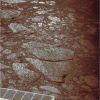
OPP-SOL1308-1P243064411EFF86JZP2365R1M1-1.jpgVictoria's Paving (interpret. n° 2 - possible natural colors; elab. Lunexit) - Sol 130856 visitenessun commentoMareKromium
|
|
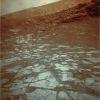
OPP-SOL1313-1N244745138EFF8700P1945R0M1-1.jpgFrom inside Victoria: the Beautiful Martian Paving (2) - Sol 131356 visitenessun commentoMareKromium
|
|
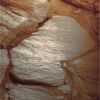
OPP-SOL1315-1P244925987EFF8700P2580R5M1.jpgVictoria's Paving & Berries (possible true colors; elab. Lunexit)56 visitenessun commentoMareKromium
|
|

Japetus-PIA08384-1.jpgThe Other Side of Japetus (false colors - elab. NASA)56 visiteCassini captures the first high-resolution glimpse of the bright trailing hemisphere of Saturn's moon Iapetus.
This false-color mosaic shows the entire hemisphere of Iapetus (1,468 kilometers, or 912 miles across) visible from Cassini on the outbound leg of its encounter with the two-toned moon in Sept. 2007. The central longitude of the trailing hemisphere is 24 degrees to the left of the mosaic's center.
Also shown here is the complicated transition region between the dark leading and bright trailing hemispheres. This region, visible along the right side of the image, was observed in many of the images acquired by Cassini near closest approach during the encounter.
Revealed here for the first time in detail are the geologic structures that mark the trailing hemisphere. The region appears heavily cratered, particularly in the north and south polar regions. Near the top of the mosaic, numerous impact features visible in NASA Voyager 2 spacecraft images (acquired in 1981) are visible, including the craters Ogier and Charlemagne.
The most prominent topographic feature in this view, in the bottom half of the mosaic, is a 450-kilometer (280-mile) wide impact basin, one of at least nine such large basins on Iapetus. In fact, the basin overlaps an older, similar-sized impact basin to its southeast.
In many places, the dark material -- thought to be composed of nitrogen-bearing organic compounds called cyanides, hydrated minerals and other carbonaceous minerals -- appears to coat equator-facing slopes and crater floors. The distribution of this material and variations in the color of the bright material across the trailing hemisphere will be crucial clues to understanding the origin of Iapetus' peculiar bright-dark dual personality.
The view was acquired with the Cassini spacecraft narrow-angle camera on Sept. 10, 2007, at a distance of about 73,000 kilometers (45,000 miles) from Iapetus.
The color seen in this view represents an expansion of the wavelengths of the electromagnetic spectrum visible to human eyes. The intense reddish-brown hue of the dark material is far less pronounced in true color images. The use of enhanced color makes the reddish character of the dark material more visible than it would be to the naked eye.
This mosaic consists of 60 images covering 15 footprints across the surface of Iapetus. The view is an orthographic projection centered on 10.8 degrees south latitude, 246.5 degrees west longitude and has a resolution of 426 meters (0.26 miles) per pixel. An orthographic view is most like the view seen by a distant observer looking through a telescope.
At each footprint, a full resolution clear filter image was combined with half-resolution images taken with infrared, green and ultraviolet spectral filters (centered at 752, 568 and 338 nanometers, respectively) to create this full-resolution false color mosaic.
MareKromium
|
|
| 25353 immagini su 2113 pagina(e) |
 |
|
|
|
|
1723 | |
|
|
|
|





