| Piú viste |

Quasar_MC2-1635+119-A.jpgQuasar MC2-1635+11956 visite"...Da operam ne quid umquam invitus facias..."
(Seneca)
"...Fa in modo di non fare mai nulla di mala voglia..."MareKromium
|
|
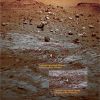
SOL1352-2P246395581EFFAVPBP2407R1M1-3.jpgExtremely "High-Albedo" Surface Feature (possible Surface Anomaly; comparison ctx-fr 1 and 2)56 visiteShift Prospettico? O il dettaglio si è "mosso"?
E se fosse davvero una "lamina sottile"? Un qualcosa di leggero che "rotola", spinto dal vento...MareKromium
|
|

OPP-SOL1338-1P156772319EDN4000P2279L6M1.jpgCreation and solution of a (pseudo) Mistery - Sol 1338 (possible natural colors - elab. Marco Faccin)56 visiteL'elaborazione in possibili colori naturali di questo frame che ritrae una porzione dei Pannelli Solari del MER Opportunity e qualche dettaglio del terreno circostante è, a nostro parere, una delle più belle e realistiche mai realizzate dall'Amico e Collega, Dr Marco Faccin, che ringraziamo ed al quale facciamo i nostri più vivi complimenti! Ma non è tutto qui... Nell'inset in b/n, infatti, un'immagine ingannevole: una porzione dei MER che si confondeva con il terreno, generando l'illusione dell'esistenza di una struttura rettangolare e regolare sulla superficie. Ebbene, così come era stato creato, così il mistero è stato risolto, sempre dal Dr Faccin: la possibile "mattonella" era solo una componente del Rover che, sia a causa della sua posizione sui Pannelli Solari, sia a causa della particolare posizione del dettaglio nel quadro dell'intero frame, poteva trarre in inganno tanti Osservatori.
La morale, come sempre, è semplice: senza entusiasmo, la Ricerca non va avanti, ma con troppo entusiasmo, si rischia di prendere delle "planetarie cantonate".
Le immagini sono ingannevoli, molto spesso, e l'occhio migliore per esaminarle in maniera accurata e profonda, deve essere, si, attento ed appassionato, ma anche pragmatico e disincantato: la "sorpresa", in effetti - se c'è e quando c'è - si rivela da sola.
Sempre.
Ancora complimenti al Dr Faccin per questo SPLENDIDO Lavoro!
MareKromium
|
|
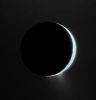
Enceladus-PIA09761.jpgThe "Fountains" of Enceladus (again)56 visiteCaption NASA:"With Enceladus nearly in front of the Sun from Cassini's viewpoint, its icy jets become clearly visible against the background.
The view here is roughly perpendicular to the direction of the linear "tiger stripe" fractures, or sulci, from which the jets emanate. The jets here provide the extra glow at the bottom of the moon. The general brightness of the sky around the moon is the diffuse glow of Saturn's E-Ring, which is an end product of the jets' material being spread into a "torus", or doughnut shape, around Saturn.
North on Enceladus is up and rotated 20° to the left.
The image was taken in visible light with the Cassini spacecraft narrow-angle camera on Sept. 30, 2007. The view was obtained at a distance of approx. 187.000 Km (such as about 116,000 miles) from Enceladus and at a Sun-Enceladus-spacecraft, or phase, angle of 157°.
Image scale is about 1 Km (apprx. 0,6 mile) per pixel".MareKromium
|
|

OPP-SOL1338-1P246971497EFF8788P2391L2M1.jpgVictoria's Paving (detail mgnf - possible natural colors; elab. Lunexit) - Sol 133856 visitenessun commentoMareKromium
|
|

Comets-Comet_Holmes-UY.jpgComet 17-P-Holmes, from Hungary56 visiteCaption NASA:"A beautiful blue ion tail has become visible in deep telescopic images of Comet Holmes. Pointing generally away from the Sun and also planet Earth, the comet's ion tail is seriously foreshortened by our extreme viewing angle.
Still, enthusiastic comet watchers have remarked that on the whole, the compact but tentacled appearance suggests a jellyfish or even a "cosmic calamaro".
This stunning view of the comet's greenish coma and blue tail was recorded on November 4, 2007, in clear skies near Budapest, Hungary.
The colors are caused by molecules in the tenuous gas, like C2 (green) and CO+ (blue), fluorescing in sunlight". MareKromium
|
|
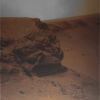
OPP-SOL1329-1P246169340EFF8754P2379R1M1-2.jpgThe True Colors of Victoria - sample n. 2 (Sol 1329)56 visitenessun commentoMareKromium
|
|
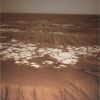
OPP-SOL599-1N181360191EFF6247P1665L0M1.jpgMeridiani Planum (2) - natural colors; elab. Lunexit56 visitenessun commentoMareKromium
|
|
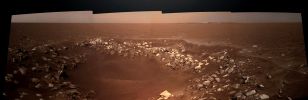
OPP-SOL086-1NN085ILF14CYP07P1983R000M1-B086R1_br2.jpgFram Crater (natural colors; elab. Lunexit)56 visitenessun commentoMareKromium
|
|

Dione-PIA09772.jpgThe "Face" of Dione (HR)56 visiteCaption NASA:"Canyons slink southward on Dione, while bright-walled craters gleam in the Sun. (...) This view is centered on 9° North Latitude and 51° West Longitude.
North on Dione is up.
The image was taken in polarized green light with the Cassini spacecraft narrow-angle camera on Sept. 30, 2007. The view was acquired at a distance of approx. 197.000 Km (such as about 122.000 miles) from Dione and at phase angle of 25°.
Image scale is roughly 1 Km (about 0,6 mile) per pixel".MareKromium
|
|

SOL564-2N176424151EDNAD92P1585L0M1.jpgIs Mars a "Dark" place? - Sol 564 (natural colors; elab. Lunexit)56 visitenessun commentoMareKromium
|
|

SOL491-2P169942343EFFAAEEP2423L5M1.jpgVolcanic rocks in a NON-Volcanic environment? - Sol 491 (natural colors; elab. Lunexit)56 visitenessun commentoMareKromium
|
|
| 25353 immagini su 2113 pagina(e) |
 |
|
|
|
|
1721 | |
|
|
|
|





