| Piú viste |

SOL1198-2P232715105EFFATB4P2539L6M1.jpgIn the trench... - Sol 1198 (natural colors; elab. Dr Marco Faccin)56 visitenessun commentoMareKromium
|
|
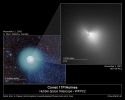
Comets-Comet_Holmes-UZ-1.jpgComet 17-P-Holmes, from Earth and from HST56 visiteNASA's HST has probed the bright core of Comet 17P/Holmes, which, to the delight of sky watchers, mysteriously brightened by nearly a millionfold in a 24-hour period beginning Oct. 23, 2007.
Astronomers used Hubble's powerful resolution to study Comet Holmes' core for clues about how the comet brightened. The orbiting observatory's Wide Field Planetary Camera 2 (WFPC2) monitored the comet for several days, snapping images on Oct. 29, Oct. 31, and Nov. 4. Hubble's crisp "eye" can see objects as small as 33 miles (54 Km) across, providing the sharpest view yet of the source of the spectacular brightening.
The Hubble image at right, taken Nov. 4, shows the heart of the comet. The central portion of the image has been specially processed to highlight variations in the dust distribution near the nucleus. About twice as much dust lies along the east-west direction (the horizontal direction) as along the north-south direction (the vertical direction), giving the comet a "bow tie" appearance.
The composite color image at left, taken Nov. 1 by an amateur astronomer, shows the complex structure of the entire coma, consisting of concentric shells of dust and a faint tail emanating from the comet's right side.
The nucleus-the small solid body that is the ultimate source of all the comet's activity- is still swaddled in bright dust, even 12 days after the spectacular outburst. "Most of what Hubble sees is sunlight scattered from microscopic particles," explained Hal Weaver of The Johns Hopkins University Applied Physics Laboratory in Laurel, Md., who led the Hubble investigation. "But we may finally be starting to detect the emergence of the nucleus itself in this final Hubble image."
Hubble first observed Comet 17P/Holmes on June 15, 1999, when there was virtually no dusty shroud around the nucleus. Although Hubble cannot resolve the nucleus, astronomers inferred its size by measuring its brightness. Astronomers deduced that the nucleus' diameter was approximately 2.1 miles (3.4 kilometers), about the length of New York City's Central Park. They hope to use the new Hubble images to determine the size of the comet's nucleus to see how much of it was blasted away during the outburst.
Hubble's two earlier snapshots of Comet Holmes also showed some interesting features. On Oct. 29, the telescope spied three "spurs" of dust emanating from the nucleus, while the Hubble images taken on Oct. 31 revealed an outburst of dust just west of the nucleus.
The Hubble images, however, do not show any large fragments near the nucleus of Comet Holmes, unlike the case of Comet 73P/Schwassmann-Wachmann 3 (SW3). In the spring of 2006 Hubble observations revealed a multitude of "mini-comets" ejected by SW3 after the comet increased dramatically in brightness.
Ground-based images of Comet Holmes show a large, spherically symmetrical cloud of dust that is offset from the nucleus, suggesting that a large fragment broke off and subsequently disintegrated into tiny dust particles after moving away from the main nucleus.
Unfortunately, the huge amount of dust near the comet's nucleus and the comet's relatively large distance from Earth (149 million miles, or 1.6 astronomical units, for Holmes versus 9 million, or 0.1 astronomical unit for SW3), make detecting fragments near Holmes nearly impossible right now, unless the fragments are nearly as large as the nucleus itself.
The Hubble Comet Holmes observing team comprises H. Weaver and C. Lisse (The Johns Hopkins University Applied Physics Laboratory); P. Lamy (Laboratoire d'Astrophysique de Marseille, France); I. Toth (Konkoly Observatory, Hungary); M. Mutchler (Space Telescope Science Institute); W. Reach (California Institute of Technology); and J. Vaubaillon (California Institute of Technology).
MareKromium
|
|
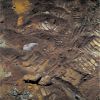
SOL1387-2P249497499EFFAWNSP2552L6M1-3.jpgRover Tracks and colored Pebbles - Sol 1387 (MULTISPECTRUM; elab. Lunexit)56 visitenessun commentoMareKromium
|
|

SOL1388-2P249497680EFFAWNSP2552R6M1.jpgRover Tracks and Blue Pebbles - Sol 1388 (Natural Colors; elab. Dr Marco Faccin - Lunexit Team)56 visiteUn bellissimo commento (che fa pensare), a cura del Dr Faccin:"...A volte penso che qualche giapponese sia dentro al Programma MER/Marte: un certo metodo di "fare" fotografia è tipico del Sol Levante.
Un Metodo dettato da una cultura essenzialmente diversa e forse più incline al particolare che all'insieme. Spirit zappa il terreno e riesuma ciò che è sotto a pochi cm - tra cui i famosi mirtilli -; Opportunity non ha bisogno di scavare, quasi che potrebbe farne delle marmellate con i berries...Nello stesso tempo, Opportunity ha gli obbiettivi veramente sporchi, mentre Spirit è bello lindo e, sopra la polvere, ci cammina...
Possiamo dedurre che i MER si muovano in ambienti diversi? Spirit in un ambiente con meno vento ad esempio, ed in una zona dove difficilmente la polvere riesce a ricoprire il primo strato di superficie. In conclusione quello che sta "al di sotto" è veramente diverso dalla superfice visibile.
A differenza di quanto vediamo qui, sulla nostra Terra, su Marte abbiamo depositi, a strati, di "mirtilli"; tenere pietre evidenziate dai filtri in blu che potrebbero essere e/o rappresentare dei fossili - e non espressamente dei minerali... -. I Rover scavano con le loro ruote ed il peso di Spirit, su Marte, dovrebbe essere intorno al quintale (o forse meno), distribuito poi su più punti. Il che significa che per frantumare quel "blu" occorre davvero poco.
Un "blu tenero", in fondo.
Ed oltre al blu, c'è tutto il resto...".
Già: c'è TUTTO il resto... Complimenti, ancora una volta, al nostro Caro Amico e Socio, Dr Faccin!MareKromium
|
|

Comets-Comet_Holmes-UZ-2.jpgComet 17-P-Holmes, from Hungary56 visiteCaption NASA:"Comet Holmes refuses to fade. The unusual comet that surprisingly brightened nearly a million-fold in late October continues to remain visible to the unaided eye from dark locations. Night to night, Comet 17P/Holmes is slowly gliding through the constellation Perseus, remaining visible to northern observers during much of the night right from sunset. Pictured above, Comet Holmes was captured from Hungary last week. The remarkable snowball continues to retain a huge coma, but now shows very little of a tail. To the far right is the open cluster of stars NGC 1245.
How much longer Comet Holmes will remain visible to the unaided eye is unknown".MareKromium
|
|

SOL278-1.jpgJust like true Hierogliphs! - Sol 27856 visiteUna segnalazione davvero curiosa e stimolante, da parte del nostro Amico e Socio Lorenzo Leone: nel rettangolo rosso (in alto a Dx), una - davvero stranissima - serie di "incisioni" sulla roccia.
Si tratta, con ogni probabilità (anzi: diremmo certamente), di uno scherzo di luci ed ombre e di un effetto ottico derivante dalla non eccezionale qualità del frame.
Di questo tipo di rilievi potremmo parlare per un secolo senza, purtroppo, arrivare a nulla e allora, in sede di commento, citiamo le parole di Lorenzo:"...E' possibile che Marte abbia delle rocce così particolari e caratteristiche come evidenziato nel quadrato rosso? Forse si, ma è davvero bizzarra la natura geologica di Marte. Se si guarda, per quanto possibile, quei dettagli, sicuramente rocciosi, si noterà una certa simmetria: 4 sfere laterali e una linea retta centrale. Geroglifici? Fossili? Natura bizzarra? Chi lo sa. Io so solo che rimango sempre incuriosito e dubbioso...".
Anche noi.
Un carissimo saluto e COMPLIMENTI a Lorenzo Leone per il "colpo d'occhio"!MareKromium
|
|
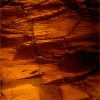
OPP-SOL1363-1.jpgVictoria's Paving (possible natural colors; elab. Dr Gianluigi Barca) - Sol 136356 visitenessun commentoMareKromium
|
|

OPP-SOL251-2.jpgWopmay - Sol 251 (MULTISPECTRUM; elab. Lunexit)56 visiteMareKromium
|
|

SOL1392-2P249936403EFFAWTNP2427L7M1.jpgDaylight Panorama - Sol 1392 (5 - MULTISPECTRUM; elab. Lunexit)56 visitenessun commentoMareKromium
|
|
SOL1392-2P249936369EFFAWTNP2427R1M1.jpgDaylight Panorama - Sol 1392 (4 - MULTISPECTRUM; elab. Lunexit)56 visitenessun commentoMareKromium
|
|

SOL1392-2P249936344EFFAWTNP2427L7M1.jpgDaylight Panorama - Sol 1392 (3 - MULTISPECTRUM; elab. Lunexit)56 visitenessun commentoMareKromium
|
|

as16-107-17421.JPGAS 16-107-17421 - Beautiful Desolation (2)56 visitenessun commentoMareKromium
|
|
| 25353 immagini su 2113 pagina(e) |
 |
|
|
|
|
1719 | |
|
|
|
|





