| Piú viste |
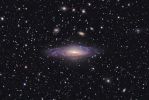
NGC-7331-0.jpgNGC 7331 - Spiral Galaxy56 visite"...insieme uniti tutti,
Entro il Patrio terren dolce è dormire:
Pace hanno i cuori, i pianti son rasciutti,
Sciolgonsi al vento gli amor nostri e l'ire..."
E. Severino Ferrari - "Versi"
|
|

Eta Carinae~2.jpgEta Carinae56 visite"...Graeca mercari fide..."
(Plauto)
"...Mercanteggiare con fede greca..." (ossìa "senza fidarsi di parole e promesse")
|
|

Epsilon Eridani.jpgEpsilon Eridani56 visite"...Qualis dominus, talis et servus..."
(Petronio)
"...Come (è) il padrone, così (è) il servo..."
(detto riferito originariamente ai servitori di case private e poi esteso fino ad intendere i governanti ed i governati)
|
|

NGC-4435_and_4438.jpgNGC 4435 and 4438 - Interacting Galaxies56 visite"...Canis timidus vehementius latrat quam mordet..."
(Q. Curzio)
"...Il cane timido (pavido) abbaia più forte di quanto morda..."
|
|
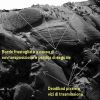
OPP-SOL967-1P214025987ESF76POP2594L7M1.jpgThe rim of Victoria (in a bad frame) - Sol 96756 visitenessun commento
|
|
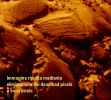
OPP-SOL967-1P214031259ESF76POP2594L7M1.jpgThe rim of Victoria (after "fixing" the frame) - Sol 96756 visitenessun commento
|
|

NGC-4038_and_NGC-4039-0.jpgNGC 4038 and 4039 - The "Antennae Galaxies"56 visite"...Ars longa, Vita brevis (est)..."
(Seneca)
"...La via dell'Arte (intesa come Scienza e Conoscenza) è eterna; la Vita (invece) è breve..."
Nota: tutta la Vita di un Uomo che si dedichi alle Arti ed alla Scienza non basta perchè egli possa svolgere la sua opera ed il suo pensiero per intero. Come Faust cade sul libro non finito, altri lo riprenderà per continuarlo e quindi seguirà la stessa fine e così via...ad infinitum.
|
|

Corvus.jpgCorvus56 visite"...Conscia Mens, recti famae mendacia ridet..."
(Ovidio)
"...La Coscienza dell'Uomo onesto ride delle menzogne (proprie) della fama..."
|
|

NGC-4038.jpgNGC 4038 - The "Antennae Galaxies"56 visite"...la Gloria è solo un effimero dono degli Dei..."
(dal film "Patton")
|
|
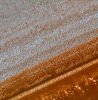
TRA_000825_2665_IRB-01.jpgNorth Polar Layers (2)56 visiteNOTA:
This color images cover only the center swath of the full image, and is composed of images acquired through infrared, red, and blue-green filters. The color has been enhanced to better show the subtle color differences.
It is NOT natural color or how it would appear to normal human vision.
|
|

TRA_000830_1440_IRB-1.jpgNiger Vallis (1)56 visiteThis image shows a portion of the floor of Niger Vallis, an ancient Martian outflow channel. Niger Vallis originates on the flanks of the volcano Hadriaca Patera, and empties into the Hellas impact basin. Outflow channels are observed in many regions of the planet, and may have been carved by brief eruptions of liquid water from beneath the surface. Since Niger Vallis formed, impacts have cratered the channel floor, and fine-grained wind-blown debris has been transported across the surface, eroding and burying all but the freshest craters. The curved ridge in the scene may be the remnant of a large crater rim. At the high resolution of this image, a pattern of parallel dunes and ripples can be seen, as well as individual boulders as large as two meters across.
Image TRA_000830_1440 was taken by the High Resolution Imaging Science Experiment (HiRISE) camera onboard the Mars Reconnaissance Orbiter spacecraft on September 30, 2006. The full image shown below is centered at -35.5 degrees latitude, 92.1 degrees East longitude. The range to the target site was 255 km (159 miles). At this distance the image scale is 51 cm/pixel (with 2 x 2 binning) so objects ~153 cm across are resolved. The image shown here has been map-projected to 50 cm/pixel and north is up. The image was taken at a local Mars time of 3:35 PM and the scene is illuminated from the west with a solar incidence angle of 77.5 degrees, thus the sun was about 12.5 degrees above the horizon. At a solar longitude of 113.8 degrees, the season on Mars is Northern Summer / Southern Winter.
|
|
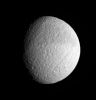
Tethys-PIA08291.jpgTethys56 visiteCaption NASA:"Tethys has a crater-saturated surface, where older, larger basins have been completely overprinted by newer, smaller impacts. This state is what scientists expect to see on a very old surface, where small impactors have struck more frequently than larger ones over several billion years. Larger impacts were more common events in the early history of the Solar System.
This view looks toward the Leading Hemisphere of Tethys (1.071 Km, or about 665 miles across). North is up. The great scar of Ithaca Chasma is seen at right.
The view was captured in visible light with the Cassini spacecraft narrow-angle camera on Sept. 25, 2006 at a distance of approx. 449.000 Km (such as about 279.000 miles) from Tethys and at a phase angle of 49°. Image scale is roughly 3 Km (about 2 miles) per pixel".
|
|
| 25353 immagini su 2113 pagina(e) |
 |
|
|
|
|
1715 | |
|
|
|
|





