| Piú viste |

Mimas-PIA08278.jpgHerschel Crater on Mimas56 visiteCaption NASA:"The great basin that interrupts the contours of this moon's crescent identifies the satellite unmistakably as Mimas. The giant crater Herschel (about 130 Km, or 80 miles wide) is this moon's most obvious feature.
North on Mimas (approx. 397 Km, or 247 miles, across) is up and rotated 23° to the left.
The image was taken in visible light with the Cassini spacecraft narrow-angle camera on Sept. 8, 2006 at a distance of approx. 534.000 Km (about 331.000 miles) from Mimas and at a Sun-Mimas-spacecraft, or phase, angle of 115°. Image scale is roughly 3 Km (about 1,9 miles) per pixel".
|
|

NGC-1333-00.jpgNGC 1333 - Emission Nebula56 visite"...Coniunctio animi maxima est cognatio..."
(P. Siro)
"...Il supremo vincolo parentale esiste nella comunione di anime (simili, ancorchè non legate da vincoli di sangue)..."
|
|

Saturn-PIA08732.jpgThe clouds of Saturn56 visiteThis false-color mosaic of Saturn shows deep-level clouds silhouetted against Saturn's glowing interior. The image was made with data from Cassini's VIMS, which can image the Planet at 352 different wavelengths. This mosaic shows the entire Planet, including features like Saturn's Ring shadows and the Terminator, the boundary between day and night.
The data were obtained in February 2006 at a distance of 1,6 MKM (about 1 MMs) from directly over the plane of Saturn's Rings, which appear here as a thin, blue line over the equator. The image was constructed from images taken at wavelengths of 1,07 microns (blue), 2,71 microns (green) and 5,02 microns (red).
The blue-green color (lower right) is Sunlight scattered off clouds high in Saturn's atmosphere and the red color (upper left) is the glow of thermal radiation from Saturn's warm interior, easily seen on Saturn's night side (top left), within the shadow of the Rings and with somewhat less contrast on Saturn's day side (bottom right). The darker areas within Saturn show the strongest thermal radiation. The bright red color indicates areas where Saturn's atmosphere is relatively clear. The great variety of cloud shapes and sizes reveals a surprisingly active planet below the overlying sun-scattering haze.
The brighter glow of the northern hemisphere versus the southern indicates that the clouds and hazes there are noticeably thinner than those in the south. Scientists speculate that this is a seasonal effect, and if so, it will change as the northern hemisphere enters springtime during the next few years.
|
|

S-PIA08812.jpgCape Verde and Cabo Frio (1)56 visiteThis image from the High Resolution Imaging Science Experiment on NASA's Mars Reconnaissance Orbiter shows the Mars Exploration Rover Opportunity near the rim of "Victoria Crater." Victoria is an impact crater about 800 meters (half a mile) in diameter at Meridiani Planum near the equator of Mars. Opportunity has been operating on Mars since January, 2004. Five days before this image was taken, Opportunity arrived at the rim of Victoria, after a drive of more than 9 kilometers (over 5 miles). It then drove to the position where it is seen in this image.
Shown in the image are "Duck Bay," the eroded segment of the crater rim where Opportunity first arrived at the crater; "Cabo Frio," a sharp promontory to the south of Duck Bay; and "Cape Verde," another promontory to the north. When viewed at the highest resolution, this image shows the rover itself, wheel tracks in the soil behind it, and the rover's shadow, including the shadow of the camera mast. After this image was taken, Opportunity moved to the very tip of Cape Verde to perform more imaging of the interior of the crater.
This view is a portion of an image taken by the High Resolution Imaging Science Experiment (HiRISE) camera onboard the Mars Reconnaissance Orbiter spacecraft on Oct. 3, 2006. The complete image is centered at minus7.8 degrees latitude, 279.5 degrees East longitude. The range to the target site was 297 kilometers (185.6 miles). At this distance the image scale is 29.7 centimeters (12 inches) per pixel (with 1 x 1 binning) so objects about 89 centimeters (35 inches) across are resolved. North is up. The image was taken at a local Mars time of 3:30 PM and the scene is illuminated from the west with a solar incidence angle of 59.7 degrees, thus the sun was about 30.3 degrees above the horizon. At a solar longitude of 113.6 degrees, the season on Mars is northern summer.
Images from the High Resolution Imaging Science Experiment and additional information about the Mars Reconnaissance Orbiter are available online at: http://www.nasa.gov/mro or http://HiRISE.lpl.arizona.edu.
|
|
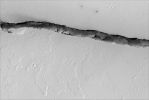
T-TRA_000827_1875_RED.jpgA long trough in Cerberus Fossae56 visiteThe prominent trough in this image is a segment of the Cerberus Fossae rift system. In geological terminology the trough is known as a graben, or down-dropped region bounded by faults. In this location the graben is about 300 m wide and 90 m deep. Bright, dust-covered, cratered plains surround the graben, and darker sediments blanket much of its floor. Dunes that vary in size and spacing occur within the darker sediments, and their shapes suggest that the wind typically blows from east to west. Light-toned, angular boulders pepper the darker sediments. They have broken away from the rocky walls of the graben and tumbled downhill. Over time this mass wasting has caused the cliffs to retreat, widening the trough. The somewhat lighter patches of cratered terrain on the graben floor were once level with the surrounding plains, but have since been lowered by faulting. Over time they may become obscured or buried by the darker sediments. High-standing ridges - remnants of the former surface - cast jagged shadows on the floor of the graben that reveal the rugged nature of the landscape in this region of Mars.
|
|
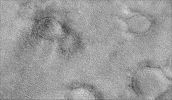
T-TRA_000828_2495_RED.jpgNorthern Plains56 visiteA network of shallow surface troughs and fissures coalesce into polygonal patterns that are ubiquitous throughout this image. Polygonal patterned ground of this nature is quite common in permafrost regions of Earth, where seasonal thermal contraction of ice-cemented soil produces a honeycomb network of subsurface cracks. Cracks of this nature can also be produced by desiccation (mud cracks) or lava cooling (columnar joints), though typically on a smaller scale. The diameter of these martian polygons are dominantly 10-20 meters, analogous to terrestrial permafrost. The individual troughs are frequently only a couple of meters or less wide, and easily resolved at HiRISE resolution. Other characteristics, such as small ridges on either side of the troughs and the distribution of rocks in and around each polygon is also readily apparent. Small rocks and occasional larger boulders are also seen scattered throughout the image. Rocks protruding above the surface soil can be seen to cast shadows (solar illumination is from the lower left), which can aid in the determination of the rock's size and height. This image is located near an area under consideration as a landing site for the Mars Scout mission, Phoenix, planned for 2008. Examination of many factors including surface texture (roughness and morphology) and the size distribution of rocks will aid in final landing site selection.
|
|
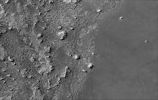
T-TRA_000833_1800_RED.jpgMeridiani Planum56 visiteThis HiRISE image shows geologic "contacts", or boundaries, between light-toned and dark-toned material in Meridiani Planum, near the equator of Mars. Merdiani Planum is where the Mars Exploration Rover Opportunity is located, although this image covers an area that is more than 600 km to the east of the Opportunity site. The central portion of the image shows very smooth, dark plains that are typical of much of the Meridiani region. These plains are flanked by more rugged lighter-toned materials. The light-toned materials have been eroded to form dramatic pits, buttes and mesas. Based on the lengths of the shadows that they cast, some of the buttes and mesas are up to about 30 meters (~100 feet) tall. The light-toned material shows distinctive layering, suggesting that it may be composed of sedimentary rock. Scattered across the scene, especially in the light-toned materials where they are prominent in low spots and around some of the larger buttes and mesas, are dunes and other similar landforms created by martian winds.
|
|
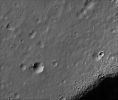
T-TRA_000866_1420_RED.jpgGorgonum Chaos56 visiteThis HiRISE image shows cratered plains along the edge of a large fracture to the south of Gorgonum Chaos. The wall of the fracture is in shadow and, at first glance, appears to reveal little detail about the geologic setting. In reality, the high quality of the HiRISE image, as shown in the stretched sub-image [below], demonstrates that considerable detail along the wall of the fracture can be discerned. A relatively dark layer extends along the upper wall of the fracture and approximately separates the exposed wall above from talus below. Some well defined talus chutes are also visible and are formed by the down slope movement of debris shed from higher along the fracture wall. The wind blown drifts of fine grained sediment accumulated along the base of the talus slope are relatively free of obvious talus. Hence, the wind likely accounts for much of the most recent modification of the scene in the sub image.
|
|
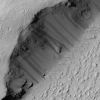
T-TRA_000853_1900_RED_MarteValles_01.jpgSeeps in Marte Vallis56 visiteMarte Vallis is a relatively young channel system on Mars that was carved by catastrophic floods of water. The HiRISE image samples just a small part of the valley system, but captures a variety of different landforms. The mesa in the eastern half of the image is a remnant of the pre-flood surface while the valley floor is covered by a surface with plates and ridges.
We highlight a piece from the southeastern portion of this HiRISE image, along the edge of the mesa. Some of the most striking features in this area are the dark streaks streaming down the cliff face. These mark locations where the layer of dust has been removed, exposing the darker surface underneath. The details of this cleaning process are not well-understood, but are thought to be driven by avalanches of dust. These avalanches appear to be more capricious than typical landslides or mudslides—they are sometimes able to surmount some large obstacles but in other cases are deflected by relatively small boulders. The darkness of the streaks vary, which suggests that they formed at different times. These streaks are expected to gradually fade as more dust will be deposited in the future. However, such fading has yet to be observed.
The role of dust is also clearly evident on the floor of the valley. The fluted mounds are characteristic of a thick dust deposit that is being gradually stripped away by wind. This extensive dust cover complicates any attempt to understand the details of the floods that carved the valley and the processes that formed the plates and ridges on the floor.
|
|
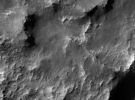
T-TRA_000853_1450_RED_AtlantisChaos_01.jpgAtlantis Chaos56 visiteThis HiRISE image covers a small area within a degraded crater adjacent to Atlantis Chaos in the Electris region of Mars. The crater and much of the surrounding region were once extensively mantled by a layer of material(s) of unknown origin and only small remnant outcrops of this material remain seen as flat topped mesas in the image sub-frame shown here. Intervening areas expose ancient uplands materials locally punctuated by narrow ridges that may represent more resistant material within the mantling deposit that were left in relief as the sediments were eroded away. Although the mesas do not appear to be comprised of finely layered materials, hints of some layering in a few locations can be seen. Large blocks of material are being shed from the mesas, but do not appear to accumulate on the mesa slopes as large talus aprons. Some wind blown dunes and ripples can be observed, but are not as widespread as in many other locations imaged with HiRISE. Collectively, these characteristics suggest that the material(s) forming the mantling deposit possess some limited strength, but are easily broken down and removed by wind over time. One possible Earth analog for these deposits may be the wind blown accumulations of very fine sediments, or silt known as loess.
|
|
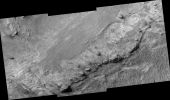
T-TRA_000849_1675_RED.jpgCoprates Labes56 visiteCoprates Labes is a Martian canyon, part of the huge Valles Marineris system. Valles Marineris most likely formed through tectonic processes, with extensional stresses leading to collapse of the terrain that now lies at the base of the canyons. Filling most of this image, we see a raised block on the canyon bottom, which is quite possibly a horst—a block bounded by faults that separate it from sunken blocks on each side. The raised block is heavily eroded, possibly by wind; this erosion has exposed its internal layering, especially at the southeast margin of the block. Here we see asymmetric erosion features with shallow slopes trailing off to the northwest, suggesting that southeasterly winds dominate the flow through this region. The arrangement of dunes and ripples in the lower right portion of the image confirms this prevailing wind direction. Finally, dark-toned material appears to have flowed from northeast to southwest along the block, possibly moving in a very fluid debris flow.
|
|

NGC-6188-0.jpgNGC 6188 - Emission Nebula56 visite"...Nihil melius Aeterna Lex fecit, quam quod unum introitum nobis ad Vitam dedit, exitus multos..."
(Seneca)
"...Nulla di meglio fece l'Eterna Legge, che darci una sola via per venire al Mondo, e tante per andarcene..."
|
|
| 25353 immagini su 2113 pagina(e) |
 |
|
|
|
|
1714 | |
|
|
|
|





