| Piú viste |

61-smart-1_data1002887_030_H.jpgDouble Crater56 visiteCaption ESA originale:"This beautiful oblique view was taken on 2 September 2006 by the AMIE camera on board SMART-1 during the last few orbits prior to Moon impact, and shows a double crater.
This view was captured during the imaging session which took place bewteen 15:19 and 17:34 CEST (17:19 - 19:34 UT)".
|
|
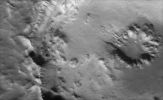
Craters-Unnamed_Crater_in_Arabia_Terra-PIA08730-1.jpgAncient Crater in Arabia Terra (1 - Original NASA/2001 Mars Odyssey Orbiter b/w Frame)56 visiteImage information: VIS instrument;
Latitude: 16,7° North;
Longitude: 350,0° East;
Resolution: 18 meter/pixel.
|
|
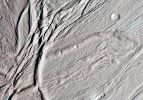
Enceladus-3D.jpgThe frozen canyons of Enceladus (3D)56 visitenessun commento
|
|

004-vg1_3400941.jpgSaturn56 visitenessun commento
|
|

010-vg2_p23919.jpgDense clouds and "tiny" cyclons...56 visitenessun commento
|
|

Mimas-PIA08264.jpgMimas56 visiteCaption NASA originale:"Mimas plows along in its orbit, its pockmarked surface in crisp relief. The bright, steep walls of the enormous crater, Herschel (130 Km, or 80 miles wide), gleam in the Sunlight.
The lit terrain seen here is on the Leading Hemisphere of Mimas (about 397 Km, or 247 miles across). North is up.
The image was taken in visible light with the Cassini spacecraft narrow-angle camera on Aug. 16, 2006 at a distance of approx. 221.000 Km (about 137.000 miles) from Mimas and at a Sun-Mimas-spacecraft, or phase, angle of 80°.
The image scale is roughly 1 Km (about 0,6 mile) per pixel".
|
|
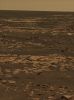
OPP-SOL901-PIA08753-005.jpgBeagle Crater and 360° Panorama from Sol 901 through 904 (5)56 visiteCaption NASA originale:"Beagle Crater takes its unofficial name from a great ship of exploration, the HMS Beagle, whose most famous passenger was British naturalist Charles Darwin. During the Beagle expedition around the world, Darwin conducted many of the observations that led to his theory of natural selection. Scientists have unofficially named many rocks and features in the area of Beagle Crater after the Galapagos Islands and the varieties of finches Darwin observed there. The name Beagle Crater also commemorates the ill-fated British lander, Beagle 2, reminding us how difficult space exploration can be".
|
|

Saturn-PIA08734.jpgInner Warmth, Hidden Light...56 visiteCaption NASA originale:"This false-color image of Saturn shows Ring shadows running across the upper portion of the Planet, and sunlight illuminating the lower portion of the Planet.
The upper area, in the Ring shadow, would be black in visible light but glows red in infrared because Saturn is warm inside. This light shines out through the clouds, giving scientists a look at some of Saturn's interesting atmospheric structure.
This image was taken on June 30, 2006, with Cassini's VIMS. It was constructed from images taken at wavelengths of 0,91 microns (blue); 2,25 microns (green) and at 5,01 (red).
The distance from Cassini to Saturn's center in this image is aspprox. 335.000 Km (about 208.159 miles)".
|
|

Helene-PIA08269.jpgMoments of "Helene"56 visiteCaption NASA originale:"This set of images exposes details on small and crumpled-looking Helene. Large portions of this Trojan moon of Dione appear to have been blasted away by impacts.
Cassini passed within 50.000 Km (about 31,000 miles) of Helene (which is about 32 Km - or 20 miles across) on Aug. 17, 2006, when these images were acquired.
The views were obtained over the course of an hour and are presented here in reverse order (i.e.: the leftmost image was taken latest).
The images were taken in visible light with the Cassini spacecraft narrow-angle camera. As presented here, the views were acquired at distances ranging from about 62.000 to 51.000 Km (such as about 39.000 to 32.000 miles) from Helene and at a Sun-Helene-spacecraft, or phase, angle of 111 to 120°. Image scale is roughly 375 to 300 meters (approx. 1.230 to 984 feet) per pixel, from left to right".
|
|
![Comets-Halley-Giotto-86hc145[1].jpg](albums/userpics/10008/small_Comets-Halley-Giotto-86hc145%5B1%5D.jpg "Nome del file=Comets-Halley-Giotto-86hc145[1].jpg
Dimensione del file=634KiB
Dimensioni=1756x1788
Aggiunta il=Set 17, 2006")
Comets-Halley-Giotto-86hc145[1].jpgThe "Halley Comet", from Giotto56 visitenessun commento
|
|

MWMW01_radio_408_allsky.jpgAll Sky: the "Radio Sky"56 visite"Tu parli
e sveli a voce lieve
il segreto che freme
e non teme la morte.
Mattino: il tuo viso.
Il mare mi conosce:
l’ascolterò lentamente.
Tu.
Anche la città
tace lontana".
Gianluigi Barca - "Poesie"
|
|

MWMW04_molec_hyd_allsky.jpgAll Sky: the "Molecular Hydrogen Sky"56 visite"Di partigiani in questi boschi - dice
il vecchio contadino - ne sono rimasti
che paiono foglie - e guarda lontano,
quasi si sentisse il loro respiro
tra le colline bruciate.
Il vecchio contadino
non c’è stato nei boschi ;
ora beve e ricorda una sera che
camminando lungo i binari
sentì un ragazzo con l’amico
- Sei sicuro ?- - Compagno
presto risuonerà nell’aria la vittoria,
una vittoria rievocata
fino all’ultimo respiro.-
Poi il silenzio
e i due entrare nei boschi
a pugni chiusi
tra le foglie che avvisavano.
Ora il vecchio racconta
per non morire sotto il sole ;
la sera attende,
guardando lontano,
e non si capisce se sappia
che dietro quella collina
si trova un cimitero
che custodisce le storie
di tante foglie senza nome".
Gianluigi Barca - "Poesie"
|
|
| 25353 immagini su 2113 pagina(e) |
 |
|
|
|
|
1712 | |
|
|
|
|





