| Piú viste |
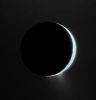
Enceladus-PIA09761.jpgThe "Fountains" of Enceladus (again)56 visiteCaption NASA:"With Enceladus nearly in front of the Sun from Cassini's viewpoint, its icy jets become clearly visible against the background.
The view here is roughly perpendicular to the direction of the linear "tiger stripe" fractures, or sulci, from which the jets emanate. The jets here provide the extra glow at the bottom of the moon. The general brightness of the sky around the moon is the diffuse glow of Saturn's E-Ring, which is an end product of the jets' material being spread into a "torus", or doughnut shape, around Saturn.
North on Enceladus is up and rotated 20° to the left.
The image was taken in visible light with the Cassini spacecraft narrow-angle camera on Sept. 30, 2007. The view was obtained at a distance of approx. 187.000 Km (such as about 116,000 miles) from Enceladus and at a Sun-Enceladus-spacecraft, or phase, angle of 157°.
Image scale is about 1 Km (apprx. 0,6 mile) per pixel".MareKromium
|
|

OPP-SOL1338-1P246971497EFF8788P2391L2M1.jpgVictoria's Paving (detail mgnf - possible natural colors; elab. Lunexit) - Sol 133856 visitenessun commentoMareKromium
|
|

Comets-Comet_Holmes-UY.jpgComet 17-P-Holmes, from Hungary56 visiteCaption NASA:"A beautiful blue ion tail has become visible in deep telescopic images of Comet Holmes. Pointing generally away from the Sun and also planet Earth, the comet's ion tail is seriously foreshortened by our extreme viewing angle.
Still, enthusiastic comet watchers have remarked that on the whole, the compact but tentacled appearance suggests a jellyfish or even a "cosmic calamaro".
This stunning view of the comet's greenish coma and blue tail was recorded on November 4, 2007, in clear skies near Budapest, Hungary.
The colors are caused by molecules in the tenuous gas, like C2 (green) and CO+ (blue), fluorescing in sunlight". MareKromium
|
|
OPP-SOL1329-1P246169340EFF8754P2379R1M1-2.jpgThe True Colors of Victoria - sample n. 2 (Sol 1329)56 visitenessun commentoMareKromium
|
|
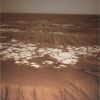
OPP-SOL599-1N181360191EFF6247P1665L0M1.jpgMeridiani Planum (2) - natural colors; elab. Lunexit56 visitenessun commentoMareKromium
|
|
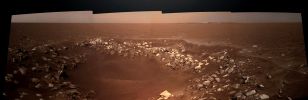
OPP-SOL086-1NN085ILF14CYP07P1983R000M1-B086R1_br2.jpgFram Crater (natural colors; elab. Lunexit)56 visitenessun commentoMareKromium
|
|

SOL564-2N176424151EDNAD92P1585L0M1.jpgIs Mars a "Dark" place? - Sol 564 (natural colors; elab. Lunexit)56 visitenessun commentoMareKromium
|
|

SOL491-2P169942343EFFAAEEP2423L5M1.jpgVolcanic rocks in a NON-Volcanic environment? - Sol 491 (natural colors; elab. Lunexit)56 visitenessun commentoMareKromium
|
|

Comets-Comet_Holmes-UZ-1.gifBigger than the Sun!56 visiteCaption NASA:"The spherical coma of Comet Holmes has swollen to a diameter of over 1,4 MKM, making the tenuous, dusty cloud even bigger than the Sun. Scattering sunlight, all that dust and gas came from the comet's remarkably active nucleus, whose diameter before the late October outburst was estimated to be a mere 3,4 Km.
In this sharp image, recorded on November 14, 2007, with the Canada-France-Hawaii Telescope, stars are easily visible right through the outer coma, while the nucleus is buried inside the condensed, bright region. The bright region of the coma seems offset from the center, consistent with the idea that a large fragment drifted away from the nucleus and disintegrated, producing the comet's spectacular outburst. Of course, more recent images of Holmes also show the bright star Mirfak (Alpha Persei) shining through as the comet sweeps slowly through the constellation Perseus".MareKromium
|
|

SOL1368-2P247817719EFFAWCCP2416R1M1-2.jpgThe Martian "Turtle" (extra-detail mgnf; elab. Dr G. Barca) - Sol 136856 visitenessun commentoMareKromium
|
|
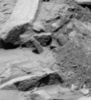
SOL1368-2P247810244ESFAWCCP2546L7M1-2.jpgMars' Anatomy... (2) - Sol 1368 (extra-detail mgnf; elab. Dr G. Barca)56 visite...Che dire? Diciamo che si tratta di uno "spuntone" roccioso di origine ignota, ma di forma...Bizzarramente ed anatomicamente familiare...
Uno "scherzo" della Natura (in tutti i sensi!), per sorridere, fra un Mistero e l'altro...MareKromium
|
|
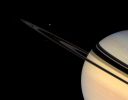
Saturn-PIA09776.jpgJust like the Solar System!56 visiteCaption NASA:"Saturn's icy satellites wheel about the colorful Giant Planet, while the Rings shine dimly in scattered sunlight. The Ringed Planet is, in many ways, a laboratory for investigating the history of our Solar System and how planets form around other stars. There are 4 moons visible in this view. Tethys (1071 Km, or 665 miles across), largest in the scene, is on the far side of the Ring-Plane. Mimas (397 Km, or 247 miles across), is the one on the near side of the Rings, below Tethys. Janus (181 Km, or 113 miles across), is left of the Rings' edge. Pandora (84 Km, or 52 miles across) is a speck below the Rings' edge, between Janus and Mimas. Mimas casts a shadow onto Saturn's bluish Northern Hemisphere.
This view looks toward the unilluminated side of the Rings from about 2° above the Ring-Plane. Images taken using red, green and blue spectral filters were combined to create this natural color view. The view was acquired with the Cassini spacecraft wide-angle camera on Oct. 30, 2007.
The view was taken at a distance of approx. 2,6 MKM (such as about 1,6 MMs) from Saturn.
Image scale is roughly 153 Km (about 95 miles) per pixel on the Planet".MareKromium
|
|
| 25353 immagini su 2113 pagina(e) |
 |
|
|
|
|
1706 | |
|
|
|
|





