| Piú viste |

Mawrth_Vallis-The_Waterfall-CC.gifZooming on the "Waterfall" - Mawrth Vallis (GIF-Movie, by Carlo Contu)56 visiteAcquisition date: January, 04, 2008
Local Mars Time: 14:19
Latitude: 23,0° North
Longitude: 341,6° East
Range to target site: 309,9 Km
Original image scale range: 31 cm/pixel (with 1 x 1 binning) so objects ~93 cm across are resolved
Map projected scale: 25 cm/pixel and North is up
Map projection: EQUIRECTANGULAR
Emission angle: 22,7°
Phase angle: 60,1°
Solar incidence angle: 38°, with the Sun about 52° above the horizonMareKromium
|
|
PHOE-SOL060-lg16033-16034-16035.jpgPhoenix and Surface - Sol 60 (Superdefinition and natural colors; credits: Dr G. Barca)56 visitenessun commentoMareKromium
|
|
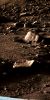
PHOE-SOL061-lg16201-16202-16203.jpgVastitas' Rocks - Sol 61 (Superdefinition and natural colors; credits: Dr G. Barca)56 visitenessun commentoMareKromium
|
|
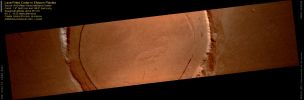
Psp_008753_1880_red.jpgLava-filled Crater in Elysium Planitia (natural colors; credits: Lunexit)56 visiteElysium Planitia is a part of the Martian Lowlands that has been repeatedly covered by vast floods of lava. This image shows an older Impact Crater that has been filled by one of the youngest of those lava floods.
Only sections of the circular rim of the Crater remain uncovered. The lava surface consists of ridged plates that have rafted apart with smoother lava filling between the plates. The ridges formed as the solidifying lava crust was crumpled by compression, and the gaps between the plates formed as the crust was pulled apart. Similar compression and extension of lava crust has been observed in the largest lava flows in Iceland.
The most puzzling aspect of this image is that the lava in the floor of the Crater appears to have sunk down compared to its surroundings. This happened after a thick crust had formed on the lava. The most likely explanation is that the last molten lava inside the flow drained away through a now buried gap in the crater rim.
A final point of interest are the small circular cones visible near the center of the Crater. These formed when ground water (or ice) was turned to steam by the heat of the lava flow. This steam exploded through the flow, producing the small cratered cones.MareKromium
|
|
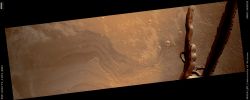
Psp_008779_1905_red.jpgThe Head of Athabasca Valles (natural colors; credits: Lunexit)56 visiteThis observation is located at the head of the Athabasca Valles Channel System, which lies just North of Mars’ Equator, in a low-elevation Region known as Elysium Planitia.
Athabasca Valles has an interesting geologic history. It was probably carved by one or more catastrophic floods of water, but more recently, a flood of lava coursed through the channel system. Both the water and the lava erupted from a few discrete points (or “vents”) along the Cerberus Fossae, a 1600-Km(1000-mile) long network of extensional (or “normal”) faults. The two prominent troughs that cut across the Southern end of this HiRISE image are part of the Cerberus Fossae. They are distinct fault segments that overlap at their tips, as one tapers in and the other pinches out.
They were not always as wide as they are today. Erosional processes have widened the troughs over time. Major eruptions occurred along both of the fault segments seen in this image, though they occurred to either side of the imaged area itself. Lava that erupted from the western vent covers the northern half of the image. The lava has raised, lobate margins and is slightly darker in tone than the older cratered plains it embays. The lava also has a banded appearance of subtly contrasting lighter and darker tones, that correspond to variations in surface roughness.
The bands are concentric to a vent located immediately west of the imaged area. Unfortunately, vents along the Cerberus Fossae are not well preserved.MareKromium
|
|
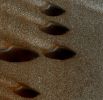
PSP_008839_2575_RED-01.jpgDunes and Polygons (edm - natural colors; credits: Lunexit)56 visitenessun commentoMareKromium
|
|

PSP_008930_1880_RED.jpgStair-Stepped Mounds in Meridiani Planum (natural, but enhanced, colors; credits: Lunexit)56 visiteThis image shows layered sedimentary rocks that fill an impact crater in the Meridiani Planum Region of Mars.
These layered rocks may have formed through the accumulation of sediment (sand and dust) that were transported into this crater by blowing wind or flowing water. These sediments formed an extensive deposit that once covered the floor of the surrounding impact crater.
This crater is so large that the HiRISE image is entirely within it, and the crater rim is not visible. These sedimentary rocks were then eroded, likely by the wind. The original sand and dust were deposited in distinct layers within the crater; these layers now give the mounds their distinctive stair-stepped appearance, and are all that remain from this once extensive deposit.MareKromium
|
|

PSP_008982_1965.jpgLayered Deposits in Arabia Terra Region (True Colors; credits: Dr M. Faccin & Lunexit)56 visiteThis image shows the floor of an Unnamed Impact Crater in Arabia Terra that has Layered Deposits. There are many craters in this Region where layering is observed.
These layers are often exposed along the sides of large isolated mounds, small knobs and mesas, and other positive relief features. In some cases, the layering is expressed as narrow sinuous ridge-like structures along crater floors.
The presence of Layered Deposits is of particular interest because these materials are not likely to be related to the impact event, but rather post-impact infill of the crater. Modification of the deposits has now revealed layers of material.
HiRISE and other instruments onboard the Mars Reconnaissance Orbiter may provide more clues to the origin of the these deposits.MareKromium
|
|
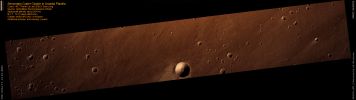
PSP_006271_2210_RED_abrowse.jpgPrimary and Secondary Craters in Arcadia Planitia (MULTISPECTRUM; credits: Lunexit)56 visiteThese unusual craters were spotted in Arcadia Planitia, which is part of an extensive region of Mars blanketed by a thick layer of bright dust.
Light southeasterly winds during southern spring and summer blow the dust towards the northwest (top left of the picture in the cutout above). The dust is trapped temporarily in the lee of crater rims, both inside the craters and along the outside rims where they form streamers that resemble St. Nick’s beard.
MareKromium
|
|
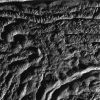
Enceladus-PIA11109.jpgCairo Sulcus56 visiteCaption NASA:"This image is the 4th skeet-shoot footprint taken during Cassini's very close flyby of Enceladus on Aug. 11, 2008. Cairo Sulcus is shown crossing the upper left portion of the image. An unnamed fracture curves around the lower right corner.
The image was taken with the Cassini Spacecraft narrow-angle camera on Aug. 11, 2008, a distance of approx. 3027 Km (such as about 1881 miles) above the surface of Enceladus.
Image scale is approximately 20 meters (66 feet) per pixel". MareKromium
|
|
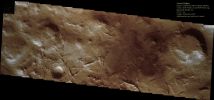
Linear_Ridges-PCF-LXTT.jpgLinear Ridges (Enhanced Natural Colors; credits for the additional process. and color.: Dr Paolo C. Fienga - Lunexit Team)56 visitenessun commentoMareKromium
|
|

PSP_009162_1570.jpgFresh 5-Kilometer Diameter Rayed Crater (False Colors; credits: Dr M. Faccin)56 visiteThe crater featured in this scene formed on top of ejecta from a nearby rampart crater, located to the North.
The crater’s distinct rim indicates that it is relatively young. There is bright material on many of the crater walls that might be landslides of dust or another bright substance.
The mounds of material on the crater floor probably formed during late stages of crater’s own formation. The crater floor is speckled with even smaller craters.MareKromium
|
|
| 25353 immagini su 2113 pagina(e) |
 |
|
|
|
|
1694 | |
|
|
|
|





